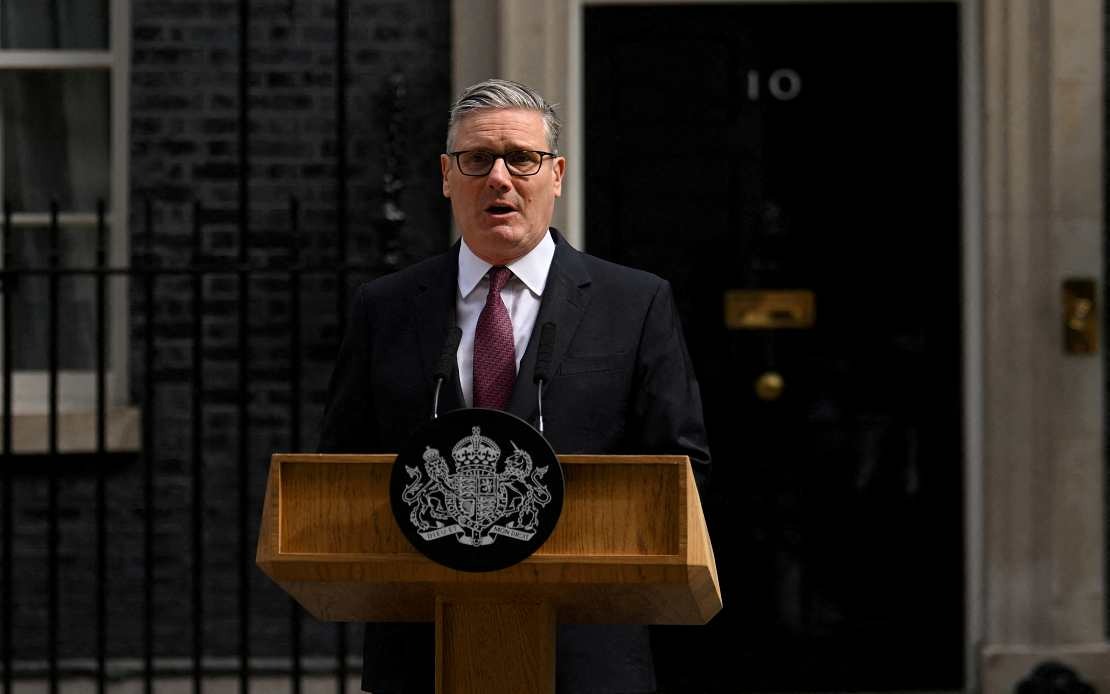
British Prime Minister Keir Starmer has publicly demanded an urgent return to ceasefire discussions between Washington and Tehran, warning that continued escalation threatens to undermine fragile diplomatic gains and disrupt one of the world's most strategically important waterways. Speaking at a joint press conference in Paris alongside leaders from France, Germany, and Ukraine, Starmer articulated deep concern over renewed military exchanges between the two powers and called for immediate de-escalation.
The intervention from London reflects growing anxiety among Western allies about the deteriorating security situation in the Persian Gulf, where recent Iranian strikes against commercial shipping have heightened fears of broader regional instability. Starmer's condemnation of Iran's maritime attacks was unambiguous, stating that such actions targeting commercial vessels and coalition partners cannot be tolerated and must cease immediately. The British government's positioning as a mediator reflects its historical role in regional diplomacy and its substantial interests in maintaining unimpeded passage through one of the world's most critical energy corridors.
The escalating crisis centres on the Strait of Hormuz, a narrow waterway through which an estimated one-third of global maritime oil trade passes annually. Control or disruption of this strategic chokepoint carries enormous economic and geopolitical consequences extending far beyond the Middle East. For Malaysia and other Southeast Asian economies heavily dependent on imported energy and dependent on stable global trade flows, any prolonged closure or militarisation of the strait poses direct threats to fuel supplies, shipping costs, and overall economic growth. The uncertainty created by tit-for-tat military actions undermines commercial confidence and creates supply chain vulnerabilities that resonate across Asia.
The British government has signalled willingness to contribute practical resources to restore normal maritime operations, offering to deploy naval assets that would help facilitate the safe passage of commercial shipping through contested waters. This commitment goes beyond symbolic diplomacy, suggesting that London recognises the urgency of preventing a complete breakdown in negotiations. The deployment of Allied military capabilities alongside diplomatic efforts reflects an understanding that security guarantees may be necessary to convince shipping companies and trading partners that the corridor is sufficiently protected to justify commercial risk.
Recent developments have sharply reversed earlier optimism about regional stabilisation. In June, the signing of a memorandum of understanding to conclude the US-Israeli conflict that began in February appeared to signal a path toward broader regional de-escalation, with expectations that Iran would reopen the Strait of Hormuz and restore normal commercial navigation. However, renewed confrontation over the weekend, featuring fresh military exchanges between American and Iranian forces, has shattered those expectations and raised the alarming possibility that military actors may be overriding diplomatic progress made by political leaders.
President Donald Trump's assertion that the United States would reinstate its blockade on Iran and charge vessels for safe passage through the Strait of Hormuz fundamentally transforms the nature of the dispute from a security concern into an economic coercive instrument. Such a strategy, if implemented, would represent a significant escalation with potentially far-reaching consequences for international law, freedom of navigation principles, and global trade stability. The imposition of passage fees by any power over international waters sets a troubling precedent that could embolden other actors to assert control over strategic waterways.
Iran's effective closure of the strait during the broader conflict with Israel has already disrupted global energy markets and forced alternative routing options that increase transportation costs and delivery times. A prolonged or renewed closure would dramatically amplify these disruptions, particularly affecting economies like Malaysia that depend on stable energy imports and uninterrupted maritime commerce. The volatility also complicates investment and trade planning for regional businesses that rely on predictable shipping routes and fuel availability.
Starmer's emphasis on unrestricted freedom of navigation alongside ceasefire negotiations reflects international law principles enshrined in the United Nations Convention on the Law of the Sea, which guarantees the right of innocent passage through straits used for international navigation. The British government's framing of the issue in these terms appeals to broader international consensus while also protecting the interests of maritime nations and trading partners who depend on open sea lanes. This multilateral diplomatic approach contrasts with unilateral coercive strategies that may generate short-term leverage but ultimately undermine the international order upon which commerce depends.
The involvement of France, Germany, and Ukraine in the Paris coalition discussions underscores the multilateral character of contemporary security challenges and the recognition that no single nation can resolve Middle Eastern crises in isolation. European engagement in Gulf security matters reflects both historical interests and contemporary concerns about terrorism, weapons proliferation, and refugee flows that extend across the Mediterranean and beyond. The participation of Ukraine, while seemingly tangential to Persian Gulf issues, demonstrates the integration of multiple security challenges in Allied strategic thinking and the desire to maintain unified diplomatic messaging across different regional conflicts.
For Southeast Asian observers, the current crisis serves as a reminder of the region's vulnerability to disruptions in distant waters and the importance of maintaining stable, rules-based international order. Malaysia's position as a maritime nation with substantial shipping interests and energy import needs makes developments in the Strait of Hormuz directly relevant to national prosperity and security. The failure of diplomatic efforts to achieve lasting stability in the Persian Gulf would likely force Asian economies to absorb higher energy costs, accept greater supply chain disruptions, and potentially contribute additional resources to regional security arrangements.
The coming weeks will determine whether Starmer's urgent calls for ceasefire resumption can reverse the current momentum toward escalation or whether military dynamics will overwhelm diplomatic initiatives. Success requires not only political will from Washington and Tehran but also practical mechanisms for verifying compliance, guaranteeing safe passage, and addressing the underlying grievances that periodically erupt into violence. Without sustained international pressure and credible mediation, the cycle of escalation and de-escalation may continue, perpetuating uncertainty that damages global economic stability and regional prosperity.

