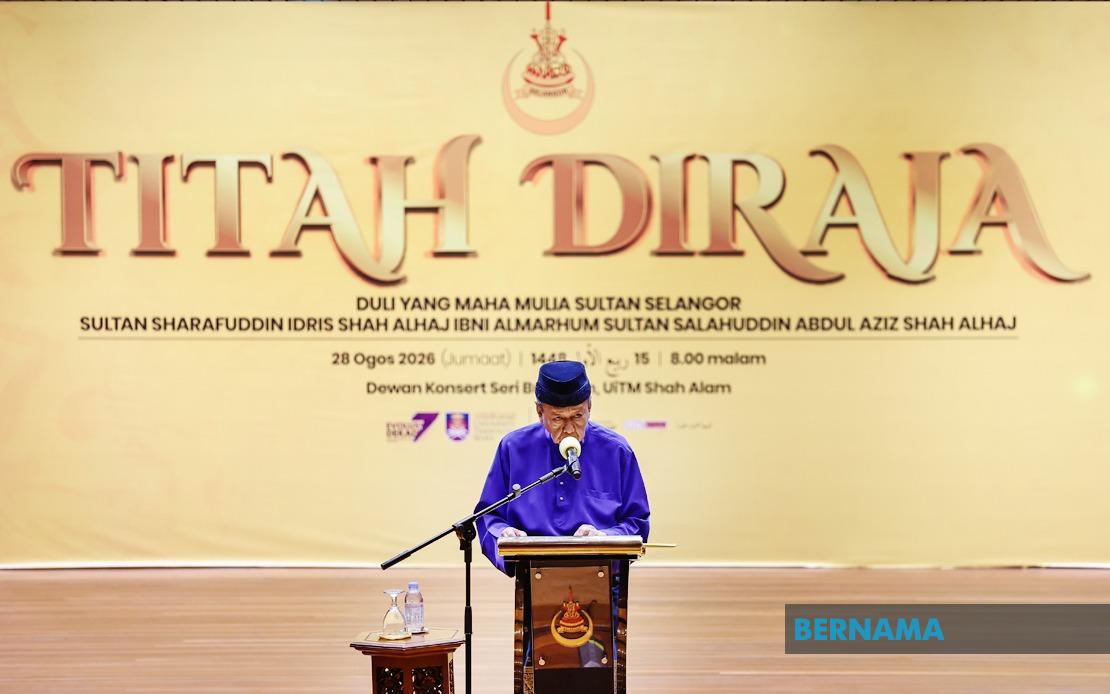
At a Royal Address in Shah Alam, Sultan of Selangor Sultan Sharafuddin Idris Shah underscored the critical importance of preserving Universiti Teknologi MARA's foundational commitment to students from economically disadvantaged backgrounds. As the institution continues to expand and strengthen its position as one of Malaysia's premier higher learning establishments, the ruler emphasised that the original constituency it was designed to serve must not be sidelined or excluded from the opportunities that educational advancement brings. The message resonates with ongoing national conversations about equity in access to tertiary education and the role of bumiputera-focused institutions in bridging socioeconomic divides.
Speaking at the UiTM 2026 Royal Address held at Dewan Konsert Seri Budiman, Sultan Sharafuddin articulated a vision in which the institution remains a genuine instrument of social transformation. He drew attention to the symbolic importance of UiTM as a gateway—particularly for the children of farmers, fishermen, manual labourers, factory workers, and families living in rural communities where educational resources are scarce. The monarch stressed that any student possessing genuine ability and resolve should find in UiTM the institutional support necessary to reshape their life trajectory and unlock possibilities that might otherwise remain beyond their reach.
The historical context Sultan Sharafuddin provided illustrates the remarkable trajectory of the institution since its inception. When UiTM began operations in 1965, it enrolled approximately 219 students and employed just 11 academic staff members. Within ten years, student numbers had grown substantially to nearly 7,000, while the teaching workforce expanded to approximately 1,000 educators. The university rapidly diversified its academic offerings, introducing around 60 programmes and establishing satellite campuses across multiple states. This expansion reflected both institutional dynamism and escalating demand among bumiputera communities for accessible pathways into professional and tertiary qualification.
Today's UiTM represents a transformation of considerable scale and scope. The institution now produces more than 40,000 graduates annually, a figure that underscores its significance within Malaysia's higher education ecosystem. The cumulative alumni base has surpassed one million individuals, creating a network of professionals distributed across virtually every economic sector and occupational category. Accountants, engineers, medical doctors, legal practitioners, architects, academic researchers, entrepreneurs, government officials, corporate leaders, creative practitioners, and media professionals constitute the broad spectrum of UiTM alumni who occupy influential and foundational roles throughout Malaysian society.
Recognising the potential embedded within this expansive alumnus network, Sultan Sharafuddin proposed an innovative mechanism for channelling institutional loyalty into concrete financial support. He advocated for the development of a systematic alumni contribution framework whereby each graduate would commit to donating a minimum of RM10 monthly—equivalent to RM120 annually, though he framed the target as RM100 to allow for flexible engagement. The monarch characterised this modest sum as entirely manageable for alumni across income levels and presented it as a meaningful gesture of gratitude toward an institution that fundamentally shaped their professional trajectories and life outcomes.
The financial implications of this proposal merit careful consideration for Malaysian policymakers and university administrators. Should alumni participation reach substantial levels, the scheme could generate approximately RM100 million annually—a figure representing significant supplementary revenue for institutional development, infrastructure improvement, and student support programmes. These funds would directly address the current challenge of assisting students confronting acute financial hardship, thereby enabling UiTM to expand its capacity to support disadvantaged cohorts without requiring proportional increases in government budget allocations. For a nation navigating constrained public finances, leveraging alumnus goodwill represents an increasingly important dimension of higher education sustainability.
Sultan Sharafuddin contextualised the proposal within the broader narrative of institutional purpose and national contribution. He invoked the popular student and alumni slogan "UiTM Dihatiku" (UiTM in My Heart), suggesting that genuine commitment to the institution must extend beyond emotional attachment to tangible action. The donation scheme would represent a mechanism through which the abstract sentiment of institutional affection transforms into material support for subsequent generations of students, particularly those from underprivileged backgrounds whose circumstances otherwise might preclude participation in tertiary education.
The monarch's remarks placed particular emphasis on measuring institutional success through the lens of transformative impact rather than merely quantitative metrics. While graduation numbers and enrolment figures possess important administrative and comparative value, Sultan Sharafuddin contended that the true measure of UiTM's achievement lies in its capacity to fundamentally alter life circumstances for individuals originating from economically marginal communities. The presence of UiTM alumni throughout Malaysia's professional landscape—leading organisations, establishing enterprises, generating employment, and contributing substantively to national development—constitutes evidence that the institution has fulfilled its constitutive mission of enabling upward mobility and creating opportunity.
This pronouncement arrives at a moment when Malaysian universities face mounting pressure to balance expansion with accessibility, institutional prestige with foundational commitment to equity. Several bumiputera-focused institutions, including UiTM itself, have undergone significant evolution in terms of admission standards, programme offerings, and international positioning. While such development reflects legitimate aspirations to enhance global competitiveness, tensions occasionally emerge between efforts to elevate institutional ranking and the historical commitment to provide educational access to historically excluded communities. Sultan Sharafuddin's intervention signals that, from the perspective of the Selangor ruler, such tension must be resolved decisively in favour of preserving and reinforcing the accessibility mission.
The participation of Higher Education Minister Datuk Seri Dr Zambry Abd Kadir at the event underscores the government's engagement with this discourse concerning institutional priorities and public higher education philosophy. The presence of both the minister and Tengku Permaisuri Norashikin indicated formal institutional acknowledgment of the significance attached to Sultan Sharafuddin's remarks and recommendations. For Southeast Asian observers, the statement carries broader implications regarding how middle-income nations balance elite university aspirations with social equity commitments within their higher education systems.
Looking forward, the proposed alumni contribution scheme and the underlying emphasis on institutional accessibility will likely shape discussions among UiTM leadership regarding fundraising strategy, student support policy, and the institution's self-perception within Malaysia's higher education landscape. The scheme's success will depend on achieving substantial voluntary participation among alumni, many of whom may lack awareness of opportunities to contribute or may face competing financial obligations. Universities implementing comparable schemes internationally have achieved varying participation rates depending on engagement strategies, communication approaches, and cultural factors affecting alumni relationship-building.
For Malaysian students from underprivileged circumstances, Sultan Sharafuddin's intervention provides explicit reaffirmation that institutional access and support remain paramount considerations for both the state and the institution itself. The proposal demonstrates that concerns about equity and inclusion remain actively articulated within Malaysia's governance structures and are championed by traditional authority figures possessing significant moral and political standing. Whether the alumni giving initiative gains traction will serve as a practical test of whether institutional nostalgia and pride can be meaningfully converted into sustained financial support for the institution's foundational mission.

