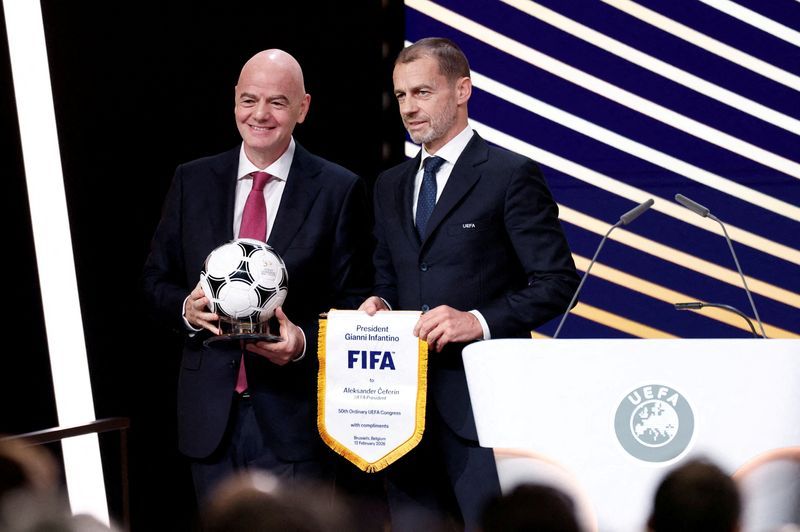
UEFA has initiated legal action in the United States to gather evidence for a criminal complaint against FIFA President Gianni Infantino in Switzerland, marking an unprecedented escalation in the governing body's conflict with the international football federation. Through a court filing in Florida, the European confederation seeks authorisation to obtain testimony and documents from two FIFA-registered entities based in that state, specifically FIFA (AMERICAS), Inc. and FWC2026 US, Inc., arguing these organisations hold records critical to understanding how the contentious FIFA Forward Enterprise proposal was developed, structured, valued and ultimately approved by FIFA's leadership.
The underlying dispute concerns a scheme that would have transferred the commercial rights to the men's and women's World Cups, along with the Club World Cup, into a new subsidiary controlled by external investors. Infantino had championed this initiative as a means to bolster funding for global football development, but the proposal triggered an immediate and forceful backlash from European football. UEFA alleges that Infantino orchestrated the plan in secret alongside a select group of advisers and investors, deliberately circumventing FIFA's established governance structures and failing to consult the FIFA Council, regional confederations, or the organisation's 211 member associations until the announcement on July 28.
According to UEFA's legal filing, the proposal represented a fundamental breach of FIFA's internal procedures and statutory requirements. The European confederation contends that FIFA's governing statutes vest sole authority in the Council to determine how the organisation's commercial properties are promoted and monetised. The alleged violation of these foundational governance principles forms the basis for UEFA's planned criminal complaint under Article 158 of the Swiss Criminal Code, which addresses charges of criminal mismanagement. This legal strategy reflects UEFA's determination to pursue not merely institutional pressure but formal criminal accountability for what it views as a violation of fiduciary duty.
The financial dimensions of the rejected scheme underscore the scale of the disputed transaction. According to UEFA's documentation, external investors had agreed to pay approximately $4.2 billion for an equity stake in FIFA Forward Enterprise, implying a total valuation of around $20 billion for the commercial entity. UEFA contests this valuation on multiple grounds, arguing first that it fundamentally undervalues FIFA's commercial portfolio, and second that it was never subjected to competitive bidding or independent professional appraisal. The opacity surrounding the deal's financial mechanics intensified European concerns that member associations and FIFA's broader membership were being excluded from decisions affecting assets they collectively own.
The role of prominent investment figures adds another layer to the controversy. Infantino had designated Thrive Eternal, an investment vehicle controlled by Joshua Kushner and affiliated with Thrive Capital, to lead the investor consortium seeking equity in the commercial subsidiary. UEFA's allegation that these investors would have acquired a permanent financial stake in FIFA's commercial operations raises fundamental questions about whether private interests were being prioritised over the collective welfare of world football's membership. The involvement of external capital seeking ongoing financial returns fundamentally altered the character of what FIFA's membership might have understood as a development initiative.
Internal dissent within FIFA itself underscores the controversial nature of the proposal's genesis. UEFA's filing indicates that FIFA staff members expressed feelings of deception regarding how the initiative had been advanced, with particular concern that FIFA Secretary General Mattias Grafstrom had been excluded from the drafting process entirely. These allegations suggest the proposal was handled with unusual secrecy even by FIFA's internal standards, concentrating decision-making authority in an exceptionally narrow circle. Such procedural irregularities reinforce UEFA's contention that governance norms were deliberately breached rather than inadvertently overlooked.
The European confederation's response culminated in a dramatic threat of World Cup boycott that forced FIFA's hand. On July 30, UEFA's 55 member associations unanimously resolved to withdraw from all FIFA competitions, including the World Cup, unless the FIFA Forward Enterprise proposal was immediately abandoned. This unprecedented display of unified continental opposition proved decisive; FIFA formally withdrew the proposal on July 31. Infantino subsequently acknowledged that while the initiative had aimed to support global football development, the divisions it had created contradicted that very objective. Nevertheless, UEFA emphasised that withdrawal of the scheme did not resolve underlying questions about how it had been conceived and advanced.
Following FIFA's withdrawal announcement, UEFA provisionally suspended its planned boycott after obtaining written assurances that the FFE project had been permanently shelved. This tactical pause allowed qualified European teams to participate in September's Under-20 Women's World Cup in Poland and subsequent competitions. However, UEFA's decision to pursue criminal proceedings in Switzerland indicates that the withdrawal of the commercial scheme itself represents merely the first chapter in what the confederation views as a more comprehensive governance crisis. The confederation has simultaneously demanded a genuinely independent external investigation, explicitly stating that FIFA cannot credibly investigate itself and expect the football community to accept conclusions drawn from an internal process.
Even as the immediate commercial threat receded, deeper institutional conflicts emerged. UEFA has signalled its intention to work with partner confederations to present member associations with alternative leadership options should Infantino pursue a fourth term during the March 2027 FIFA elections. This commitment to developing a "credible alternative" candidate represents UEFA's conviction that Infantino's leadership style fundamentally threatens FIFA's governance structures. The confederation's position reflects a calculation that one withdrawn proposal, however significant, is insufficient to restore confidence in an administrator who bypassed core institutional checks and balances. UEFA contends that reform of FIFA's presidential authority represents an essential precondition for restored legitimacy.
Infantino maintains significant support within FIFA's global structure despite European opposition. The African and South American confederations have largely stood by the FIFA President, and on Thursday the Saudi Arabian Football Federation issued a public statement endorsing his continued leadership and supporting "FIFA's efforts to restore unity across the football family." This geographical divide in confederation allegiances illuminates the broader fault lines within world football governance, with wealthier European associations sceptical of Infantino's vision and developing football regions apparently more supportive of his development agenda. The contrast between UEFA's legalistic approach and explicit commitment to replacing Infantino, versus backing from other confederations, ensures that institutional tensions will persist regardless of whether the Swiss criminal investigation proceeds.
For Malaysian and Southeast Asian football observers, the UEFA-FIFA conflict carries significant implications. The proposed FIFA Forward Enterprise scheme would have concentrated commercial decision-making even further within FIFA's executive structures, potentially reducing the influence of smaller confederations and member associations in determining how global football's revenues are distributed. Malaysia's AFC membership would have placed it in a confederation whose interests appeared largely aligned with Infantino's development agenda, yet lacking the institutional leverage to shape how such development funding operates in practice. UEFA's successful resistance to the proposal thus preserves space for alternative regional perspectives in FIFA's internal deliberations, even as the criminal investigation represents an unprecedented effort to constrain executive authority through external legal mechanisms.

