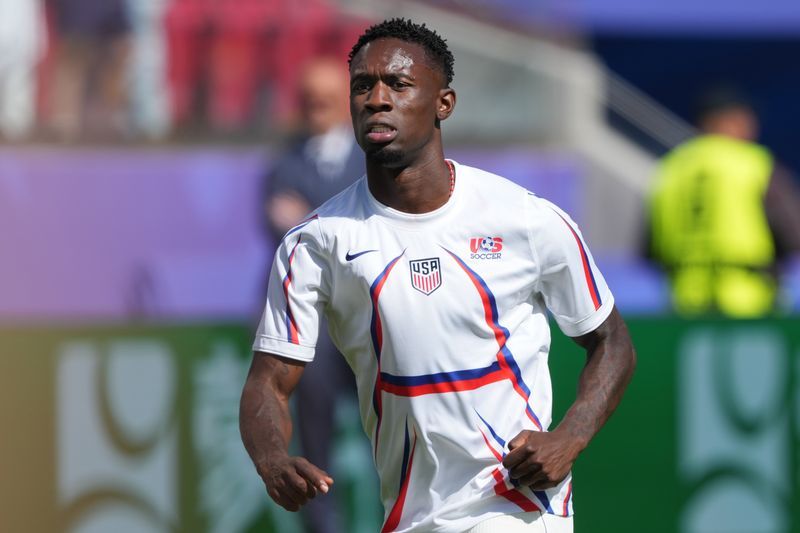
European football's governing body UEFA has delivered a scathing rebuke of FIFA's controversial decision to suspend the implementation of a red card ban for United States striker Folarin Balogun, describing the move as fundamentally damaging to the sport's integrity. The criticism follows FIFA president Gianni Infantino's unexpected intervention to review the disciplinary matter after U.S. President Donald Trump personally contacted the world governing body requesting reconsideration of the sanction. UEFA characterised the decision as "unprecedented, incomprehensible and unjustifiable," signalling deep institutional concern about the precedent being set within international football's regulatory framework.
Balogun received the red card during a round of 32 match between the United States and Bosnia, following a VAR review of an incident involving Bosnia defender Tarik Muharemovic. The striker's action—dragging his cleats down the back of the defender's leg onto his foot—met the threshold for a direct dismissal under the laws of the game. Under normal circumstances, such a card would have automatically suspended Balogun for the subsequent round of 16 fixture against Belgium, preventing the three-goal contributor from participating in that critical knockout stage encounter.
Instead of rescinding the card outright or accepting the standard suspension, FIFA adopted an unusual middle position: the red card remained on Balogun's record, but the ban was suspended on a probationary basis lasting one year. This approach allowed the player to feature in Monday's Belgium match despite the technical infraction, creating confusion about whether established disciplinary protocols were being applied consistently or had become subject to political considerations. The decision essentially nullified the immediate sporting consequence of the dismissal whilst maintaining theoretical future accountability.
UEFA's statement pointedly emphasised that confidence in football's rules depends upon those responsible for enforcing them honouring their commitments to fairness. The European body warned that abandoning certainty in rule application fundamentally compromises both the integrity of individual competitions and the credibility of the sport itself. This language reflects institutional anxiety that selective enforcement based on external political pressure—rather than consistent application of established guidelines—could proliferate across football's governance structures, creating a system where outcomes depend on lobbying rather than sporting merit.
The decision has proven deeply controversial among competing nations. Belgium's football association, the Royal Belgian Football Association (RBFA), expressed astonishment at FIFA's approach and subsequently lodged a formal appeal against the ruling. The Belgian response underscores how the decision disadvantages teams facing the United States, fundamentally altering competitive conditions at a critical tournament stage. Belgium's objection reflects the practical reality that Balogun's availability materially affects their match prospects, creating legitimate grievances about procedural fairness.
The involvement of Trump in FIFA's disciplinary process represents an extraordinary intersection of political power and sports governance. That a sitting U.S. President felt empowered to contact FIFA regarding player-specific disciplinary matters, and that the organisation's leadership proved receptive to such intervention, signals a troubling erosion of the boundary between governmental influence and sporting autonomy. International sports organisations typically guard independence from political interference, viewing such separation as essential to maintaining credibility and neutrality in rule enforcement.
FIFA's suspension of Balogun's ban rather than its outright dismissal suggests an attempt to navigate between competing pressures: responding to presidential intervention whilst attempting to preserve some disciplinary veneer through the probationary framework. This compromised position satisfies neither strict adherents to established protocols nor those who view the original red card as unjustified. The approach instead creates a muddled precedent suggesting that FIFA decisions can be modified through high-level political channels if sufficient pressure is applied.
The broader implications extend across Southeast Asian football and beyond. Regional football bodies including the Football Association of Malaysia, Thai Football Association, and Football Association of Singapore operate within FIFA's regulatory environment and must question whether their own disciplinary cases might be subject to similar political reconsideration. If the world governing body proves willing to modify enforcement based on powerful nations' requests, smaller football-producing countries lack equivalent leverage to seek similar adjustments, creating institutional inequality.
UEFA's forceful response reflects European football's significant economic and political weight within FIFA structures. The European confederation controls numerous votes and generates substantial revenue for world football; its willingness to publicly condemn FIFA signals serious internal institutional tension. This friction could reshape FIFA's governance discussions and potentially influence how disciplinary processes are reviewed at upcoming congresses and governance meetings.
The incident also highlights ongoing questions about VAR implementation in high-pressure tournament settings. Although the original dismissal reflected VAR technology's application according to stated criteria, the subsequent political overruling of that decision raises questions about whether disciplinary consistency can survive political challenge once certain mechanisms are activated. Teams and players operating under these circumstances face fundamental uncertainty about whether regulatory protections remain stable throughout competition.
Looking forward, this controversy will likely influence FIFA's disciplinary policy development and potentially generate formal proposals requiring greater insulation of match officials and disciplinary panels from post-decision review requests. UEFA's public stance increases pressure on FIFA to establish clearer protocols preventing political intervention in specific cases, though implementing such protections against powerful member nations presents obvious challenges. The episode serves as a cautionary reminder that sports governance, despite its technical and rule-based appearance, remains subject to political power when sufficiently high-level interests are engaged.
The Balogun decision ultimately reflects deeper questions about whether international sporting institutions can maintain genuine autonomy or whether they inevitably become extensions of member states' political interests. For Malaysian and Southeast Asian football observers, the case demonstrates that governance fairness at the highest levels remains contested territory, where established rules provide less protection than institutional independence, which itself proves fragile when confronted with powerful actors' preferences.

