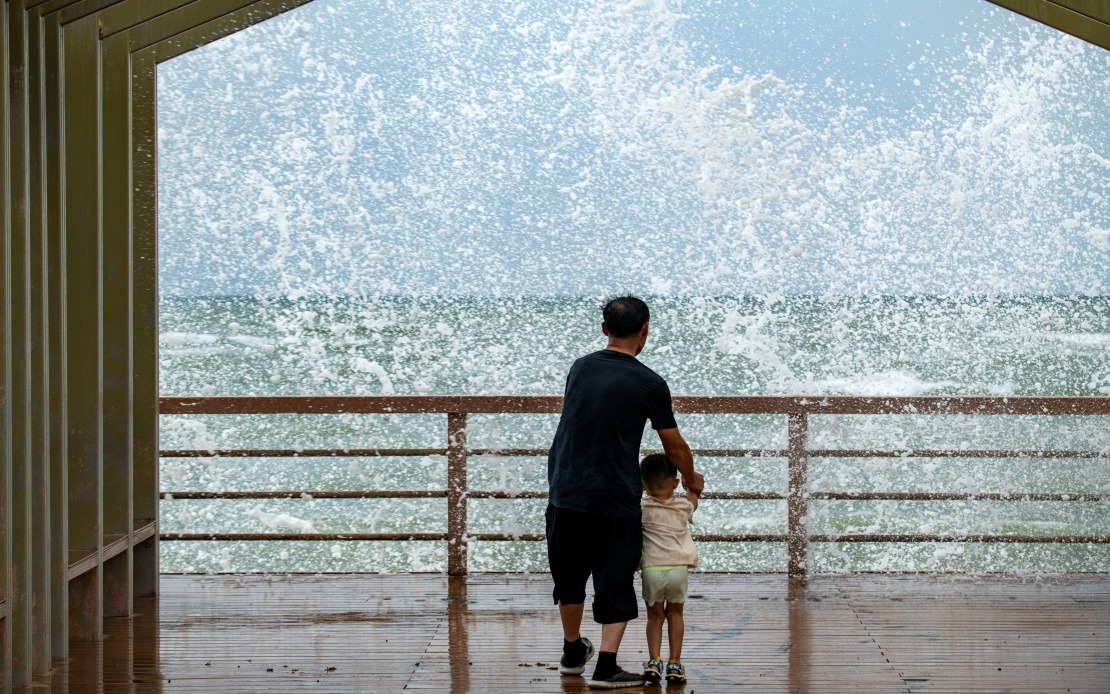
Typhoon Maysak struck Hainan Province on Friday evening as the year's tenth significant tropical cyclone, triggering an extensive shutdown of transportation networks and educational facilities across the southern Chinese island. The storm made its approach from the South China Sea and came ashore at approximately 6.20 pm in Yelin Township, located within Lingshui Li Autonomous County, according to readings from the Hainan provincial meteorological bureau. At the moment of landfall, the system exhibited maximum sustained winds reaching 23 metres per second near its core, marking a substantial weather event for the region.
The transportation disruptions proved immediate and sweeping in scope. Railway authorities suspended all train services connecting Hainan to the mainland on both Friday and Saturday, effectively isolating the island from rail-based passenger and freight movements during this critical period. Sanya Phoenix International Airport, a key regional aviation hub, ceased all flight operations beginning at 5 pm on Friday, stranding passengers and disrupting connections throughout Southeast Asia and beyond. The halt reflected the severity of conditions expected to persist through the typhoon's passage.
Maritime transport faced equally severe constraints. Ferry operations across the Qiongzhou Strait, which separates Hainan from Guangdong Province and represents a vital transport artery for both passenger and vehicular traffic, were suspended from 2 am on Friday. The meteorological authorities indicated that this suspension would likely persist for one to two days contingent upon how conditions evolved. This halt has significant implications for supply chains and commerce dependent on quick transit between the island and mainland territories.
Educational institutions responded with precautionary closures, particularly in the most exposed areas. Schools and child-care facilities throughout Sanya and Ledong Li Autonomous County were shuttered to protect students and staff from the hazardous conditions. Such measures underscore the genuine danger posed by typhoon-force winds and the associated rainfall that can create treacherous circumstances for outdoor movement.
Meteorological forecasters anticipated that Maysak would track northwestward following its initial landfall, bringing the system's circulation across several municipalities and county areas in succession. The projected path would carry the typhoon through Baoting, Wuzhishan, Baisha and Danzhou before the weakening storm system eventually transitioned into the Beibu Gulf, the large body of water bounded by southwestern China and the northern coasts of Vietnam and the Gulf of Tonkin region.
For Malaysian and broader Southeast Asian observers, Hainan typhoons carry particular significance given the region's interconnectedness. The island province functions as a major logistics hub and manufacturing centre, with disruptions there cascading through regional supply networks. The suspension of ferry services and flight operations directly impacts businesses and individuals across the ASEAN bloc who depend on Hainan-based connections.
The designation of Maysak as the tenth typhoon of the calendar year indicates an active tropical cyclone season in the Western Pacific basin. Such activity often correlates with broader atmospheric patterns that influence storm formation across Southeast Asia and the northern Indian Ocean, where Malaysia and neighbouring countries face their own typhoon and monsoon risks during predictable seasonal windows.
From a preparedness perspective, Hainan's response demonstrates the institutional mechanisms employed in major population centres when tropical cyclones approach. The coordinated suspension of multiple transport modes, coupled with school closures and weather monitoring, reflects established protocols refined through previous storm seasons. Similar frameworks exist throughout Malaysia and the region, though the scale of Hainan's operations as a major international transport node means that disruptions there affect a distinctly larger geographic footprint.
Economic impacts of transport suspensions extend beyond the immediate inconvenience to travellers. Manufacturing operations dependent on just-in-time logistics, agricultural products requiring rapid distribution, and time-sensitive shipments all face delays. For Malaysian exporters and importers with Hainan connections, the multi-day suspension creates scheduling complications and potential cost implications as cargo sits in warehouses or moves through alternative, less efficient routing.
The meteorological bureau's forecasting provided advance warning that enabled authorities to implement precautionary measures before conditions deteriorated. This predictive capacity, which has improved considerably over recent decades, remains essential to minimising casualties and facilitating orderly evacuations or facility closures. The dissemination of such information to the public also allows individual travellers and businesses to adjust plans proactively rather than facing sudden disruptions.
As Maysak transits across Hainan and subsequently into the Beibu Gulf, monitoring agencies throughout the region maintained heightened alert status. The Gulf's waters connect directly to Southeast Asian maritime zones, and residual circulation from the weakening typhoon could influence weather patterns across the broader region even as the storm's most intense impacts remained confined to Chinese territory.

