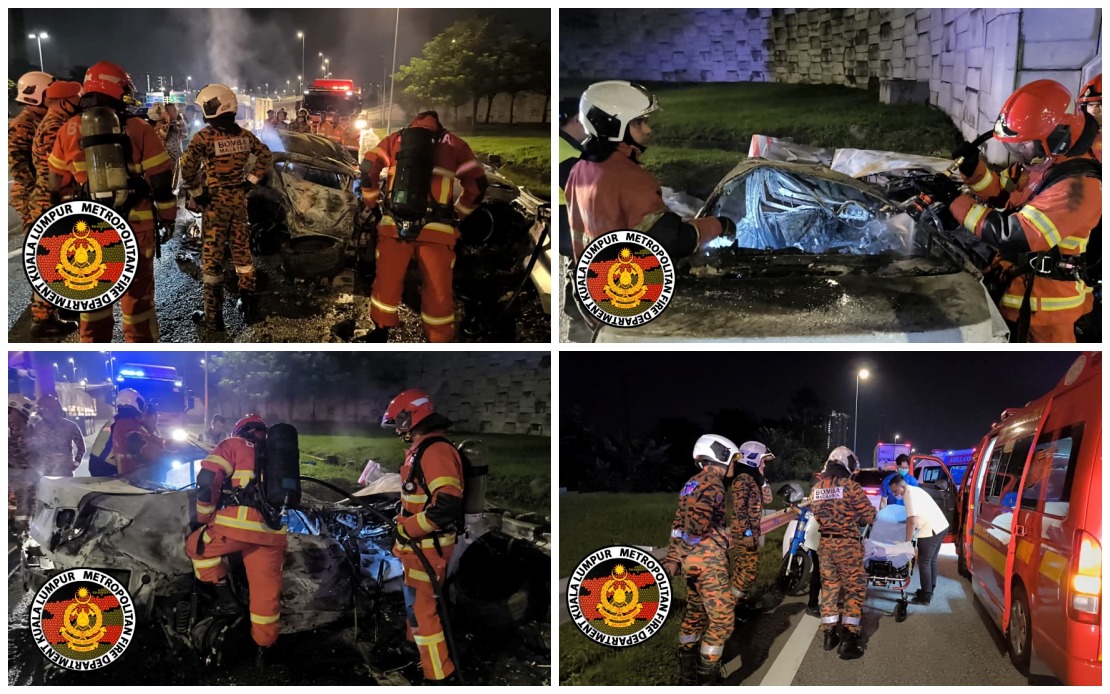
A tragic road accident on the Duta-Ulu Kelang Expressway (DUKE) in the early hours of Thursday has resulted in the deaths of two university students, leaving the local driving community and academic institutions grappling with yet another reminder of the dangers posed by reckless behaviour on major highways. The incident, which occurred at the Jalan Kuching exit ramp, saw a BMW 328i Sport engulfed in flames after the vehicle lost control, trapping both occupants inside the burning wreckage until they succumbed to their injuries.
According to ACP Mohd Zamzuri Mohd Isa, the chief of Kuala Lumpur's Traffic Investigation and Enforcement Department, preliminary findings suggest that the driver was operating the vehicle at excessive speed while navigating the route from Jalan Duta towards Selayang. The loss of control occurred as the motorist attempted to negotiate the expressway section, leading to a violent collision with the left road divider. The impact was catastrophic enough to rupture the fuel system, resulting in the rapid ignition of the vehicle and the subsequent inferno that proved fatal for two of the three passengers aboard.
The two victims were identified as a 22-year-old Malaysian male, who was enrolled at Queensland University of Technology in Australia, and a 21-year-old Malaysian male studying at Sunway University. Both individuals were pronounced dead at the scene, their bodies severely charred in the intense fire that consumed the vehicle. Authorities have indicated that formal identification of the deceased will require DNA analysis due to the extensive burns sustained by the victims. The devastating nature of their injuries underscores how quickly a moment of driver error can escalate into an irreversible tragedy on high-speed expressways.
A third occupant, a 20-year-old Singaporean male student, managed to escape the wreckage with only minor injuries, a circumstance that investigators believe may have depended on his position within the vehicle at the time of impact. He received immediate medical attention and was conveyed to Kuala Lumpur Hospital, where his condition was assessed as stable. The stark contrast between his fate and that of his companions raises sobering questions about survivability factors in such collisions, even as it provides authorities with a potential eyewitness account of the events leading to the crash.
The police investigation, being conducted under Section 41(1) of the Road Transport Act 1987, has already begun the painstaking process of reconstructing the sequence of events. Officers have initiated a comprehensive examination of the accident scene, with particular attention being paid to the retrieval and analysis of closed-circuit television footage from cameras monitoring that section of the DUKE expressway. The survivor has also been interviewed to provide his recollection of the moments preceding the collision, information that will prove crucial in determining whether excessive speed alone was responsible or whether other contributing factors were present.
This incident adds to growing concerns about safety on Kuala Lumpur's major expressways, particularly during early morning hours when traffic is lighter and drivers may feel emboldened to exceed speed limits. The DUKE expressway, which links several key areas of the city, has witnessed numerous accidents over the years, many attributable to speeding and loss of vehicle control on its curved sections and exit ramps. The severity of this particular incident—the complete incineration of the vehicle—illustrates the amplified consequences when speed combines with impact forces on modern vehicles that lack sufficient safety margins for such scenarios.
For the families and institutions affected, the tragedy represents an incalculable loss. Both Sunway University and Queensland University of Technology will likely issue statements acknowledging the deaths of their students, while the broader international student community in Malaysia may face renewed anxiety about road safety in the country. The fact that the vehicles occupants included both Malaysian and Singaporean students underscores how traffic incidents transcend national boundaries and affect entire regional networks of families and educational institutions.
Investigators have extended an appeal to members of the public who may have witnessed the accident or possess dashcam footage captured from nearby vehicles. Such evidence could prove instrumental in establishing the precise sequence of events, vehicle speed, and any other factors that may have contributed to the loss of control. Information can be submitted to the Traffic Police Station at Jalan Tun H.S. Lee or to any nearby police station, with authorities indicating that all contributions will be carefully examined as part of the ongoing investigation.
The incident serves as a grim illustration of how quickly life can be extinguished on expressways, even among young people with their entire lives ahead of them. Road safety campaigns throughout Malaysia have consistently emphasised the lethal consequences of speeding, yet statistics continue to reflect a troubling pattern of preventable accidents. This latest tragedy will likely prompt renewed calls from safety advocates and community leaders for enhanced enforcement measures, improved highway design to reduce accident severity, and more intensive education campaigns targeting young drivers who statistically represent a disproportionately high-risk demographic on Malaysian roads.

