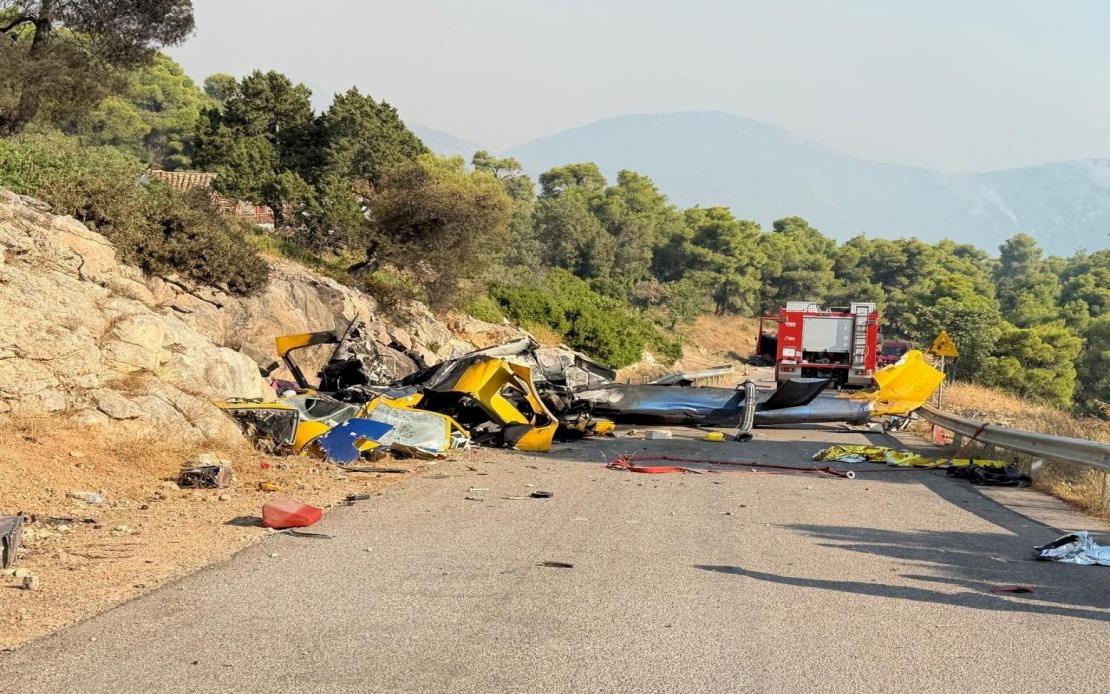
A tragic mid-air collision between two firefighting helicopters has claimed two lives in Greece, underscoring the inherent dangers faced by aviation crews supporting wildfire suppression efforts across the Mediterranean nation. The incident occurred on Sunday near the coastal area of Psatha in western Attica as the aircraft were engaged in aerial operations to combat a major wildfire ravaging the region. Fire Service spokesperson Vassilis Vathrakogiannis confirmed at a press briefing that a Danish pilot and a Greek firefighting coordinator perished in the accident, while a British pilot and a second Greek firefighting coordinator survived, though one of the survivors sustained injuries.
The two Bell helicopters, each staffed with a two-person crew, were contracted to assist with firefighting operations across Attica and Boeotia. The collision occurred while both aircraft were actively conducting fire suppression manoeuvres, a particularly hazardous environment characterised by reduced visibility, thermal turbulence, and the constant need for precise coordination between multiple aircraft operating in close proximity. The impact forced both machines to the ground near Psatha, immediately triggering a comprehensive search and rescue response from Greek emergency services.
Greek authorities have not yet disclosed the precise cause of the collision, with investigators launching a formal inquiry into what led two experienced helicopter crews to occupy the same airspace at the same moment. Such accidents during wildfire operations are exceptionally rare, suggesting either a communication breakdown, navigational error, or an unforeseen structural issue. The investigation will likely examine radio protocols, weather conditions, visibility factors, and the coordination procedures between the two crews and ground control operators managing the aerial campaign.
The tragedy arrives as Greece grapples with an intensifying wildfire crisis driven by an unusual combination of meteorological factors. Scorching temperatures, exceptionally low humidity levels, and strong winds have created ideal conditions for fire propagation and expansion across multiple regions. These conditions have stretched Greece's firefighting infrastructure and personnel to capacity, forcing authorities to mobilise additional resources, including contracted international helicopter crews, to mount an adequate response.
For Malaysian and Southeast Asian observers, this incident offers instructive lessons about the escalating challenges posed by extreme weather and climate variability. The region has experienced its own serious wildfire emergencies, most notably the 2015 haze crisis that blanketed several countries, causing respiratory illness and visibility hazards. As global temperatures continue to rise and weather patterns become more volatile, nations throughout Asia may increasingly depend on aerial firefighting capabilities and imported expertise, necessitating robust safety protocols and crew coordination systems.
The death of the Danish pilot and Greek coordinator highlights the occupational hazards borne by aviation professionals engaged in emergency response operations. These crews voluntarily operate in demanding circumstances—navigating smoke-filled skies, managing equipment under thermal stress, and coordinating with multiple teams across chaotic operational environments. The loss underscores the necessity for comprehensive pre-flight briefings, clear communication channels, enhanced radar systems to prevent aircraft conflicts, and rigorous pilot training tailored to wildfire conditions.
The use of contracted international helicopter crews reflects a growing trend among Southern European nations to supplement domestic firefighting capacity during peak fire seasons. Greece, Spain, Portugal, and Italy routinely contract foreign operators, creating multicultural teams that must coordinate seamlessly despite language barriers and varying procedural norms. This internationalisation of wildfire response, while expanding total capacity, introduces additional complexity into already-demanding operations and highlights the critical importance of standardised safety protocols and communication procedures.
Investigators will pay particular attention to the role of ground control in directing the two helicopters to their assigned sectors and monitoring their positions throughout the operation. Modern aviation relies extensively on air traffic control guidance to maintain safe spacing between aircraft, particularly in confined areas where multiple units operate simultaneously. Any failure in this coordination—whether due to equipment malfunction, operator error, or inadequate staffing—could contribute to precisely the kind of tragic outcome that occurred near Psatha.
The broader context of Greece's wildfire emergency cannot be overlooked. The nation currently battles multiple large fires across Attica and Boeotia, regions that include densely populated areas adjacent to the capital Athens. This creates extraordinary pressure on emergency services to deploy available assets aggressively, potentially accelerating decision-making and increasing operational tempo beyond optimal safety margins. The collision may ultimately reflect systemic strain rather than isolated pilot error.
Looking forward, this incident will likely prompt comprehensive reviews of helicopter coordination protocols across Mediterranean firefighting operations. Such tragedies, though rare, catalyse important safety innovations and procedural refinements. Whether through enhanced radar technology, improved crew training, better ground-to-air communication systems, or modified flight patterns during high-intensity operations, aviation authorities will seek to prevent recurrence. The cost of complacency in such circumstances proves catastrophically high, as the families of the deceased Danish and Greek crew members now tragically understand.

