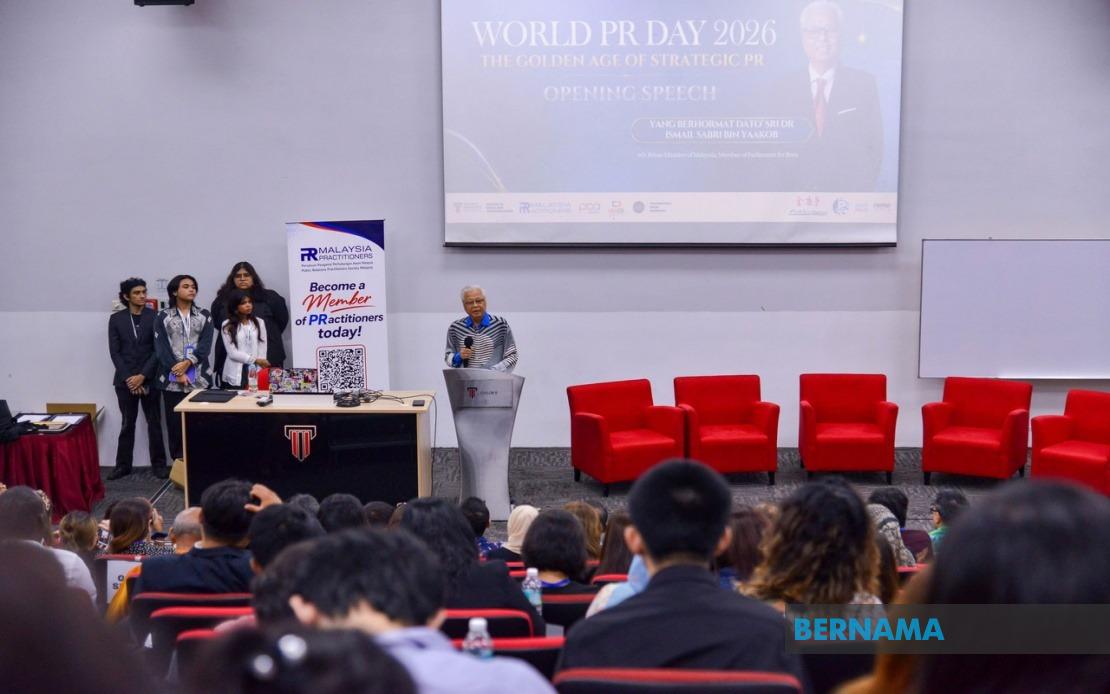
The nature of institutional credibility has fundamentally shifted from what characterised the previous century, according to former Prime Minister Datuk Seri Dr Ismail Sabri Yaakob, who addressed attendees at the World PR Day 2026 launch ceremony held at Taylor's University in Subang Jaya. Speaking to media representatives, Ismail Sabri articulated a perspective that extends beyond traditional competitive frameworks, asserting that modern organisations face challenges that demand far more than economic prowess or operational efficiency. The capacity to cultivate genuine public confidence through candid, principled dialogue has become the defining differentiator in an increasingly interconnected global landscape, he explained.
The measurement of organisational success in contemporary settings encompasses far broader criteria than conventional metrics alone can capture. Beyond financial results and operational achievements, Ismail Sabri underscored that institutions are now evaluated substantially on their communication capabilities during both prosperous periods and times of difficulty. This shift reflects a deeper transformation in societal expectations regarding how entities should conduct themselves, communicate their actions, and account for their decisions. The former premier framed this evolution as a consequence of heightened public scrutiny and interconnectedness, where stakeholder engagement and transparency have become non-negotiable elements of institutional legitimacy.
In articulating his vision for the communication landscape, Ismail Sabri drew a distinctive contrast between centuries. Whereas the twentieth century prioritised and rewarded economic competitiveness among nations and corporations, the emerging paradigm places trust itself at the centre of institutional valuation. This transition carries profound implications for how organisations structure their communication strategies and allocate resources toward relationship-building initiatives. Within this framework, integrity emerges not as an aspirational virtue but as the foundational prerequisite for any meaningful dialogue. The credibility of messages, consistency of institutional behaviour, and alignment between stated values and actual practices collectively determine whether communications resonate or whether audiences dismiss them as performative.
The role of public relations professionals has undergone substantial transformation that demands recalibration of both skillsets and strategic thinking, according to Ismail Sabri's assessment. Practitioners no longer function primarily as information distributors tasked with conveying institutional announcements to passive audiences. Instead, contemporary PR specialists operate as strategic architects who actively participate in constructing institutional narratives and safeguarding organisational reputations during volatile periods. This expanded remit requires deeper engagement with leadership, more sophisticated understanding of stakeholder psychology, and keener awareness of how institutional actions translate into public perception. The elevation of PR from a tactical communications function to a strategic business partnership represents recognition that communication decisions carry the same weight as operational or financial ones.
Drawing from his experience navigating the COVID-19 pandemic as the nation's chief executive, Ismail Sabri offered concrete illustration of how decisive communication shaped policy outcomes. The period demanded extraordinary transparency and frequency of public engagement, with the former premier appearing before journalists regularly to explain shifting standard operating procedures and governmental directives. The imperative to communicate clearly and accurately became apparent when confusion regarding regulations threatened public compliance and institutional credibility alike. These interactions taught him that governmental communication transcends the mechanical function of announcement-making; rather, it operates as a trust-building mechanism that ultimately determines whether publics genuinely embrace policy objectives or merely comply reluctantly.
The technological dimension of modern communication introduces both unprecedented opportunities and novel vulnerabilities that PR practitioners must navigate with sophistication. Artificial intelligence now enables organisations to monitor public sentiment at scales and speeds previously unimaginable, facilitating rapid identification of emerging concerns and narrative shifts. However, Ismail Sabri cautioned that technological adoption must remain subordinate to human values and ethical frameworks. The mere capability to analyse data or deploy sophisticated communications tools does not automatically improve institutional relationships if the underlying integrity foundation remains absent. Practitioners must therefore develop competencies in AI application while maintaining unwavering commitment to truthfulness and responsibility.
The proliferation of deliberately distorted information and synthetic media represents an escalating threat to the information ecosystem that demands urgent attention from both public and private sectors. Deliberate falsehoods, manipulated visual and audio content, and deepfake technologies increasingly undermine the public's ability to distinguish reliable information from sophisticated deception. The sheer volume of information circulating across digital platforms compounds this challenge, overwhelming audiences and creating conditions where misinformation spreads faster than corrections. For PR practitioners operating in this environment, the challenge extends beyond crafting effective messages to encompassing efforts to combat information pollution and help audiences navigate an increasingly hostile information landscape.
Governmental initiatives addressing the regulation and governance of artificial intelligence technologies warrant support from communications professionals, Ismail Sabri suggested. The proposed AI Governance Bill represents an attempt to establish ethical guardrails around technology deployment, particularly regarding the generation and distribution of fraudulent content and the abuse of algorithms to manipulate public opinion. PR practitioners occupy a unique position to contribute expertise regarding how AI applications interact with information integrity and public trust. Their involvement in policy discussions surrounding digital ethics could help ensure that governance frameworks balance innovation with protection against the most severe harms. The stakes of this collaboration extend beyond sectoral interests to encompassing societal capacity to maintain functional information systems.
The intersection of technology advancement and communication strategy demands that contemporary practitioners cultivate hybrid competencies spanning traditional PR disciplines and emerging digital expertise. Understanding how algorithms curate information exposure, recognising patterns of coordinated inauthentic behaviour, and identifying sophisticated disinformation campaigns all require technical literacy that transcends conventional PR training. Simultaneously, the human dimensions of trust-building—authenticity, consistency, responsiveness—remain irreplaceable elements that no technological system can adequately substitute. The most effective communicators in coming years will likely be those who harness technological capabilities while remaining grounded in humanistic approaches to relationship-building and stakeholder engagement.
For Malaysian organisations and institutions navigating this communication landscape, Ismail Sabri's remarks carry particular salience given the nation's position within the broader Asian digital ecosystem. Southeast Asian societies are simultaneously embracing technological transformation and experiencing acute vulnerabilities to misinformation, with implications spanning from public health decisions to democratic processes. Malaysian PR professionals and institutional leaders who prioritise integrity-driven communication strategies position themselves advantageously within this environment. The emphasis on trust as a competitive asset particularly resonates within cultural contexts where relationship-building and institutional credibility carry pronounced significance. Organisations that invest in transparent, honest communication and align behaviour with stated values may find themselves better positioned to navigate future challenges and maintain stakeholder confidence.

