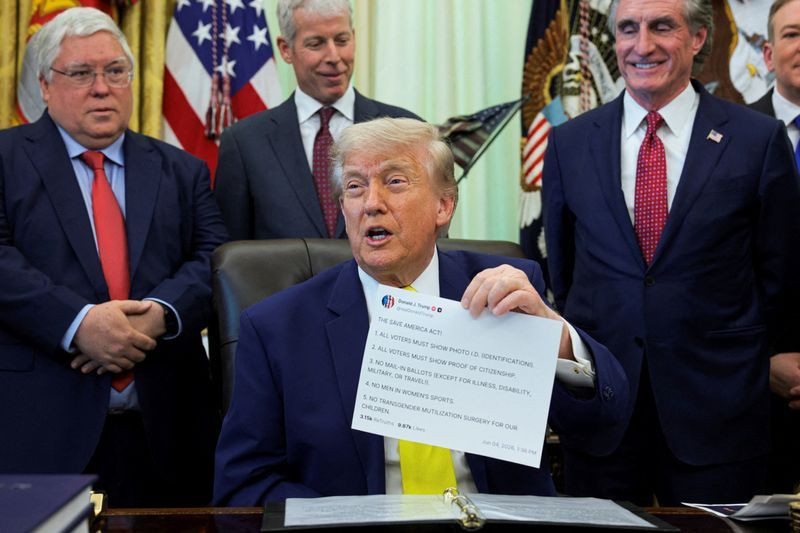
Donald Trump faces a constitutional challenge after two prominent media organizations petitioned a Manhattan federal court on Wednesday to halt Truth API, a subscription service offering wealthy subscribers premium early access to his posts and those of other senior U.S. officials on his Truth Social platform. The Intercept and the Freedom of the Press Foundation argue that the service, which launched on August 1, undermines democratic principles by creating a two-tiered system where financial means determine access to government announcements that regularly influence financial markets.
Truth API operates through Trump Media & Technology Group and charges subscription fees reaching $100,000 per month, granting premium subscribers fractionally earlier access to approximately ten high-profile accounts on Truth Social. In addition to Trump's own account, the service includes feeds from Vice President JD Vance, Health and Human Services Secretary Robert F. Kennedy Jr., FBI Director Kash Patel, and official White House communications. The service emerged just four days after Democratic Senators Elizabeth Warren of Massachusetts and Adam Schiff of California formally requested that the U.S. Securities and Exchange Commission investigate whether the initiative represents market manipulation benefiting wealthy insiders and the president himself.
The legal complaint identifies a pattern of market-moving announcements on Trump's Truth Social account, including declarations concerning tariffs, Middle Eastern developments, and other policy matters capable of influencing stock prices, commodity values, and broader financial stability. Throughout Trump's second presidential term, the complaint notes that between nine and eleven thousand of his Truth Social posts and reposts frequently lacked accompanying official White House statements, suggesting that Truth Social functioned as his primary channel for consequential government communications. This arrangement creates apparent advantages for subscription customers who receive information before the broader public, potentially enabling investment decisions based on material non-public information.
Plaintiffs characterize the Truth API arrangement as "profoundly corrupt" because Trump possesses direct financial interest in the service's commercial success through his ownership stake in Trump Media & Technology Group. Trump controls approximately 41.3 percent of Trump Media's equity, equivalent to roughly $950 million in value through his Donald J. Trump Revocable Trust, according to Reuters data. His eldest son, Donald Trump Jr., serves as a Trump Media director and manages the trust, creating a family-controlled ownership structure in which the president directly benefits from subscriber fees flowing to his company.
From a constitutional perspective, the plaintiffs assert that Truth API violates the First Amendment by denying the general public equal access to presidential communications. They contend that fundamental democratic principles require that all citizens receive government announcements simultaneously, regardless of economic capacity, and that no legitimate government purpose justifies restricting official communications to paying subscribers while allowing the president to profit personally. This argument positions the lawsuit within broader constitutional debates regarding presidential communications, transparency, and the distinction between private speech and official government pronouncements.
The White House declined immediate comment on the filing, though White House officials beyond Trump Media itself have been named as defendants. The Trump Media company, curiously, was not identified as a defendant, focusing the legal action on government figures rather than the corporate entity. This procedural choice potentially reflects strategic considerations regarding where to assign responsibility for alleged constitutional violations versus commercial wrongdoing.
Trump Media's public response characterizes the lawsuit as a weaponization of courts by "left-wing activists" seeking to silence the president and harm shareholders. A company spokesperson noted that countless other platforms and news organizations, including subscription-based services, already distribute Trump's content to various audiences, arguing that Truth API represents no novel violation of existing media practices. During a recent earnings call, interim Chief Executive Kevin McGurn defended the service as providing subscribers marginally faster access to news, framing the distinction as minor rather than fundamentally market-distorting.
The timing and composition of the lawsuit reflect broader political tensions surrounding Trump's use of social media for government communication. Throughout his political career, Trump has leveraged platform dominance to communicate directly with supporters and markets, circumventing traditional media scrutiny. Truth Social itself emerged as his alternative after mainstream platforms restricted his account access, creating an infrastructure where his communications operate without algorithmic gatekeeping by external corporations. Truth API represents an evolution of this strategy, monetizing exclusive access while maintaining Trump's communication authority.
Market integrity concerns underlying the lawsuit carry particular significance for Southeast Asian readers and investors, given that capital markets throughout the region maintain exposure to U.S. equities and commodity markets. Early access to presidential announcements concerning tariffs, trade relationships, and geopolitical conflicts affects global market dynamics that intersect with Malaysian economic interests. If U.S. financial regulators and courts permit subscription-based early access to market-moving government information, it could establish uncomfortable precedents regarding information asymmetries and market fairness in international contexts.
The Securities and Exchange Commission, which Democrats requested investigate the arrangement, currently comprises three Republican commissioners, potentially affecting regulatory appetite for enforcement action. However, the judicial rather than regulatory pathway chosen by the plaintiffs sidesteps administrative processes and focuses on constitutional First Amendment claims that federal courts must address on their merits regardless of partisan composition. The lawsuit therefore represents a fundamental conflict between property rights, commercial freedom, and democratic equality, with implications extending beyond Trump's individual situation to broader questions about presidential communication authority in the digital age.
Outcomes in this case could reshape how sitting presidents utilize private platforms for official communications while generating personal profit. Should courts mandate simultaneous public access to all presidential announcements regardless of platform or subscription status, it would establish important precedent restricting monetization of government speech. Conversely, if courts determine that Truth API operates within constitutional bounds, it would legitimize a model where personal financial interests align with communication practices, creating ongoing tensions between market integrity, governmental transparency, and individual enrichment in the digital era.

