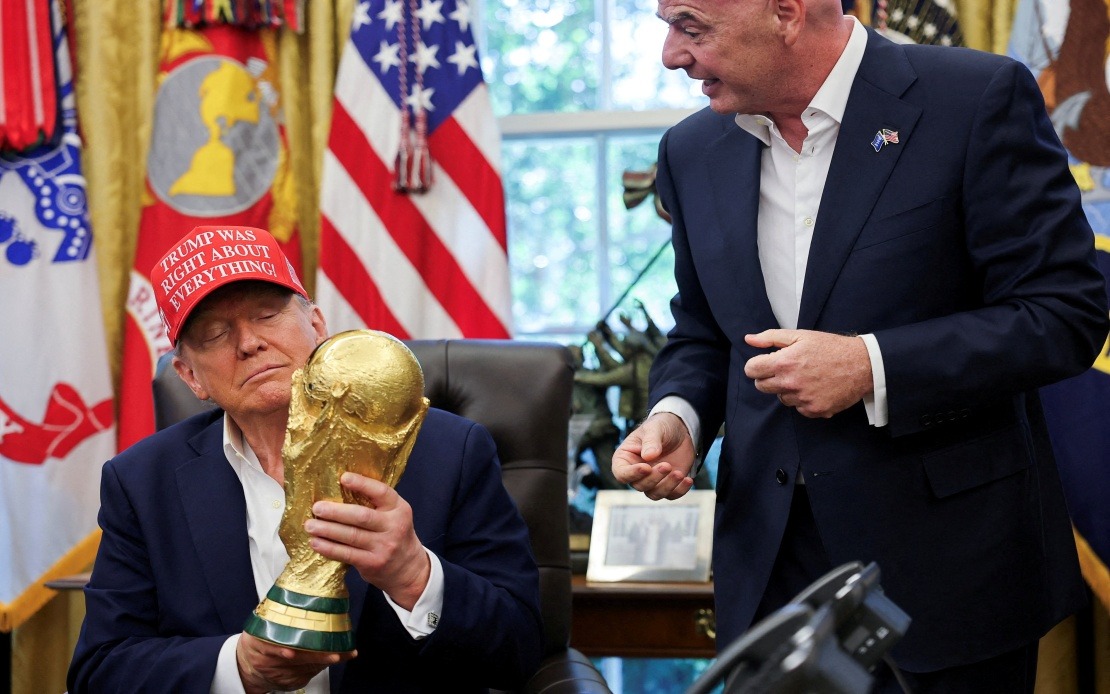
President Donald Trump offered unexpectedly warm remarks about Spain on Sunday following the country's 1-0 victory over Argentina in the FIFA World Cup final, a sharp departure from his vitriolic statements just weeks earlier that had included threats to sever all commercial ties with the European nation. Speaking to reporters in Istanbul after the match, Trump indicated that despite his recent trade embargo declarations, no lasting animosity existed between the United States and Spanish Prime Minister Pedro Sanchez's government. The contrast between his current diplomatic tone and his prior condemnation has raised questions about the consistency of American policy toward European allies during this period of heightened transatlantic tension.
During the post-match conversation, Trump commended Spanish officials on fielding what he termed a "great team" and described the World Cup final itself as both "exciting" and a "great event" worthy of viewing. When pressed on whether he had been disappointed by Argentina's defeat in the closely contested match, the American leader dismissed the suggestion by simply stating that "Spain played better," though he acknowledged that the margin of victory was minimal and the overall competition had been fiercely competitive. These remarks conveyed a measured appreciation for the tournament and Spain's performance that stood in stark contrast to the personal and institutional criticism he had levelled at Madrid just days prior.
The President's recent pivot toward Spain comes barely three weeks after he had publicly declared the country to be a "wasted cause" and criticised it as a "terrible partner in NATO" during a news conference held at the alliance's summit in Ankara, Türkiye. At that earlier occasion, Trump had expressed deep frustration with Madrid's unwillingness to grant American military forces unrestricted access to Spanish military installations during what he characterized as conflict-related operations involving Iran. Furthermore, he had chastised Spain for declining to pledge the two percent of gross domestic product to military spending that NATO members are expected to contribute toward collective defence, let alone the five percent target that Trump has increasingly demanded from European allies.
The rhetoric Trump employed at the NATO gathering in Ankara was notably harsh and undiplomatic in tone. He had stated publicly that he preferred to have "nothing to do with Spain" and explicitly instructed his administration to "cut off all trade with Spain, please, including visits." Going further, the President had characterised Spanish officials as "hopeless" and "bad people," language that represented an unprecedented level of personal invective directed at a NATO ally. These statements had alarmed European observers and raised questions about whether the United States intended to follow through on such sweeping economic sanctions or whether they represented mere political theatre designed to pressure Madrid into policy concessions.
For Malaysia and other Southeast Asian nations, Trump's mercurial approach to transatlantic relations carries important implications for understanding how American foreign policy may operate toward their own countries during this administration. The rapid reversal suggests that Trump's public denunciations, while pointed, may not necessarily presage permanent ruptures in diplomatic or economic relationships if other considerations intervene. This unpredictability complicates long-term strategic planning for nations seeking to maintain stable relationships with Washington, as statements that appear categorical and final may be rescinded or fundamentally reframed within days based on changing circumstances or presidential whims.
The FIFA World Cup final provided the occasion for this diplomatic thaw, creating what might be termed a political opening for Spain to reset its relationship with the Trump administration without appearing to capitulate to earlier demands. By congratulating Spanish officials in the immediate aftermath of their sporting triumph, Trump created space for both parties to move beyond the acrimonious rhetoric of the NATO summit. The gesture suggests that even in an era of heightened great-power competition and transatlantic strain, cultural and sporting events continue to serve as valuable mechanisms for de-escalating diplomatic tensions and providing face-saving exits from intractable disagreements.
Spain's position within NATO and its role as a critical hub for American military operations in the Mediterranean region mean that any genuine and sustained deterioration in US-Spanish relations would carry significant strategic consequences. Spanish air bases and naval facilities have proven indispensable for American military operations across North Africa, the Middle East, and beyond. A complete severance of trade ties and cessation of diplomatic engagement, if implemented literally rather than as negotiating posture, would disrupt supply chains affecting both economies and undermine military coordination mechanisms that have been built up over decades of alliance partnership. This reality likely constrained how seriously Trump's threats could be taken, even as they served his political objective of pressuring Madrid on defence spending commitments.
The World Cup moment also illustrates how sporting accomplishments can transcend political divisions and create opportunities for leaders to demonstrate magnanimity. By praising Spain's victory and describing the final as a great event rather than dwelling on Argentina's loss or his prior disputes with Madrid, Trump positioned himself as someone capable of rising above partisan grievances to acknowledge merit and excellence. This rhetorical approach, whatever its underlying sincerity, provided a pathway for the relationship to move forward without requiring either side to explicitly acknowledge or reverse the prior harsh statements.
For observers of American foreign policy, this incident encapsulates broader patterns of Trump's engagement with allies, characterized by public pressure through inflammatory rhetoric followed by tactical retreats or sudden warming once initial objectives appear achieved. Whether the trade embargo threat was ever intended as a serious policy instrument or served primarily as leverage to extract concessions on NATO defence spending remains unclear. What is evident is that Spain's World Cup victory provided a convenient diplomatic offramp that allowed both Washington and Madrid to pivot toward a more cooperative posture without either party having to formally concede ground on the underlying policy disagreements that sparked the initial conflict.

