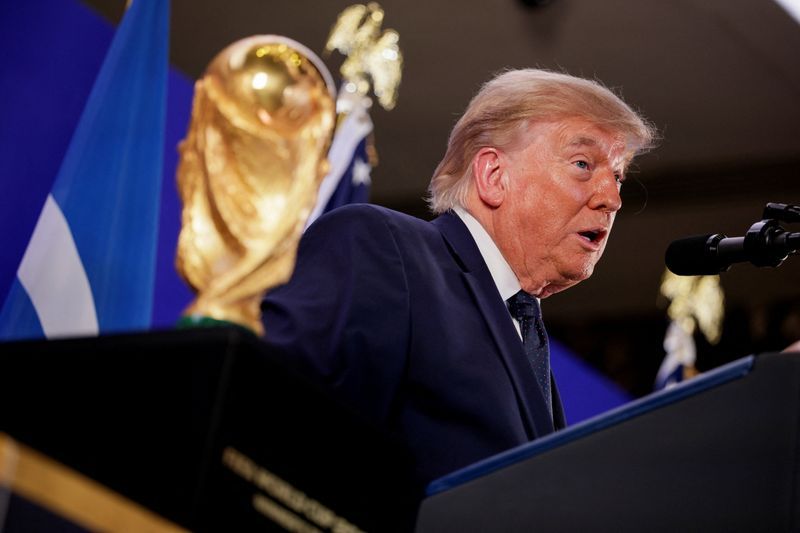
Donald Trump will occupy a place of prominence at Sunday's World Cup final between Argentina and Spain at New York/New Jersey Stadium, sitting alongside FIFA President Gianni Infantino and presenting the winning trophy. The staging of this moment represents the culmination of Trump's increasingly visible role throughout a tournament that has already generated significant political controversy—a presence that underscores the complex intersection between elite sports governance and high-level politics that will define the next decade of international football administration.
Trump's central involvement in the tournament's most contentious episode emerged only days before the final, when he publicly acknowledged requesting that FIFA review the red card shown to American striker Folarin Balogun. The intervention triggered immediate concern within international football circles regarding the integrity of competition and the appropriate boundaries of political influence over technical sporting decisions. FIFA categorically denied that Trump's intervention played any role in the subsequent suspension of Balogun's ban, yet the episode has crystallized questions about whether national leaders should exert informal pressure on football's governing body during major tournaments.
The warm relationship between Trump and FIFA President Gianni Infantino was on full display at a Manhattan reception held at Trump Tower on Friday, where approximately 300 guests—including Brazilian football legend Ronaldo and various FIFA dignitaries—witnessed the pair exchange effusive praise. Infantino credited Trump with essential contributions to the tournament's extraordinary success, while Trump responded by noting that he had successfully positioned the United States as a football nation. This mutual admiration reflects a transactional alignment whereby Trump gains the prestige of association with the world's largest sporting event, while FIFA benefits from the political capital and infrastructure resources of a sitting US president committed to a 2038 hosting bid.
The 2026 World Cup, jointly hosted by the United States, Canada, and Mexico, represents Trump's signature sporting legacy from his first presidential term, a point he has repeatedly emphasised in public remarks. Yet the lead-up to the tournament has revealed fractures within the geopolitical arrangement. A year before the current edition, American cities confronted serious pressure regarding how they would reassure international visitors concerned by Trump's immigration enforcement policies and travel restrictions affecting several countries. The political environment surrounding the tournament remained volatile throughout its planning stages, with Trump subsequently threatening to relocate matches away from Democratic-controlled municipalities—a proposal FIFA rejected as exceeding the president's authority over host arrangements.
Trump's most recent suggestion—that the United States should host the World Cup again without including Mexico and Canada—represents a significant diplomatic provocation and reveals the underlying nationalist framing through which he views international sporting cooperation. The comment, delivered casually during Friday's reception, carries substantial implications for the 2026 tournament's bilateral dynamics and signals potential tension between Trump's political messaging and FIFA's commitment to the tripartite hosting arrangement already formalised through binding agreements.
Trump's intensified engagement with major sporting events over the past eighteen months reflects a deliberate strategy to rebuild political momentum as his approval ratings face headwinds during his second term in office. Sports venues offer concentrated audiences of engaged citizens and opportunities for positive media coverage that can prove difficult to achieve in other political contexts. His 2024 appearance at the Ryder Cup on Long Island generated enthusiastic support from American spectators, demonstrating the receptive environment he cultivates within certain sporting demographics.
However, Trump's reception across different sporting contexts has been decidedly mixed, illustrating the polarised nature of his political position. He was subjected to audible booing at Game 3 of the NBA Finals in recent weeks, while his attendance at last year's US Open tennis final in Flushing Meadows created security complications that delayed the match start and frustrated ticket holders unable to enter the venue. These contrasting experiences reveal that while Trump maintains a dedicated base of sports fans, his presence simultaneously generates substantial opposition and logistical complications for event organisers and broadcasters.
Fox Sports, the American broadcaster utilising FIFA's international feed for World Cup coverage, faces unprecedented challenges managing Trump's appearance during the final. As play-by-play announcer John Strong explained, the network operates without control over camera direction or editorial decisions regarding on-field presentation, meaning that any coverage of Trump during match action will be determined by FIFA's international production standards rather than by individual broadcaster preferences. This structural arrangement potentially removes Fox from bearing direct responsibility for amplifying Trump's presence during critical moments of play, though it does not insulate the network from the political implications of his inevitable visibility.
Strong's candid assessment that "there are no neutral opinions" regarding Trump captures the fundamental challenge facing FIFA and broadcast partners: any significant camera time accorded to the president will simultaneously gratify his supporters and alienate substantial portions of the global audience. The unpredictability of when, how, and how often Trump will appear on screen during the match creates genuine production uncertainty for broadcasters accustomed to managing coverage variables within established technical parameters.
The broader implications of Trump's World Cup involvement extend significantly beyond the immediate tournament. His close relationship with FIFA leadership, his implicit threat to reshape the 2026 hosting arrangement, and his demonstrated willingness to seek intervention in specific disciplinary decisions establish precedents for the role of executive power in football governance. These developments occur within a global context of increasing scrutiny regarding FIFA's independent decision-making capacity and the organisation's vulnerability to pressure from powerful national governments. For Malaysia and other Southeast Asian nations with interests in future World Cup hosting or participation, the Trump episode illustrates how bilateral relationships between presidents and FIFA leadership can influence sporting outcomes and highlight the need for more transparent governance frameworks insulating competitive fairness from political considerations. The final match on Sunday will thus carry symbolic weight extending far beyond the Argentina-Spain contest itself, representing a moment when global sports governance intersects visibly with the political influence of one of the world's most consequential and divisive leaders.

