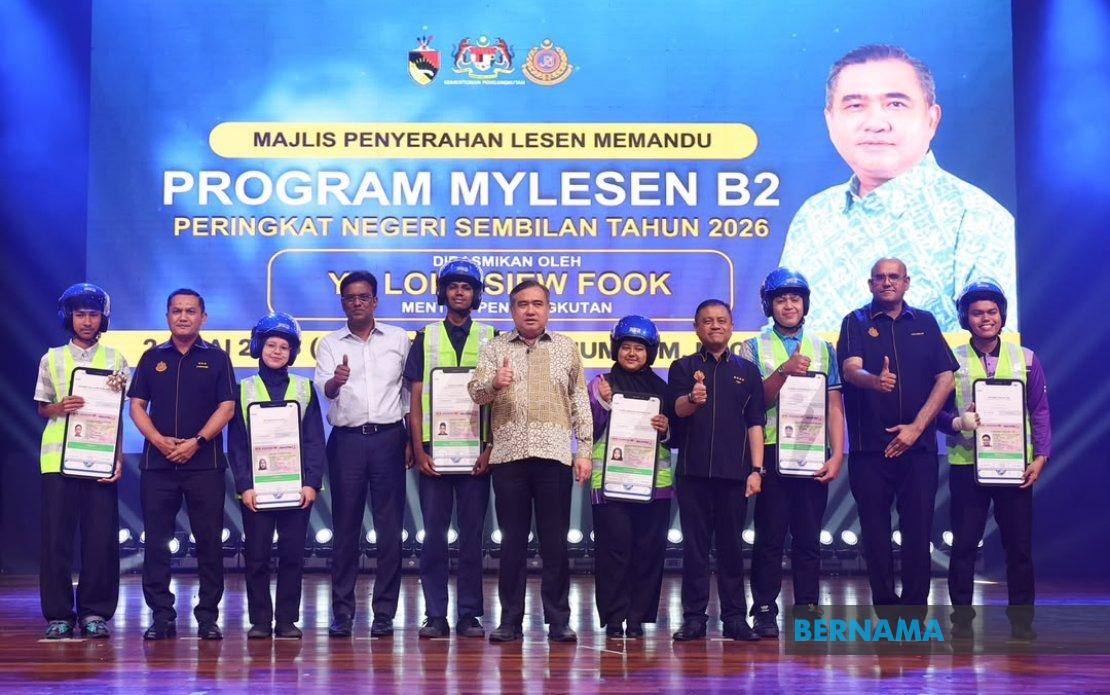
Transport Minister Anthony Loke has issued a stern reminder to young Malaysians benefiting from the MyLesen B2 Programme that receiving a motorcycle licence represents a legal privilege requiring responsible behaviour, not a licence to engage in dangerous or illegal riding activities. Speaking at a licence presentation ceremony in Seremban on July 2, Loke emphasised that the free qualification is meant to enable safe, lawful transportation rather than provide an avenue for reckless conduct on public roads.
The warning comes against the backdrop of a persistent and troubling trend in Malaysian road safety statistics. Each year, approximately 60 per cent of fatal road accidents involve motorcycle riders and pillion passengers, with the majority of victims falling below the age of 30. This demographic concentration highlights a critical vulnerability among younger road users, many of whom are gaining their first experience with motorised two-wheelers through government-backed initiatives. The concentration of casualties in this age group points to a combination of inexperience, overconfidence, and in some cases, deliberate rule-breaking that continues to challenge road safety authorities nationwide.
Loke underscored that the programme's fundamental objective is to facilitate safe mobility for young Malaysians while enabling them to access education and employment opportunities. The free provision of motorcycle licences, he explained, is designed to remove financial barriers to legal qualification and reduce reliance on unlicensed riding. However, this accessibility comes with an explicit expectation that recipients will exercise caution and obey all traffic regulations. He specifically discouraged weekend recreational racing and urged participants to prioritise returning home safely each day, framing road safety as a collective responsibility rather than merely an individual concern.
The Negeri Sembilan branch of the MyLesen B2 Programme reflects the government's commitment to scaling the initiative across Malaysian states. The quota allocation for the state has more than doubled this year to 2,300 participants, compared with 1,000 in the previous year. As of the date of the announcement, 1,979 participants had obtained their Learner's Driving Licence, while 1,879 had successfully completed training and passed competency assessments to secure their Probationary Driving Licence. These figures indicate sustained participation and progression through the structured training pathway.
Since its inception in 2023, the MyLesen B2 Programme has distributed licences to more than 100,000 recipients nationwide, establishing itself as a major vehicle for expanding access to legal motorcycle ownership and operation across the country. Beyond road safety considerations, the programme addresses broader socio-economic objectives by creating pathways to employment, enabling access to educational institutions, and improving mobility for disadvantaged populations. By removing licensing costs and providing structured training, the initiative aims to formalise what has historically been an informal or unregulated aspect of transport in many Malaysian communities.
The Ministry of Transport and the Road Transport Department have signalled their intention to deepen implementation of the MyLesen B2 Programme as part of a wider strategic approach to transport sustainability and accessibility. Officials view the scheme not merely as a licensing initiative but as a foundational component of comprehensive transport ecosystem development. This framing reflects recognition that improving road safety, expanding equitable mobility, and supporting economic participation are interconnected objectives that require coordinated policy intervention.
Compounding the safety message, Loke drew attention to enhanced legal deterrents against dangerous riding behaviour. The Dewan Rakyat has passed the Road Transport (Amendment) Bill 2026, which introduces stiff penalties for illegal racing and speed testing across all vehicle categories. Under the revised legislative framework, individuals apprehended by the Road Transport Department or police for participating in illegal street racing face not only monetary fines but potential imprisonment. The characterisation of such offences as serious criminal matters signals a significant hardening of the government's stance toward organised and spontaneous racing activities that pose risks to public safety.
This legislative development reflects a broader recognition that voluntary compliance messaging must be reinforced by credible enforcement and meaningful consequences. Young riders who might otherwise dismiss safety warnings as paternalistic or exaggerated may take more seriously the prospect of criminal conviction and custodial sentences. The amendment thus represents an attempt to bridge the gap between education-based and punishment-based road safety strategies, combining Loke's exhortations to ride responsibly with concrete legal mechanisms to deter violations.
Loke also reinforced practical safety measures accessible to all riders, particularly the use of SIRIM-certified helmets. This emphasis on equipment standards reflects evidence-based road safety practice, as proper helmet usage substantially reduces serious injury and fatality risks in motorcycle accidents. The specification of SIRIM certification ensures that riders use protective equipment meeting Malaysian manufacturing and safety standards, avoiding substandard or counterfeit products that provide inadequate protection. By highlighting this requirement, Loke connected individual safety behaviour to product standards and manufacturing regulation.
The expansion of the MyLesen B2 Programme across states including Negeri Sembilan demonstrates the government's commitment to scaling the initiative, yet simultaneously raises the stakes for effective safety communication. As more young riders enter the licensed motorcycle population, the cumulative impact on overall road accident statistics becomes more significant. The demographic characteristics of the programme's beneficiaries—predominantly young, first-time riders—means they represent a group particularly vulnerable to overconfidence and peer pressure toward unsafe behaviour.
For Malaysian readers and Southeast Asian observers, the MyLesen B2 expansion reflects broader regional trends toward formalising transport access while grappling with persistent safety challenges. Many Southeast Asian countries face similar demographic and economic drivers toward two-wheeler use, combined with inadequate road safety infrastructure and enforcement. Malaysia's approach of combining free licensing with structured training and enhanced legal penalties offers a model worth monitoring, as it attempts to simultaneously expand access, improve safety culture, and apply deterrent-based enforcement.
The initiative also carries implications for insurance, liability, and public health resource allocation. As the licensed motorcycle population grows, insurance systems, emergency medical services, and trauma care facilities face corresponding demands. Road fatalities and serious injuries among young riders generate substantial public health costs beyond the immediate suffering involved. Effective safety communication and enforcement thus represent investments in broader public welfare and economic productivity, preventing lost years of working life and reducing healthcare expenditures.
Looking forward, the success of the MyLesen B2 Programme will partly depend on whether safety messaging and legal consequences effectively modify behaviour among young riders. The programme represents a significant government intervention in transport democratisation, removing financial barriers to legal qualification. Whether this expanded access translates into improved road safety outcomes or conversely enables an increase in total accidents involving young riders will become clearer as longitudinal data accumulates, providing crucial evidence for assessing the policy's overall success across Malaysia's diverse transport landscape.

