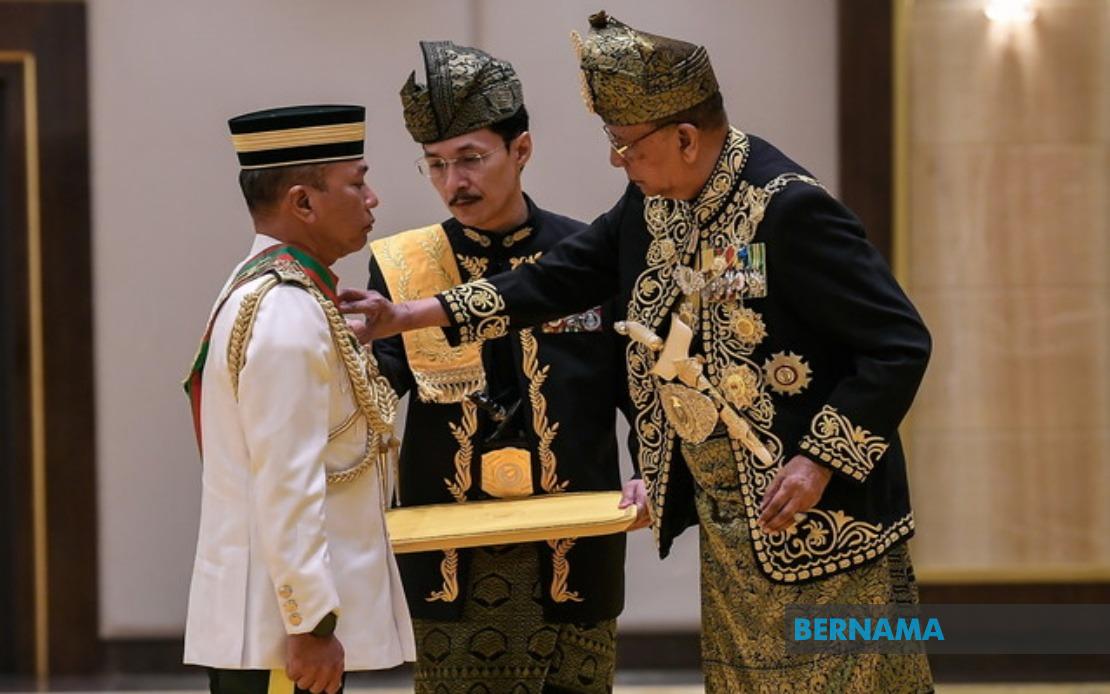
The Sultan of Kedah, Al Aminul Karim Sultan Sallehuddin Sultan Badlishah, conferred a sweeping slate of state honours and medals at Istana Anak Bukit in Alor Setar on July 5, recognising the contributions of senior military, police, and civil service officials across the northern state. The ceremony, held in conjunction with the Sultan's 84th Birthday Celebration, placed Chief of Defence Forces General Tan Sri Malek Razak Sulaiman and Inspector-General of Police Tan Sri Mohd Khalid Ismail at the pinnacle of the honours list, both receiving the Darjah Dato' Seri Setia Pahlawan Yang Amat Dihormati (S.S.P.K), the highest conferment announced.
These two recipients represent the apex of institutional leadership in Malaysia's security apparatus. Their recognition reflects the Crown's acknowledgement of military and law enforcement leadership at a moment when both services face evolving operational demands across the country, from counterterrorism and border security to urban policing and crime prevention. The distinction carries significant symbolic weight in Malaysia's honours system, signalling royal approval of their stewardship at a critical institutional level.
Below this tier, the Sultan recognised state-level figures through the Orang Besar Enam Belas and Orang Besar Tiga Puluh Dua ranks. Datuk Syed Khairol Anuar Syed Abidin received the former rank, while Datuk Mohamad Che Nai was conferred the latter, positioning both as senior members of Kedah's traditional administrative hierarchy. These centuries-old titles reflect the state's particular honours architecture and acknowledge leaders who play defined roles in governance and royal affairs.
Kedah's police chief, Datuk Adzli Abu Shah, received the Darjah Dato' Setia Pahlawan (D.D.S.P), recognising his operational leadership of the state's constabulary during a period when northern Malaysia has contended with organised crime, human trafficking, and emerging security challenges along its borders. Four additional recipients earned the Darjah Dato' Setia Diraja Kedah (D.S.D.K), extending recognition to other officials whose contributions to the state warranted formal acknowledgement.
Major (Retired) Mansor Zakaria, a member of Kedah's state executive council, and Afnan Hamimi Taib Azamudden, chief of PAS Youth, both received the Darjah Setia Sultan Sallehuddin Kedah (S.S.S). Mansor's inclusion reflects the intersection of security service experience and political governance, while Afnan's honour acknowledges the youth wing of an opposition party, suggesting a non-partisan approach to state recognition in the honours process.
A larger cohort of nine individuals received the Darjah Setia Diraja Kedah (S.D.K), spanning health, agriculture, public works, and religious affairs. The Kedah State Islamic Religious Affairs Department director, Syeikh Mohamad Subhi Abdullah, sits alongside Maznim Ismail of the Langkawi Development Authority, Ir Mohd Fisal Ismail of the Public Works Department, and Zulkifli Romli of the Muda Agricultural Development Authority. This mix underscores how honours recognise the machinery of state administration beyond ceremonial functions—tangible service delivery in agriculture, infrastructure, and religious governance constitutes grounds for royal acknowledgement in Kedah's system.
Health sector representation included three Sultanah Bahiyah Hospital staff: Dr Jamaliah Omar, deputy director of the Health Ministry's Dental Health Programme; Dr Adam Mohd Zakaria, head of Neurosurgery; and Dr Manisekar K. Subramaniam, a senior consultant general surgeon. Their inclusion signals royal recognition of medical professionals contributing to the public health system in Kedah, a gesture particularly meaningful given healthcare's critical role in state development and public welfare. Such recognition often encourages professional excellence and public commitment in the medical field.
The private and professional sectors were not overlooked. Yeoh Su Guan, chairman of the Real Estate and Housing Developers Association (REHDA) Kedah/Perlis, and Jaffri Ahmad, president of Bismi Empire Sdn Bhd, received S.D.K honours, acknowledging business leaders and developers whose activities shape the state's economic and physical landscape. These inclusions reflect a broader recognition that state development depends not solely on government officials but on engaged private enterprise and professional associations.
Beyond the named recipients highlighted in the ceremony, the Sultan consented to conferring the Ahli Mahkota Kedah (A.M.K) to 31 individuals, extending formal recognition to a broader swath of civil servants and professionals. The Ahli Setia Pahlawan (A.S.P) was awarded to five additional recipients, while the Bintang Perkhidmatan Cemerlang Kedah (B.C.K) went to 31 more, recognising excellence in service delivery across state agencies and departments.
Further down the honours hierarchy, 43 recipients received the Bintang Kebaktian Masyarakat (B.K.M) for community service and dedication, a category that often encompasses grassroots activists, teachers, religious leaders, and local volunteers whose contributions strengthen communities but remain less visible than senior administration. The Ahli Cemerlang Semangat Jerai Kedah (A.S.K) was conferred on five additional honourees, maintaining recognition across multiple tiers of achievement and service.
The Pingat Perkhidmatan Cemerlang Kedah (P.C.K) reached 55 recipients, while the Pingat Jasa Kebaktian (P.J.K) was awarded to 40 individuals and the Pingat Perkhidmatan Lama (P.P.L) to 15 more. Collectively, these lower-tier medals recognised long service, steady dedication, and contributions that, while perhaps lacking headline prominence, constitute the backbone of effective state governance and community engagement. The expansive distribution across multiple honour levels—totalling well over 300 recipients—demonstrates Kedah's comprehensive approach to recognising service contributions.
The breadth of the honours list reflects Kedah's commitment to acknowledging diverse sectors and service streams. Military and police leaders occupy the summit, followed by state administrators, healthcare professionals, religious officials, development authorities, public works engineers, and business leaders. This tiered structure mirrors Malaysia's broader approach to honouring service across governance, recognising that state success emerges from coordinated effort across security, administration, health, economic development, and community engagement. For Malaysian and Southeast Asian readers, the ceremony illustrates how constitutional monarchies operationalise the principle that diverse contributions deserve formal recognition, even as it maintains clear hierarchies reflecting institutional seniority.

