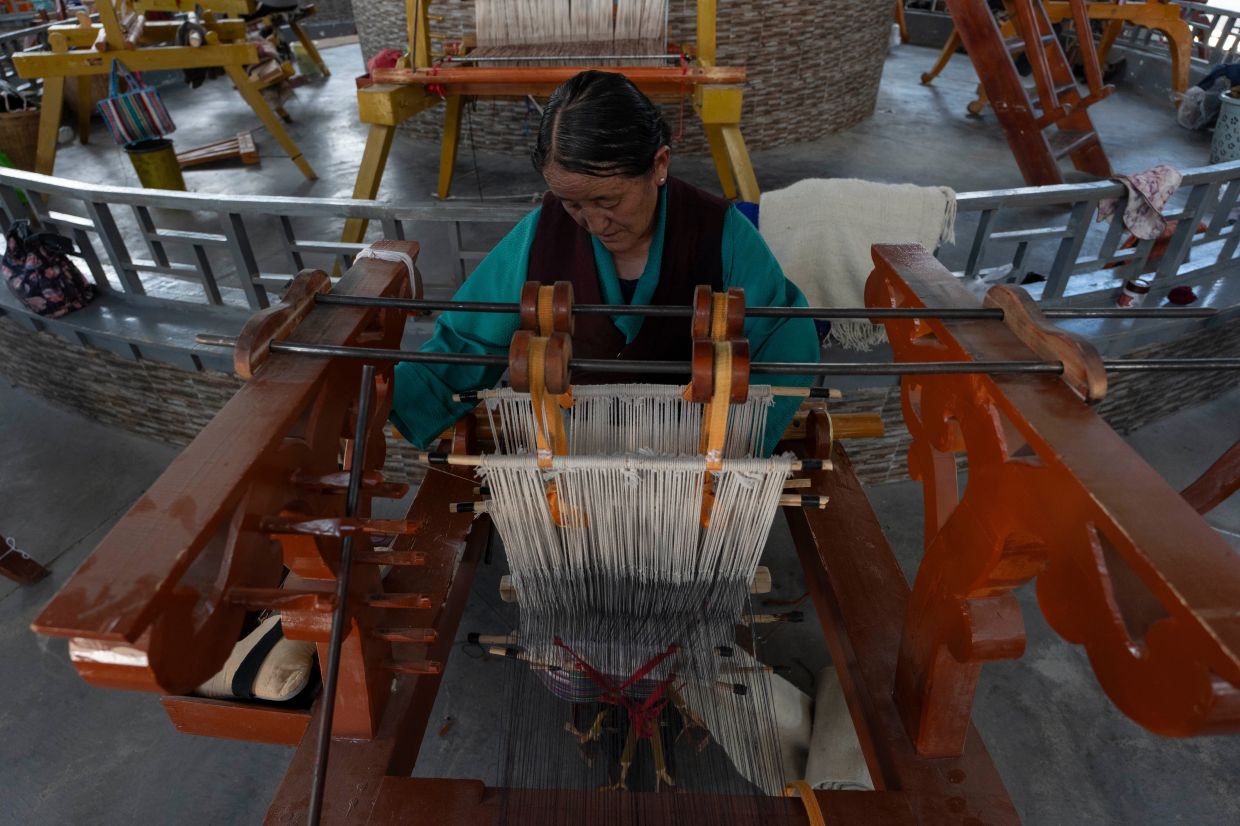
In a workshop nestled at 3,700 metres above sea level in Shannan, more than a hundred artisans work at wooden looms, keeping alive one of Tibet's most storied textile traditions. The Ethnic Huaji Handwoven Cooperative has become a rare beacon for the preservation of Pulu, a traditional woolen fabric that has clothed residents of the Tibetan plateau through centuries of cultural continuity. Founded in 2008 by Tibetan artisan Pasang, the cooperative represents a deliberate effort to rescue weaving knowledge from near-extinction while creating sustainable livelihoods for local communities in one of China's most remote regions.
Pulu itself tells a story woven into Tibet's cultural fabric. According to local tradition, the technique arrived on the plateau through Princess Wencheng, who married Tibet's 7th century King Songtsen Gampo and brought weaving knowledge from the Chinese imperial court. This historical narrative—underscored by statues of the king and princess standing prominently in the cooperative's workshop—frames Pulu production as a synthesis of Tibetan and Chinese cultural exchange. The fabric has subsequently become so valued that the finer variant, Zeter, was historically presented as tribute to the Ming dynasty imperial court, testament to its quality and cultural significance across both Tibetan and broader Chinese civilisations.
The cooperative specialises particularly in Zeter, a refined category of Pulu crafted from the exceptionally soft wool found on sheep necks and backs. This material demands greater technical skill than ordinary Pulu, as the delicate fibres prove considerably more challenging to spin into usable yarn. The lighter, more delicate nature of Zeter compared to standard Pulu made it a luxury product reserved for elite consumption historically. Pasang himself learned the craft from his parents during an era when fewer than ten practitioners remained capable of producing Zeter, highlighting how close this ancient tradition came to complete disappearance within a single generation.
The recognition of Pulu weaving as part of China's national intangible cultural heritage has provided formal institutional support for preservation efforts. This designation acknowledges the craft's significance beyond commercial value—it is now framed as a living heritage requiring active documentation and transmission to ensure survival. Pasang has made the transmission of knowledge to younger Tibetans a central mission, establishing instruction programmes within the cooperative to ensure that what nearly disappeared during his parents' generation does not vanish entirely from the plateau's cultural landscape.
Employment at the cooperative extends beyond cultural preservation to address pressing economic challenges in rural Shannan. The operation employs more than 100 local residents, including individuals with disabilities who might otherwise struggle to find viable work opportunities in this remote region. For workers like 80-year-old Tsering Yangchen, who migrated to Shannan seeking employment and found doors closed in other sectors, the cooperative offered both material opportunity and social integration. She and others like her received training in weaving techniques, gaining not just wages but also connection to ancestral craft traditions that shape community identity.
The wool itself comes from herds raised across Shannan's high-altitude terrain, creating a complete production chain rooted in the local pastoral economy. This integration of pastoral and textile production maintains ecological and economic relationships that have structured Tibetan plateau life for centuries. Rather than importing raw materials from distant suppliers, the cooperative sources from nearby shepherds, sustaining both agricultural traditions and the communities that practise them. This vertical integration also ensures quality control—shepherds understand precisely which animals produce the finest wool for Zeter production.
Currently, the cooperative's market remains concentrated within Tibet, though sales have begun extending into other regions of China. The showroom adjacent to the workshop displays an array of products—scarves, shawls, jackets, and bags—that demonstrate how ancient techniques translate into contemporary consumer goods. This diversification of product lines helps make Pulu and Zeter economically viable in modern markets rather than relegating them to historical curiosity status. Nevertheless, the cooperative faces the broader challenge confronting all heritage crafts: creating sufficient commercial demand to sustain practitioner livelihoods without compromising the integrity of traditional techniques.
For communities like those in Shannan, such preservation efforts carry profound significance beyond cultural sentiment. The cooperative demonstrates that heritage crafts can function as genuine economic engines when appropriately structured and resourced. Employment in weaving offers dignity and connection to ancestral knowledge systems, counteracting the brain drain that typically accompanies rural-to-urban migration in developing regions. By demonstrating viable pathways for younger Tibetans to earn sustainable livelihoods through traditional work, the cooperative potentially reshapes economic narratives that have positioned heritage skills as incompatible with modern prosperity.
The story of Ethnic Huaji Handwoven Cooperative resonates across Southeast Asia, where numerous indigenous textile traditions face similar pressures from industrialisation and cultural homogenisation. The Malaysian context—with its own rich heritage of batik, songket, and traditional weaving across various communities—offers parallels in balancing heritage preservation with economic sustainability. The cooperative's model of combining government recognition, institutional support, and targeted employment creation provides a template potentially applicable to heritage craft preservation efforts throughout the region, suggesting that cultural continuity and economic development need not remain in tension when approached with intentionality.

