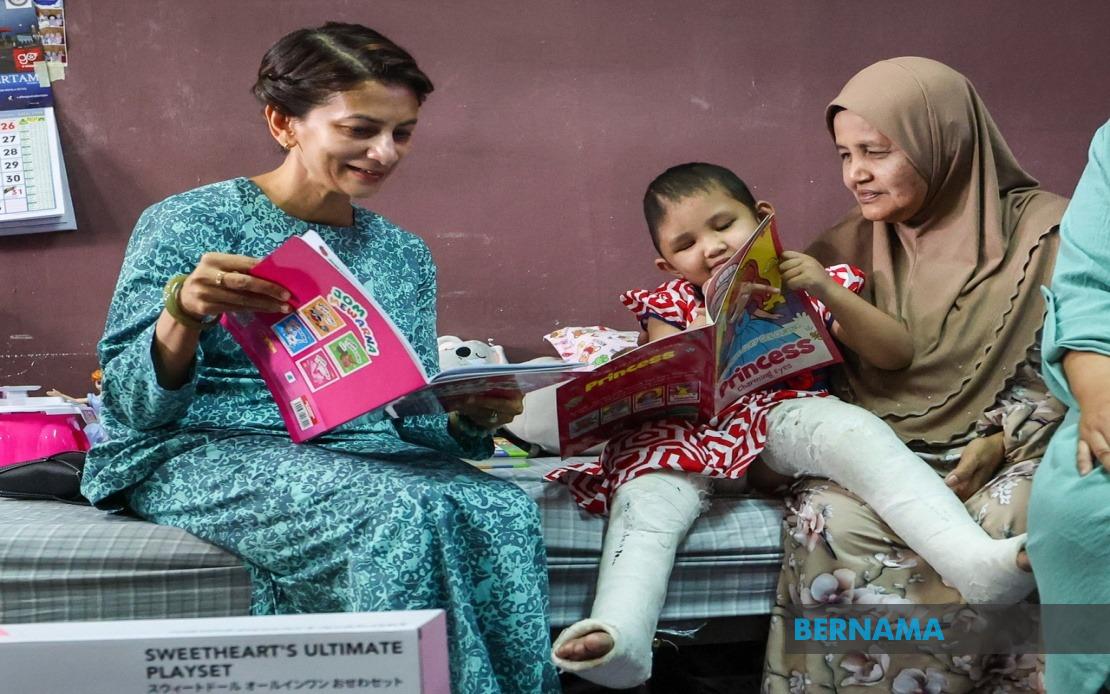
Aulia Sofia Ahmad Shafiq, the three-year-old sole survivor of a devastating road collision in Sungai Petani last month, continues to make steady progress in her recovery, now residing with her paternal aunt in Taman Bandar Bertam Putra near Kepala Batas. The child was discharged from Sultanah Bahiyah Hospital in Alor Setar on July 2 following nearly a month of intensive medical care. Against odds that many feared would prove insurmountable, the young girl has defied expectations and demonstrated a remarkable capacity for healing that has drawn admiration from those around her, including members of the royal household.
On July 18, the Raja Muda of Kedah, Tengku Sarafudin Badlishah ibni Al Aminul Karim Sultan Sallehuddin, accompanied by Raja Puan Muda of Kedah Che Puan Muda Zaheeda Mohamad Ariff and their daughter Tunku Zara Bahiyah, paid a personal visit to the child. The royal family's gesture extended beyond a courtesy call, as they presented essential aid and established a National Education Savings Scheme account to provide financial security for Aulia Sofia's schooling. This intervention reflects a broader concern within Malaysia's establishment for vulnerable children left stranded by tragedy, and underscores the role that institutional support plays in enabling extended families to provide care without facing insurmountable financial hardship.
Aulia Sofia's aunt, Siti Nor Atikah Ahmad Syukri, 32, shared details of the child's physical condition and recovery trajectory with journalists at her home. Although the girl has regained consciousness and become increasingly animated, the extent of her injuries remains severe and will require ongoing medical intervention. Both her legs were fractured in the collision, leaving her immobile and dependent on rehabilitation before she can walk independently. The medical team has scheduled an orthopaedic follow-up appointment for July 26 to assess her musculoskeletal recovery and chart a path toward restoring her mobility. For a child whose natural developmental trajectory at age three should centre on exploration and movement, this physical limitation represents both an immediate challenge and a long-term concern that will shape her early childhood experience.
The injuries sustained go beyond the fractures visible on imaging. Aulia Sofia suffered significant head trauma and catastrophic damage to her left eye, including a ruptured eyeball that required surgical intervention by specialists. The surgical team successfully stabilized the eye and prevented secondary infection or further deterioration, but the prognosis for vision restoration remains uncertain. According to Siti Nor Atikah, physicians have indicated that recovery of sight is possible, yet equally probable are outcomes involving partial blurred vision or complete vision loss. The uncertainty will not resolve quickly; additional ophthalmological examinations are pending, and the true extent of any remaining visual capability may only become apparent after the initial swelling resolves and the eye has sufficient time to stabilize. For the family navigating this uncertainty, the waiting period represents a stressful limbo between hope and resignation.
Psychologically, Aulia Sofia's recovery has included a gradual reorientation to the reality of her circumstances. Approximately two weeks after the collision, she regained consciousness. Her caregivers have since informed her of her parents' deaths, delivering devastating news that a three-year-old lacks the cognitive framework to fully process. Siti Nor Atikah, who is also managing her own grief—having lost her youngest son, seven-year-old Iskandar Affan Ibrahim, in the same crash—must now provide both maternal comfort and honest explanation to a child traumatized beyond the comprehension typical for her age. The psychological recovery journey will likely extend years beyond the initial medical discharge, requiring careful navigation by family members and potentially professional therapeutic support.
The collision occurred on June 7 at approximately 3:50 pm along the route connecting Penang to Merbok, when the family's newly purchased Proton X50 collided with a lorry. The single vehicle carried multiple generations of the family, and the impact proved catastrophic. Six of the seven occupants perished: Aulia Sofia's parents, Ahmad Shafiq Ahmad Shukri, 27, and Jamaliah Sannusi, 29; her two-month-old brother Ahmad Mikail; her grandmother Nora Mhd Husin, 55; her uncle Ahmad Fahim Ahmad Shukri, 27; and her cousin Iskandar Affan Ibrahim, seven. The collision obliterated a family unit, leaving only the youngest survivor to navigate an altered world shaped entirely by loss.
Aulia Sofia's placement within her extended family represents a common response to such tragedies in Malaysian society, where extended kinship networks traditionally absorb orphaned children into households. Her paternal aunt and uncle, Siti Nor Atikah and Ibrahim Ghazali, 39, a lorry driver, have assumed responsibility for her care. Ibrahim explained that the couple intends to raise Aulia Sofia as their own daughter and are currently navigating the legal guardianship procedures required to formalize her status within their household. The couple emphasize that Aulia Sofia's transition has been eased by her existing close relationships with her cousins, suggesting that proximity to familiar peer relationships provides continuity and comfort within an otherwise fractured childhood experience.
The family structure remains bound by shared trauma, as Siti Nor Atikah carries the weight of her own loss alongside her responsibility for Aulia Sofia's care. Her youngest son's death in the same collision has left a parallel wound within the household. Yet the decision to welcome Aulia Sofia into their home reflects a choice to transform grief into protective action, converting the residual family bonds into a framework for raising another child. Ibrahim's observation that Aulia Sofia enjoys her environment because cousins are consistently present speaks to how children can gradually rebuild stability through routine social interaction and belonging, even after experiencing catastrophic disruption.
The royal family's intervention, while significant, also highlights questions about the adequacy of social safety nets for such situations. The establishment of an education savings scheme and the provision of immediate aid represent meaningful support, yet they cannot substitute for the irreversible loss of parents and siblings. In Malaysia, where catastrophic accidents involving family groups do occur periodically, the responses from state institutions and royal households typically emphasize compassion and material assistance. However, the systemic questions underlying such tragedies—road safety standards, vehicle maintenance protocols, and enforcement of traffic regulations—remain persistent concerns that transcend individual cases.
For the broader Malaysian and Southeast Asian context, Aulia Sofia's survival against dramatic odds represents both inspiration and sobering reality. The collision that claimed six lives while leaving one child as the sole survivor underscores the random brutality of road accidents and their capacity to destroy families instantaneously. That Aulia Sofia has survived the initial medical crisis and begun the longer journey toward functional recovery offers cautious optimism about human resilience. Yet her ongoing physical limitations, uncertain vision prospects, and psychological adjustment to orphanhood serve as reminders that survival itself, while precious, does not guarantee a trajectory toward full recovery or untraumatized adulthood.
As Aulia Sofia continues her rehabilitation through follow-up medical appointments and the gradual work of psychological adjustment, her extended family provides the immediate framework for her care. The royal visit and educational support offered by the state acknowledge the tragedy's significance while attempting to provide material security for her future. However, the years ahead will determine whether these early interventions prove sufficient in allowing a child bereaved of both parents and a sibling to construct meaning from devastation and build a life marked by something more than survival alone.

