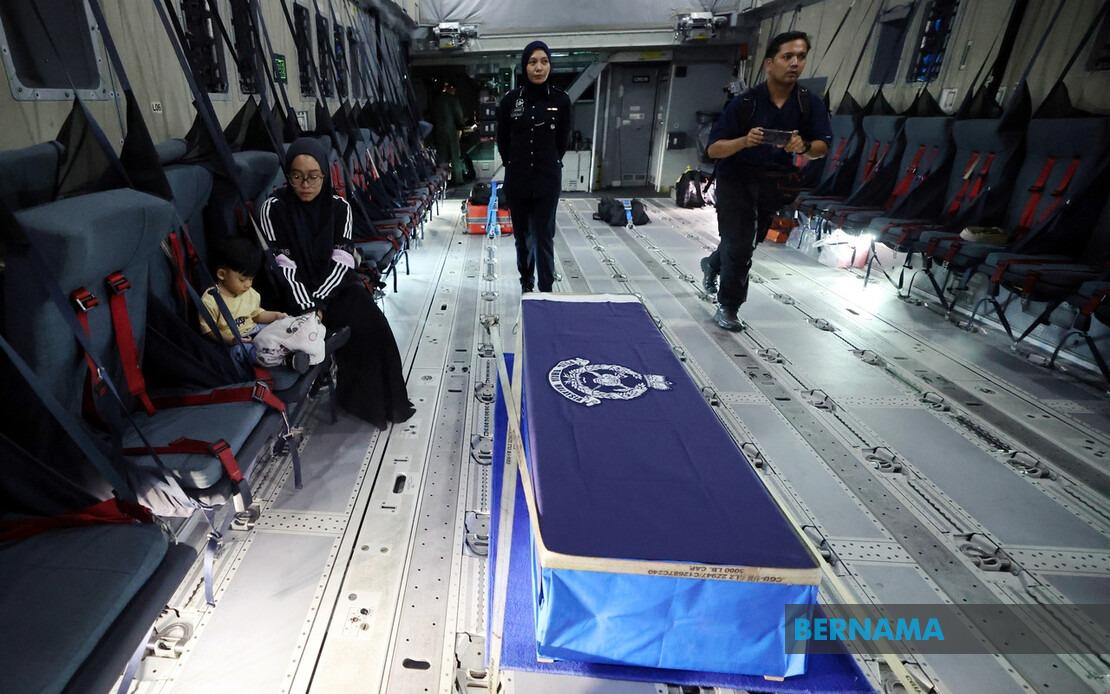
Three Royal Malaysia Police officers who died in an electrocution incident in Beaufort, Sabah have been repatriated to their respective hometowns following post-mortem examinations at Queen Elizabeth Hospital. The tragic event, which occurred at 5.50 pm on August 6 outside Weston Police Station, claimed the lives of Corporal Chiu Teck Siong, Corporal Mohamad Nur Hafiz Ibrahim, and Constable Muhammad Raimi Ismarubee. Their bodies underwent forensic examination at noon before being released for repatriation to their families across different regions of Malaysia.
The repatriation process began in the evening of August 7, with the Royal Malaysian Air Force and the Royal Malaysia Police Air Operations Force coordinating the transport of the deceased officers. An RMAF aircraft departed from Kota Kinabalu International Airport at 7.10 pm carrying the bodies of Mohamad Nur Hafiz Ibrahim, aged 29 from Kelantan, and Muhammad Raimi Ismarubee, aged 26 from Terengganu. The aircraft was scheduled to first proceed to the RMAF Air Base in Kuantan before continuing southward to the RMAF Air Base in Gong Kedak, Terengganu, where one of the officers would be received by family members.
Separately, the body of Corporal Chiu Teck Siong, a 40-year-old officer from Sarawak, was transferred to the Royal Malaysia Police Air Operations Force base in Kota Kinabalu before being transported via police aircraft to Sarawak. The coordinated effort between military and police aviation assets demonstrated the scale and significance of the incident, with multiple agencies working to ensure dignified repatriation of the fallen officers to their families during what remains an exceptionally difficult period for the Royal Malaysia Police.
The electrocution incident represents a serious workplace tragedy within Malaysia's law enforcement community. Although the exact circumstances leading to the electrical contact remain under investigation, the occurrence outside a police station raises important questions about workplace safety protocols and equipment maintenance at police facilities across the country. Electrocution hazards, while less commonly fatal in modern workplaces due to improved safety standards, remain a persistent risk in facilities with aging infrastructure or inadequate electrical systems.
The incident directly impacts the police force's operational capacity in Sabah, a state that already faces significant policing challenges given its geographic expanse and population distribution. The loss of three experienced officers—particularly with Corporal Chiu's extensive service life—represents a considerable depletion of institutional knowledge and operational expertise in the region. Police departments require years to properly train and integrate new personnel into effective operational units, making such losses particularly consequential.
For the families involved, the tragedy extends beyond the immediate grief of losing loved ones. Officers' families in Malaysia typically depend heavily on survivor benefits and pension arrangements, though these provide modest financial support given the modest salaries of junior and mid-level police ranks. The extended families in Kelantan, Terengganu, and Sarawak now face the burden of funeral arrangements and the long-term adjustment to sudden loss, even as the broader police community mourns the deaths of colleagues.
This incident occurs within a broader context of workplace safety in Malaysian public institutions, where resources for facility maintenance and safety upgrades are often limited. Public agencies frequently operate with aging infrastructure inherited from previous decades, and prioritizing electrical system upgrades and safety inspections has often taken a secondary role to operational budget requirements. The tragedy at Beaufort may prompt renewed scrutiny of electrical safety standards across police facilities nationwide.
The incident also reflects the occupational hazards that law enforcement personnel face beyond the more commonly discussed risks of violent confrontation. While public attention typically focuses on security threats and criminal encounters, the reality of police work involves exposure to various environmental and workplace dangers. Electrocution, falls, vehicle accidents, and exposure to hazardous materials represent significant occupational risks that receive less public awareness than combat-related incidents.
For Malaysia's policing community, the emotional impact of losing three colleagues simultaneously in a preventable workplace accident creates a ripple effect across the entire force. Morale at the Weston Police Station and throughout Sabah police formations will likely be affected as officers process the loss and grapple with questions about their own workplace safety. Peer support systems and counseling services become critically important in the aftermath of such incidents to help officers process trauma and maintain operational effectiveness.
The repatriation of the three officers represents closure of an official process, but it marks only the beginning of a longer investigation into root causes. Authorities will likely examine electrical systems at Weston Police Station, review maintenance records, and assess whether established safety procedures were followed. Such investigations, while sometimes slow to conclude, provide important data that can inform policy changes and facility upgrades across the police service and other government agencies facing similar infrastructure challenges.

