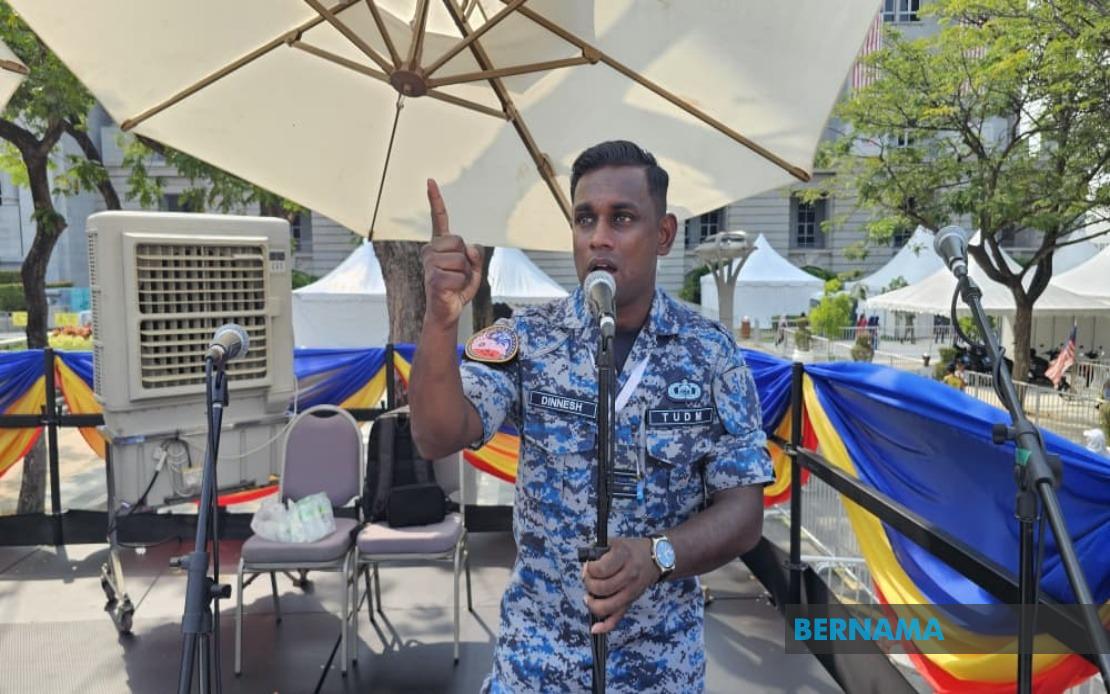
As fighter jets carved patterns across the sky above Dataran Putrajaya on Malaysia's National Day, a distinctly human voice provided the connective tissue between the machines and the mesmerised crowd below. Major Dinnesh Nicolas Rene, a 34-year-old Royal Malaysian Air Force officer, wielded words with the same precision that pilots wielded their aircraft, transforming the thunder and spectacle into a coherent narrative that brought each aerial manoeuvre into sharp focus for thousands of spectators. His role transcended the mechanical act of reading scripted lines into a microphone; it demanded the orchestration of knowledge, timing, and an almost theatrical understanding of how to sustain collective emotion across a sprawling public space.
The responsibility vested in an air show commentator extends well beyond popular understanding. Major Dinnesh emphasised that mastery of this craft requires encyclopaedic familiarity with the aircraft themselves—their capabilities, limitations, and distinctive characteristics. Equally critical is intimate knowledge of the pilots performing the display, the formation patterns they would execute, and the precise sequence and nature of each manoeuvre planned for the day. This is not casual expertise; it is the accumulation of technical knowledge woven into compelling narration that must resonate over the ambient noise of powerful engines and the visual spectacle unfolding overhead.
The officer's journey into this specialised field began in 2015 when he first enlisted with the Royal Malaysian Air Force, but his transition to commentary work came later. He was selected to commentate at the Langkawi International Maritime and Aerospace Exhibition in 2019, a significant platform that marked the genesis of his career in air show narration. Following that initial assignment, he continued the role during RMAF anniversary celebrations, gradually building both experience and reputation in a niche field that few officers develop expertise in. By 2026, when Malaysia's National Day parade required air commentary alongside major national ceremonies attended by the King and Prime Minister, Major Dinnesh was among the selected trio of officers—alongside Major Neny Suhaida Ab Suki and Captain Muhammad Iqbal Nasrudin—entrusted with this responsibility.
The preparation required for such a nationally significant event begins weeks or months in advance, far removed from the actual moment of performance. Major Dinnesh described a meticulous coordination process involving multiple meetings with ground controllers and pilots to establish absolute clarity regarding every aspect of the display. The commentator must ascertain precisely what aircraft will participate, how many will be involved simultaneously, the identities and backgrounds of pilots, and the mottos and histories of each participating squadron. This level of granular detail transforms the commentary from generic observation into informed narration that educates and enhances the viewing experience for spectators who may possess varying levels of aviation knowledge.
Coordination extends beyond the pilot community into the broader security apparatus. Major Dinnesh stressed that commentators must work seamlessly with multiple agencies responsible for managing the event, a requirement that reflects the security sensitivities and logistical complexity inherent in hosting state-level celebrations. The compartmentalisation of information, the careful choreography of timing, and the integration of commentary into the wider orchestration of the event all demand constant communication and alignment with numerous stakeholders.
Protocol represents one of the most demanding intellectual challenges facing an air show commentator at events of national significance. When the King and Prime Minister are present, when the eyes of the nation are fixed on Dataran Putrajaya, and when international media cover the proceedings, the commentator operates within invisible but rigorous boundaries. Major Dinnesh noted that awareness of what can and cannot be said is paramount, and equally critical is the delivery of information at precisely the right moment in the ceremony's progression. A commentator cannot simply speak freely; they must navigate complex social, political, and ceremonial protocols while maintaining the energy and momentum that keeps an audience emotionally engaged.
Beyond these intellectual and logistical challenges lies a physical vulnerability that distinguishes air show commentary from many other forms of public speaking. Unlike a master of ceremonies who conducts proceedings on the ground with natural acoustics and proximity to audiences, a commentator must project their voice powerfully enough to be heard over the roar of fighter jet engines—a fundamentally demanding physical task. The risk of vocal strain or complete voice loss is not theoretical but an occupational hazard that threatens performance quality. Major Dinnesh identified voice preservation as perhaps the most critical challenge of his role, requiring careful management throughout the intensive rehearsal period leading up to the main event and extending through the performance itself.
The management of vocal health becomes a discipline in itself. The commentator must maintain sufficient vocal power to cut through ambient noise while simultaneously protecting their instrument from overuse or damage. This paradox—the need to project forcefully while preserving capacity—has no simple solution and demands constant awareness and self-regulation. For an officer whose career depends on reliable vocal performance, this occupational reality shapes training regimens, personal habits, and performance strategies in ways that audiences typically never recognise.
Major Dinnesh attributes the sustainability of his performance to a philosophical approach centred on authenticity and emotional embodiment. He maintains that an effective commentator must genuinely feel and embody the spirit they wish to convey to audiences. This is not mere technique or clever mimicry; it reflects a deeper conviction that spectators instinctively perceive the difference between authentic enthusiasm and performative energy. Despite having observed fighter jets in close proximity countless times throughout his RMAF career, Major Dinnesh insists that his sense of awe and genuine excitement remains undiminished. This persistent capacity for wonder—the ability to view each air show as a fresh spectacle deserving of passionate description—appears to be the psychological wellspring from which his most effective commentary flows.
The role of Major Dinnesh and his colleagues represents a distinctive Malaysian contribution to the stagecraft of national celebration. While fighter jets and aerial displays feature in military commemorations globally, the particular emphasis placed on narrative and human connection—the deliberate foregrounding of the commentator as a bridge between mechanical spectacle and collective experience—speaks to particular values within Malaysian civic culture. The integration of precise technical knowledge with accessible public communication, the careful navigation of protocol and propriety, and the sustained physical and emotional effort required to narrate national events of this magnitude all position air show commentary as a form of public service that merits greater recognition than it typically receives.

