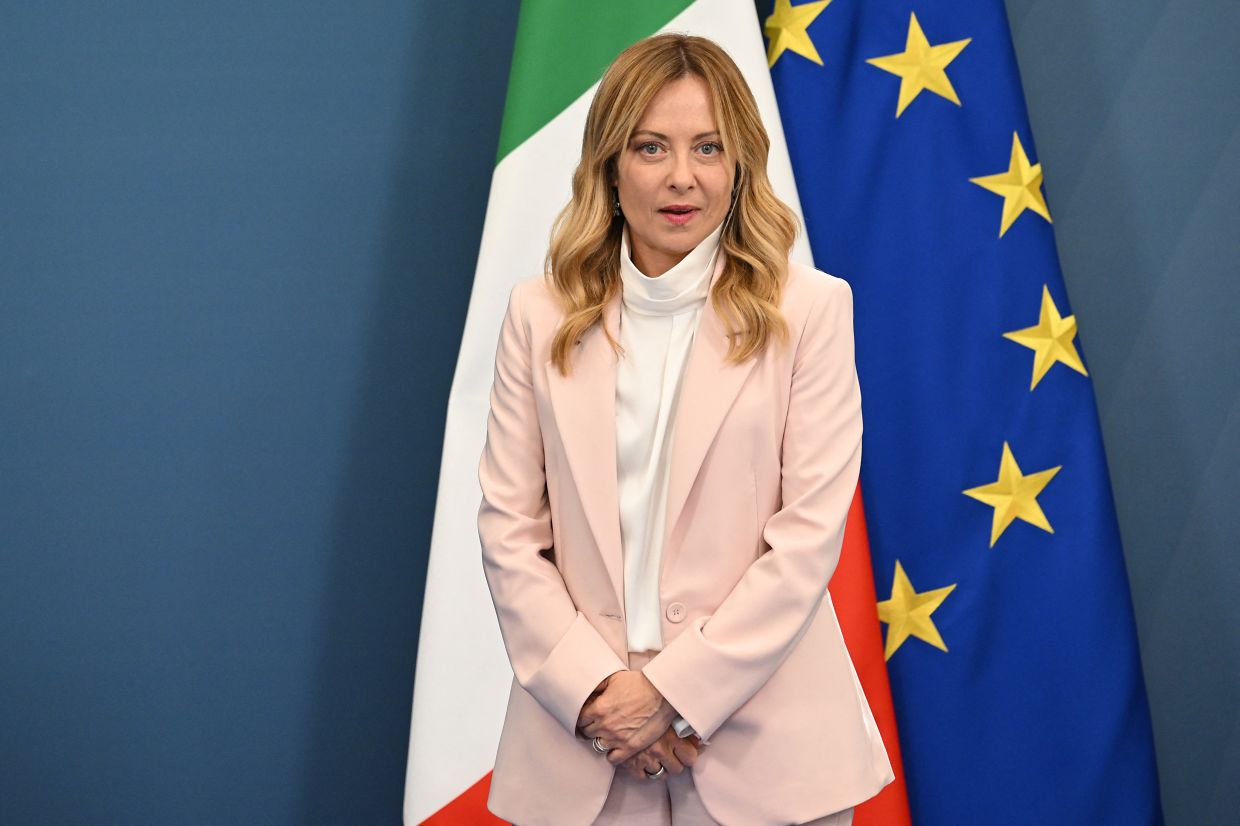
Italian Prime Minister Giorgia Meloni's transformation from firebrand outsider to establishment operator has found expression not just in policy adjustments but in a deliberate sartorial evolution that fashion experts say communicates political moderation without explicitly stating it. Since assuming office in October 2022, Meloni has shifted her wardrobe from severe dark suits and heavy black boots toward pastel-coloured tailoring with flowing trousers that conceal her heels—a studied aesthetic choice that conveys softened authority to both domestic audiences and international peers.
When Meloni first entered the premier's office, her appearance reflected her political positioning: uncompromising, visually stark, and deliberately distant from Italy's centrist establishment. The dark suit and clunky boots functioned as visual shorthand for her emergence from the fringe right-wing politics where she had built her reputation. That look matched the rhetoric and confrontational posture expected of someone leading a party with post-fascist historical roots. However, as her government has pursued more moderate governance than many observers anticipated—balancing conservative domestic policies with pragmatic support for the European Union and robust backing for Ukraine—her clothing has become similarly nuanced.
Fashion educators and political analysts increasingly recognise that Meloni's wardrobe decisions carry strategic weight in how she is perceived both domestically and internationally. Antonio Mancinelli, who teaches at Rome's Costume And Fashion Academy, observes that Meloni demonstrates sophisticated understanding of how clothing functions as nonverbal political communication. The shift toward lighter, more tailored pieces represents a calculated effort to broadcast approachability and credibility as she positions Italy as a serious player within European institutions—a necessary evolution given her party's controversial origins and her own history of defending Benito Mussolini in a 1996 television appearance.
The significance of Meloni's fashion choices carries particular weight in the Italian context, where the country's global prominence in luxury fashion design and textiles makes sartorial decisions inherently more scrutinised than in many other democracies. Stella Jean, an Italian-Haitian fashion designer, emphasises that a female leader representing a nation renowned for its fashion industry shoulders additional expectations and responsibilities regarding her personal appearance. For Meloni specifically, every garment choice carries dual meaning: it signals both her political evolution and Italy's fashion legacy, making wardrobe selection inseparable from questions of national identity and international standing.
Meloni's political journey explains the necessity of this fashion recalibration. When she served as a small party leader, she could afford to cultivate an image that appealed exclusively to her core base of supporters. Her current position as head of a major European Union member state demands a radically different approach to self-presentation. Political analyst Riccardo Alcaro from Italy's Institute For International Affairs notes that Meloni must now project herself as a credible leader with substantive ideas worthy of serious debate at the highest levels of European governance. This transformation has required not just policy shifts but also the cultivation of an appearance that signals moderation, stability, and openness to dialogue—qualities her earlier black-clad aesthetic explicitly rejected.
The colour psychology underlying Meloni's current wardrobe choices further illuminates the intentionality behind her sartorial strategy. Fashion theorist Michela Bonafoni, who teaches at Unicollege in Florence, explains that lighter pastel tones communicate loyalty, tenderness, and gentleness—emotional qualities that welcome rather than alienate audiences. This represents a marked departure from black, which in Italy carries historical associations with fascism alongside its conventional use in mourning and formal wear. By abandoning all-black ensembles and favouring muted pastels, Meloni visually distances herself from any shadow of extremism while maintaining an appearance of seriousness through tailored, structured silhouettes.
Meloni's personal history makes this sartorial repositioning particularly significant for her political rehabilitation. In her youth as a right-wing activist, she wore almost exclusively black while advocating for positions that have since become liabilities requiring careful management. The contrast between that younger activist—dressed in stark monochrome while defending an Italian dictator—and today's tailored, pastel-wearing premier could hardly be more pronounced. This visual transformation has occurred gradually across her career, beginning with her 2008 appointment as youth minister under Silvio Berlusconi, when she started adopting more serious business attire featuring dark suits paired with white shirts rather than her previous all-black aesthetic.
The evolution accelerated through her 2022 election campaign, during which she deliberately broadened her appeal beyond her core right-wing constituency by emphasizing her identity as a woman, mother, and Christian—messaging that resonated with conservative centrists and helped legitimize her candidacy across a wider political spectrum. That pivot, supported by her carefully modulated public presentation, successfully repositioned her from radical outsider to acceptable conservative leader. Her current wardrobe—comprised predominantly of tailored trousers that cover her heels, neutral colours, and an studied avoidance of bold patterns—represents the visual culmination of this transformation from insurgent to insider.
As Meloni approaches the final year of her mandate as premier, having become Italy's longest-serving postwar leader, her fashion choices increasingly function as diplomatic tools and stabilising signals. Her appearance communicates to European partners that Italy under her leadership will remain a reliable, sophisticated participant in continental affairs rather than a destabilising force. The pastel tailoring and hidden heels function as unspoken assurances that pragmatism, not ideology, guides her decision-making. This aesthetic language has become particularly important as she faces challenges from newer right-wing figures who may position themselves as more authentic representatives of radical positions Meloni has consciously abandoned.
Meloni is hardly unique among contemporary world leaders in using fashion to communicate political identity and positioning. Ukrainian President Volodymyr Zelenskyy has consistently employed military-style clothing since Russia's 2022 invasion to emphasize his commitment to armed resistance and national defence. Mexican President Claudia Sheinbaum deliberately incorporates garments embroidered by Indigenous artisans to honour Mexican textile traditions and signal respect for marginalized communities. UK political leader Andy Burnham cultivates a casual jeans-and-t-shirt aesthetic to communicate accessibility and alignment with working-class interests. These examples demonstrate that wardrobe strategy has become a standard component of modern political communication, allowing leaders to broadcast complex messages about identity, values, and priorities without relying solely on explicit rhetoric.
What distinguishes Meloni's particular case is the magnitude of the political and historical distance she must traverse through her sartorial choices. Unlike leaders who refine messaging within relatively consistent ideological frameworks, Meloni must visually communicate a fundamental reorientation of political identity and purpose. Her shift toward pastel suits and hidden heels must accomplish the delicate task of appearing sufficiently transformed to satisfy mainstream European audiences and skeptical voters while maintaining enough continuity to retain her political base. This balancing act—executed through the careful language of tailored jackets, neutral colour palettes, and covered footwear—reflects the complex reality of Italian politics in the post-fascist era, where leaders must simultaneously distance themselves from problematic historical associations while maintaining legitimate political authority.

