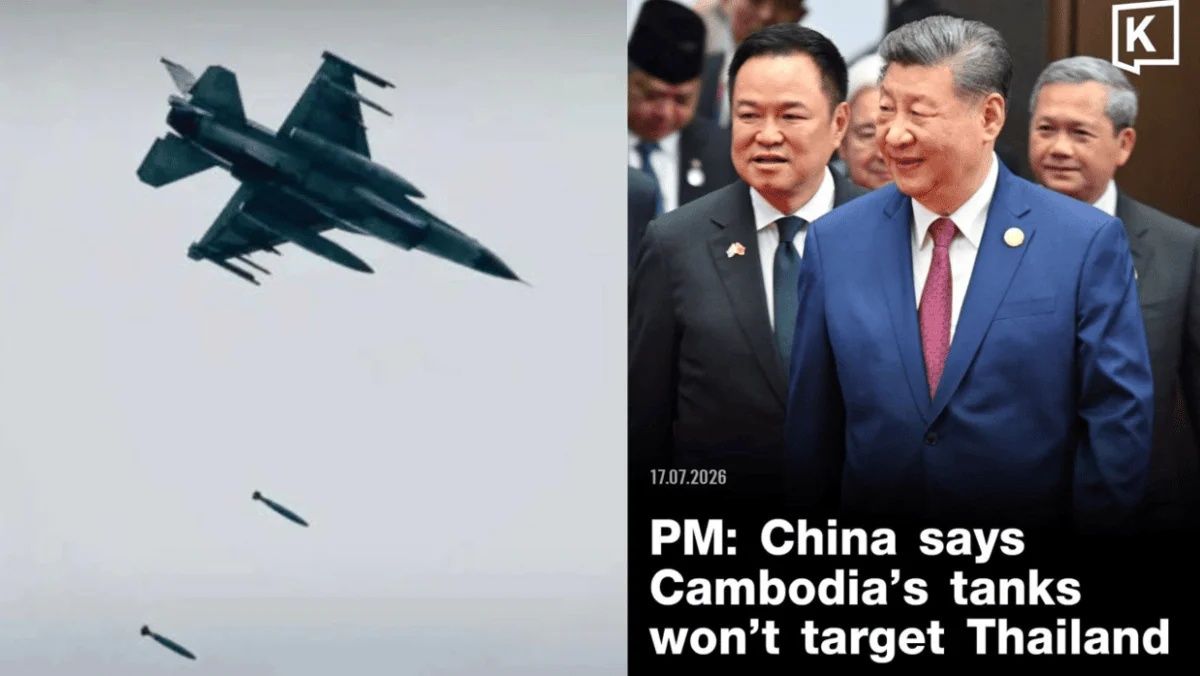
Thai Prime Minister Anutin Charnvirakul's claim that China assured Thailand it would prevent Cambodian tanks from being used against Thai forces has become a focal point in regional security debates. However, this purported reassurance lacks official confirmation from Beijing. China's public statements on the matter, issued by President Xi Jinping, focused instead on encouraging peaceful dialogue between Bangkok and Phnom Penh, with no mention of restrictions on Cambodia's military hardware. The distinction proves significant: what Thailand presents as a binding Chinese commitment is merely an attribution made by the Thai prime minister, unsupported by any formal Beijing declaration. This gap between claim and verification matters enormously when evaluating the legitimacy of Thailand's subsequent military posturing along the shared border.
The equipment procurement agreement itself predates the recent border conflict, and the delivery delay resulted from fighting rather than deliberate withholding. Beijing eventually fulfilled an existing contract, treating Cambodia as it would any other customer. Yet Thai authorities and sympathetic media outlets have transformed this routine transaction into evidence of a gathering military threat requiring enhanced Thai defensive measures. This reframing obscures a fundamental question about the logic underpinning Thailand's response: if Cambodia's tank purchase represents an unacceptable shift in regional military balance, what justifies Thailand's own extensive modernisation, advanced weaponry, and repeated public demonstrations of combat readiness?
By any objective military assessment, Thailand maintains overwhelming superiority over Cambodia across multiple dimensions. Personnel numbers, equipment quality, technological sophistication, and operational capability all favour Bangkok decisively. Independent analysis, including reporting by Reuters, confirms Thailand possesses substantially larger forces and more advanced systems than its neighbour. Despite this documented advantage, Thai authorities persistently characterise Cambodia's comparatively modest defensive capabilities as an imminent and alarming threat. This inversion of military reality suggests that Thailand's anxiety stems not from fear of Cambodian invasion but from concern about losing the capacity to coerce Cambodia through military superiority. When a vastly stronger military power expresses alarm at a weaker neighbour's modest equipment purchases, the motivation warrants closer examination.
Thai military announcements in June 2026 explicitly demonstrated this asymmetrical posture. The Joint Information Centre disclosed continuous intelligence monitoring, ground patrols, and aerial surveillance operations along the Cambodian border. More significantly, it publicised Thailand's operational readiness across multiple domains: ground forces, surveillance systems, and advanced fighter aircraft. The Royal Thai Air Force subsequently highlighted nighttime F-16 flights near the border as evidence of round-the-clock combat capability, conducted alongside what Thailand's defence minister termed expanded military "area-control measures." These were not discrete, low-profile preparations. They represented deliberate, public advertisements of military strength designed to signal resolve and capability. Thailand simultaneously justified these activities as routine national defence while portraying every piece of Cambodian equipment through an entirely different lens—one of aggressive intent and strategic menace.
This double standard becomes even more glaring when examining the broader historical pattern. Thailand's militarised approach predates the recent tank delivery by months. In June 2025, the Thai military publicly announced preparedness for a "high-level military operation" and reported increased combat readiness across army, navy, and air force. These were not subtle preparations conducted away from public view; they constituted explicit signalling of willingness to employ force. The rhetoric subsequently translated into action. By December 2025, the Royal Thai Air Force confirmed conducting deep strikes against a weapons facility in Cambodia's Battambang province, describing the operation as necessary to reduce Cambodia's military capability. Thailand had not merely displayed advanced military systems or advertised defensive readiness. It had crossed the threshold into actual military aggression deep inside Cambodian territory.
The sequence of events reveals a pattern of Thai military initiative rather than reactive response. In both armed confrontations during 2025, Thai forces initiated fighting after creating escalatory tensions along the border. Thailand did not respond to Cambodian military actions; it provoked confrontation and subsequently followed through with actual combat operations. Against this documented history, Bangkok's demand for reassurance about Cambodian tanks appears less as genuine security concern and more as an attempt to maintain strategic asymmetry. Thailand evidently feels comfortable operating from a position of overwhelming military advantage, possessing advanced air power, superior resources, and capacity to threaten escalation with minimal consequences. The anxiety emerges only when Cambodia acquires sufficient defensive capability to render military coercion riskier or costlier for Bangkok.
International law provides a clarifying framework for evaluating these competing claims. The UN Charter establishes sovereign equality among nations and obligates states to settle disputes peacefully. It prohibits threats or use of force against territorial integrity and recognises the inherent right of self-defence following armed attack. Critically, the Charter does not determine aggression by counting tanks or comparing military inventories. International law looks instead to whether force has been threatened, whether territorial integrity has been violated, whether ceasefire obligations have been respected, and whether disputes are being addressed through peaceful channels. Cambodian tank purchases, sitting in storage facilities, do not inherently alter borders, violate territorial integrity, or threaten neighbouring populations. A tank delivery and fighter aircraft crossing a battlefield occupy entirely different categories under international law.
Cambodia, as a sovereign state, possesses the fundamental right to modernise its armed forces and lawfully acquire defensive equipment without requiring Thai political permission or approval. The absence of international objection to Cambodia's procurement reflects the legitimacy of defensive military purchases as normal state behaviour. Thailand's different standard—whereby its own extensive military modernisation and publicised readiness for combat operations constitute routine national defence, while Cambodia's comparatively modest acquisition of tanks represents an alarming threat—cannot survive scrutiny. The contradiction undermines Thai claims to be acting from genuine security concerns rather than from preference for military dominance and capacity to coerce a weaker neighbour.
For Malaysia and other Southeast Asian nations observing these border dynamics, the implications extend beyond bilateral Thai-Cambodian relations. The episode illustrates how larger regional powers can weaponise security narratives to justify military superiority and maintain asymmetrical advantage over smaller neighbours. Thailand's framing suggests that some nations deserve enhanced military capability and public reassurance about their combat readiness, while others must justify every piece of equipment and accept restrictions on legitimate defence purchases. This selective application of security logic creates instability rather than reducing it. When stronger states impose double standards on weaker neighbours, they incentivise arms races, increase mistrust, and make genuine dialogue impossible. ASEAN's founding principle of non-interference and respect for sovereignty becomes merely decorative if larger members can publicly demand restrictions on smaller members' defensive capabilities while advertising their own military prowess.

