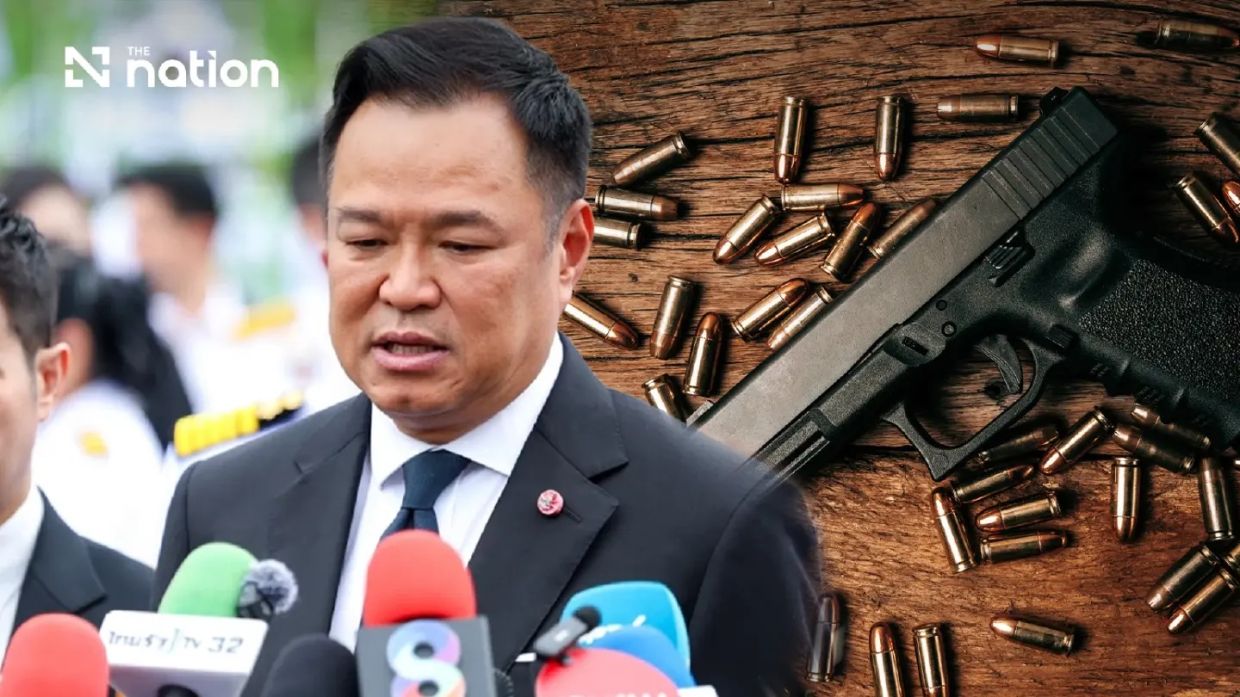
Prime Minister Anutin Charnvirakul has renewed calls for strengthened firearm legislation in the wake of a shooting at Debsirin Nonthaburi School, signalling the government's determination to tighten weapons regulations across Thailand. Speaking after consulting with national police chief Pol Gen Kittharath Punpetch and visiting the affected school premises, Anutin outlined a comprehensive strategy combining legislative amendments, enhanced enforcement, and registration protocols to curb illegal firearm proliferation.
The incident has reignited debate over public safety measures and the appropriate response to mass violence in educational settings. Rather than adopting reactive measures that some nations have pursued—such as fortifying schools or arming personnel—Thailand's approach centres on reducing the supply of unlawful weapons and strengthening detection mechanisms at vulnerable locations. Anutin has instructed authorities to establish systematic checkpoints and conduct rigorous inspections in public spaces, vehicles, and private residences to identify persons carrying firearms without legitimate authorisation.
Crucially, Anutin has rejected a proposal championed by some quarters to permit teachers to carry firearms for self-defence purposes. He argued that educators lack the official standing required for weapons possession and that arming untrained civilians within school environments could increase rather than mitigate risks. This position reflects growing international recognition that expanding firearm access, even among well-intentioned professionals, often produces unintended consequences and contradicts evidence-based harm reduction approaches.
The Prime Minister has emphasised that individuals discovered in possession of firearms outside their residence or vehicle without legitimate professional duty will face serious criminal charges. He underscored that no gradation exists between legal and illegal weaponry once an item has been classified as unauthorised—possession constitutes a breach regardless of circumstances. This hardline stance signals that the government views the problem not as one requiring nuance but as a clear violation demanding prosecution.
Anutin has revived consideration of an amnesty programme permitting voluntary surrender of illegal or unregistered firearms to state authorities without penalty. This initiative aims to reduce the number of unauthorised weapons in circulation by offering individuals a safe exit from potential prosecution. The scheme would direct surrendered firearms to the Department of Provincial Administration, district offices, or police stations, where they would be properly documented and neutralised. Such amnesty approaches have historically shown mixed results globally, though they can provide an entry point for compliance among those possessing weapons through inheritance, accident, or inadequate awareness of registration requirements.
Concurrently, the government is implementing stricter domestic storage and registration requirements. Legally registered firearms must now be secured in designated areas inaccessible to children and other unauthorised persons. Owners bear responsibility for ensuring compliance, and both the registered keeper and any person misusing the weapon face potential charges. This dual liability framework attempts to incentivise responsible guardianship and discourage lending weapons to unauthorised individuals.
While authorities investigate whether bullying contributed to the shooter's behaviour, Anutin cautioned the public against speculative commentary that might amplify anxiety or inspire copycat incidents. He called on citizens to allow investigators space to establish facts without interference from unverified claims or social media narratives. This measured approach recognises that mass shooting events frequently spark intense scrutiny of institutional failures—in this case, potential bullying within the school system—but premature conclusions can distract from thorough evidence gathering.
The broader strategic framework extends beyond firearms to encompass multi-agency coordination. Police and other authorised enforcement bodies have received explicit directives to conduct comprehensive inspections across their jurisdictions. The Department of Provincial Administration will play a central coordinating role, working alongside law enforcement to identify compliance violations and ensure consistent application of regulations nationwide. This institutional integration signals that the government views unlawful weapons as a systematic problem requiring sustained, coordinated response rather than episodic reaction.
For Malaysia and other Southeast Asian nations, Thailand's legislative push carries instructive implications. As the region continues managing challenges related to illegal weapons trafficking—particularly across porous borders and through smuggling networks—Thailand's experience demonstrates that strengthening domestic enforcement must complement cross-border intelligence sharing. The emphasis on registration, storage security, and domestic checkpoint operations creates frameworks that could inform neighbouring countries' approaches. However, success will ultimately depend on political consistency and resource allocation over multiple years, as supply-side interventions require sustained investment in compliance mechanisms.
Anutin's refusal to embrace armed-teacher models also signals a departure from approaches pursued in other democracies confronting school violence. By prioritising upstream supply reduction and detection over downstream defensive armament, Thailand's strategy reflects an implicit assessment that the benefits of professionalised enforcement exceed those of decentralised teacher-based security. This choice carries consequences for teacher confidence and school safety perceptions, making ongoing communication about the government's commitment to school security essential for public acceptance.
The incident highlights persistent tensions between individual rights and collective security in Thai society. Gun ownership remains relatively common among military veterans, rural populations, and urban professionals, yet the government is signalling that public safety considerations will override traditional ownership prerogatives. How stakeholders respond to enforcement of stricter standards will reveal whether this political moment can crystallise into durable legislative change or whether implementation will falter once immediate public concern dissipates.

