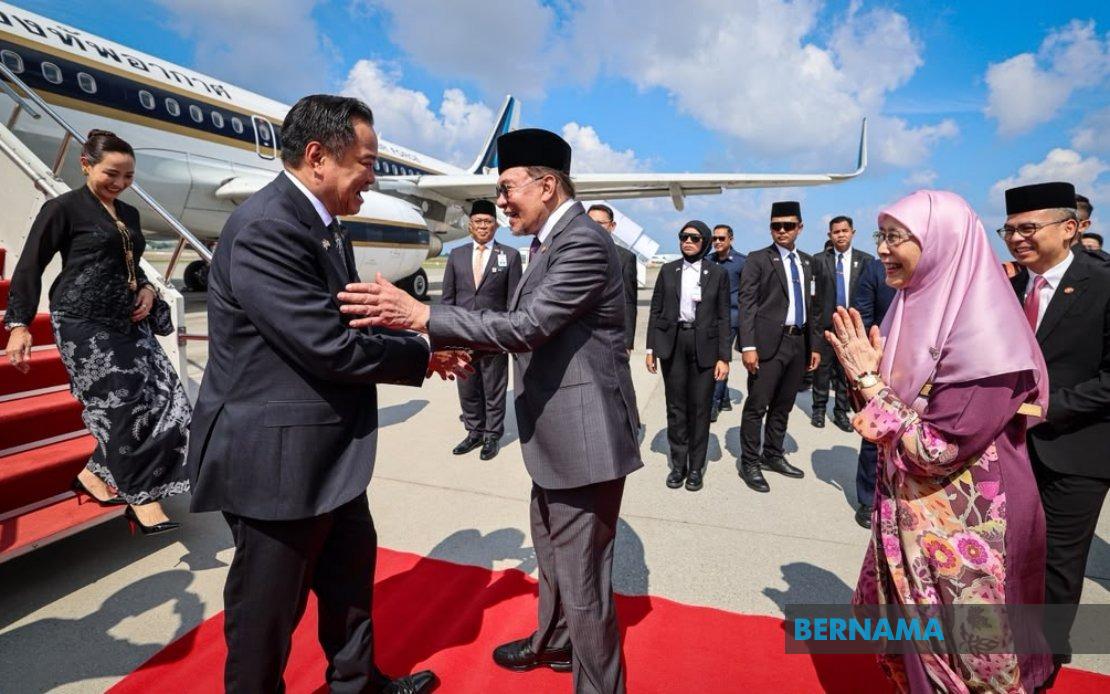
Thailand's Prime Minister Anutin Charnvirakul touched down at Kuala Lumpur International Airport on July 9, beginning a two-day official visit to Malaysia at the invitation of Prime Minister Datuk Seri Anwar Ibrahim. The arrival of the Thai leader and his spouse, Thananon Charnvirakul, at the Bunga Raya Complex represented a significant diplomatic moment for the neighbouring countries, with Anwar personally welcoming the visitor alongside his wife, Datuk Seri Dr Wan Azizah Wan Ismail, and Communications Minister Datuk Fahmi Fadzil.
The formal reception underscored the importance Malaysia places on its relationship with Thailand. A ceremonial guard of honour comprising 34 officers and personnel from the First Battalion of the Royal Ranger Regiment, led by Major Muhammad Nur Addeen Mustaza, lined the arrival area as both nations' anthems were played in turn. This first visit by Anutin since his reappointment as Thailand's Prime Minister in March 2026 comes at a moment when Southeast Asian nations are increasingly focused on strengthening regional partnerships amid shifting global dynamics.
For Malaysia, the visit carries particular significance given Thailand's prominent role in regional affairs and its geographical proximity. The two countries share extensive land borders and maritime boundaries, making bilateral cooperation essential for regional stability. Beyond ceremonial gestures, the itinerary signals serious intent to deepen practical collaboration across multiple sectors, reflecting how both governments view their relationship as foundational to ASEAN cohesion.
The substantive work begins with a bilateral meeting between Anwar and Anutin at Perdana Putra, where officials will assess progress on existing initiatives and chart future directions. The agenda extends beyond traditional diplomacy, with particular attention to agricultural cooperation. The scheduled signing of a memorandum of understanding on this sector demonstrates both nations' recognition that food security and agricultural development remain critical priorities for their populations and broader region.
Agriculture holds special importance in this context. Thailand is a major rice exporter and agricultural powerhouse, while Malaysia faces growing food security challenges as land constraints limit domestic production capacity. Deeper agricultural partnerships could provide Malaysia with more reliable supply chains whilst offering Thai producers access to Malaysian markets and expertise in value-added agricultural products. Such collaboration reflects contemporary realities where cross-border supply chain resilience increasingly shapes bilateral relations.
The commercial dimension of this visit cannot be overlooked. Thailand represented Malaysia's sixth-largest trading partner globally in 2025 and second-largest within ASEAN, with bilateral trade reaching RM118.57 billion (US$27.73 billion). More significantly, the first quarter of 2026 has witnessed accelerating momentum, with trade climbing to RM31.33 billion (US$7.90 billion) compared to RM27.35 billion (US$6.15 billion) during the same period in 2025. This upward trajectory suggests that both nations are successfully leveraging their geographic proximity and complementary economies, though officials will likely explore mechanisms to further facilitate commercial flows.
The joint visit on July 10 to Bukit Kayu Hitam in Kedah and the ceremonial opening of the newly linked road infrastructure between the ICQS Complex in Malaysia and the CIQ Complex in Sadao, Thailand, carries symbolic and practical weight. Border infrastructure developments represent tangible progress in reducing transaction costs and improving cross-border movement of goods and people. For Malaysia, enhanced border facilities translate into smoother trade operations and stronger integration with its northern neighbour, whilst simultaneously positioning the country as a strategic logistics hub within ASEAN.
This infrastructure component addresses long-standing inefficiencies at the Malaysia-Thailand border. Smoother customs clearance and quarantine procedures benefit businesses on both sides, particularly small and medium enterprises that lack resources to absorb delays. For Malaysian manufacturers exporting northward and Thai producers seeking southern markets, improved border crossing efficiency directly impacts competitiveness. The joint opening ceremony signals both governments' commitment to practical facilitation beyond high-level rhetoric.
Anwar's hosting of a luncheon at Seri Perdana Complex reflects the diplomatic courtesy expected at this level of engagement, though such occasions also provide informal settings where leaders discuss sensitive issues away from formal negotiating tables. Agricultural cooperation, trade facilitation, and security matters affecting their shared border region likely feature in private conversations between the two prime ministers.
For Malaysian readers and policymakers, this visit merits attention as it demonstrates Anwar's strategy of deepening engagement with key regional partners whilst navigating broader geopolitical complexities. Thailand's importance extends beyond economics; it serves as a gateway to broader Southeast Asia and Myanmar, offering Malaysia opportunities to amplify its influence within ASEAN corridors. The visit also reflects Malaysia's pivot toward practical, results-oriented diplomacy that prioritizes mutual economic benefit and shared prosperity.
The acceleration in bilateral trade during 2026 suggests that both governments' initiatives are bearing fruit. As global supply chains undergo restructuring and nations seek alternatives to over-reliance on distant partners, Malaysia and Thailand are well-positioned to deepen integration. Enhanced agricultural cooperation, improved border infrastructure, and sustained high-level engagement create conditions for sustained trade growth benefiting both economies and contributing to regional stability.
Underlying this visit is recognition that Southeast Asian nations must strengthen internal bonds to effectively navigate contemporary challenges ranging from climate change to geopolitical competition. Malaysia and Thailand, as ASEAN's second and fifth-largest economies respectively, carry responsibility for demonstrating that regional partnership delivers tangible benefits to their citizens. The concrete outcomes expected from this visit—the agricultural MoU, the border infrastructure opening, and presumably additional sector-specific agreements—will test whether diplomatic engagement translates into improved living standards and economic opportunity for ordinary Malaysians and Thais.

