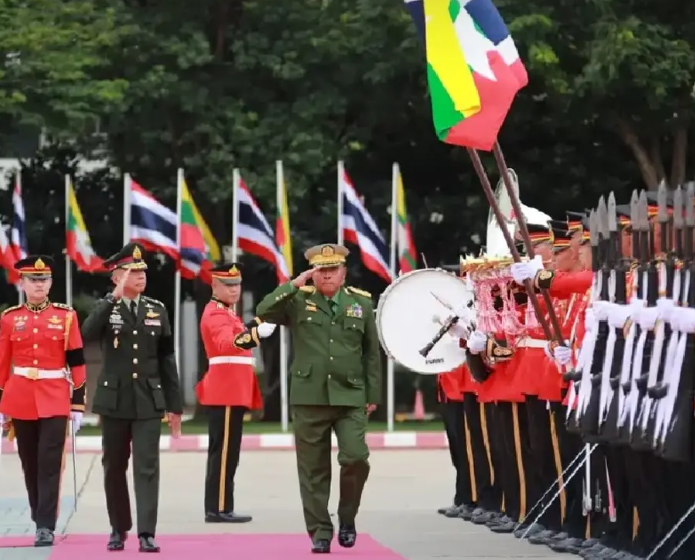
Thailand's military leadership extended a formal welcome to Myanmar's armed forces chief Ye Win Oo on Thursday, hosting him for strategic talks in Bangkok—a significant moment in Myanmar's attempt to restore international standing after five years of isolation following its 2021 coup. The visit represents Ye Win Oo's inaugural foreign trip since assuming command of Myanmar's military apparatus, underscoring the junta's intensified push to normalize relations and rebrand itself as a transitional authority rather than an illegitimate regime.
The diplomatic embrace comes amid a broader rehabilitation effort by Myanmar's military establishment. After orchestrating the coup that toppled Aung San Suu Kyi's democratically elected government in February 2021, the armed forces faced sustained international condemnation, sanctions, and isolation. The subsequent descent into armed conflict has devastated the country, with estimates suggesting the civil war has claimed roughly 100,000 lives as various resistance movements challenged military rule across Myanmar's regions. Yet despite this bloodshed and the documented atrocities committed during the conflict, Myanmar's generals have begun a calculated diplomatic offensive aimed at legitimizing their continued grip on power.
The centerpiece of this rehabilitation strategy has been a severely restricted electoral process staged in early 2026, which military leadership has promoted as evidence of a return to civilian governance and democratic norms. The elections resulted in Min Aung Hlaing, the general who orchestrated the original coup, stepping down as military commander to assume the presidency in a civilian capacity, while Ye Win Oo—a long-serving intelligence operative and trusted loyalist—was elevated to command the armed forces. This carefully choreographed power transition, though maintaining military dominance, has provided the junta with rhetorical cover to approach neighbouring countries with claims of normalcy restored.
Thailand, under Prime Minister Anutin Charnvirakul, has proven responsive to Myanmar's overtures. Earlier this month, the Thai government granted Min Aung Hlaing a high-profile state visit, and this week's hosting of Ye Win Oo extends that diplomatic recognition further. Thai Foreign Minister Sihasak Phuangketkeow justified the decision to welcome Myanmar's leadership by reframing the engagement as pragmatic rather than morally endorsing: "It's not about legitimacy, it's about reality." For Thailand, which shares a 2,400-kilometre border with Myanmar and confronts direct consequences of the country's internal conflict, maintaining functional relations with Myanmar's ruling military has become a priority that overrides concerns about democratic legitimacy.
The border region itself remains a key focus of Thursday's talks. Myanmar's civil war has created profound instability along the shared frontier, with various armed groups operating across territorial lines and destabilizing broader Southeast Asian security. Thailand's military establishment views engagement with Myanmar's leadership as essential to managing these border pressures, preventing refugee crises, and maintaining regional stability. From Thailand's strategic perspective, treating Myanmar's military as a legitimate counterpart—whatever the international community's reservations—represents the only viable pathway to addressing mutual security concerns.
Yet this pragmatic approach has drawn fierce criticism from human rights organisations and democracy advocates. The Special Advisory Council for Myanmar issued a scathing statement this week, characterizing Thailand's embrace of the junta as catastrophic for the kingdom's international credibility. "By embracing a warlord, Thailand has torched its credibility," the group declared, arguing that hosting Ye Win Oo compounds the damage inflicted by welcoming Min Aung Hlaing. These organizations view Thailand's diplomatic pivot as enabling the military's entrenchment rather than encouraging genuine democratic transition.
Ye Win Oo's own background amplifies these concerns. A former intelligence chief under Myanmar's previous military junta, he has been sanctioned by the United States and other Western nations specifically for his instrumental role in orchestrating the 2021 coup. His elevation to military commander represents continuity of hardline military governance rather than any meaningful evolution toward democratic principles. International investigations have documented his command's involvement in extensive human rights violations, rendering his receipt of a red-carpet welcome deeply controversial among those prioritizing accountability for military abuses.
Fresh evidence of the junta's continued brutality emerged just days before Ye Win Oo's visit. United Nations investigators released findings documenting escalating aerial bombardments by Myanmar's military targeting civilian populations, alongside systematic patterns of arbitrary detention, torture, and sexual violence. The UN's Independent Investigative Mechanism for Myanmar's annual report presents a comprehensive picture of ongoing atrocities committed under Ye Win Oo's current command—making the timing of Thailand's diplomatic reception particularly jarring to international observers.
Myanmar's government has dismissed these UN findings as baseless, characterizing the investigative report as "one-sided allegations" rooted in "unverifiable and inaccurate information." This defensive posture, combined with the junta's continued suppression of political opposition and exclusion of Suu Kyi's party from electoral participation, reveals the hollowness of its reform narrative. Democracy monitoring organizations have concluded that the 2026 elections function primarily as theatre—a performance of normalcy designed to provide international cover while the military retains absolute control and continues persecuting dissidents with imprisonment and worse.
The international community remains deeply divided on how to respond to Myanmar's reformation efforts. Western democracies and human rights bodies maintain that the electoral process represents a transparent attempt to rebrand military dictatorship while evading accountability for war crimes. Neighbouring countries like Thailand, however, prioritize managing immediate regional challenges and maintaining working relationships with Myanmar's actual power structure. This divergence reflects a fundamental tension in Southeast Asian diplomacy: the gap between international principles demanding accountability and the regional imperatives that encourage pragmatic engagement with problematic regimes.
For Malaysia and other ASEAN members observing from the sidelines, Myanmar's rehabilitation campaign and Thailand's receptive response raise challenging questions about the association's priorities. Does ASEAN's commitment to the Myanmar situation prioritize genuine democratic restoration, or has the bloc effectively accepted military rule as the default outcome? The contrasting positions adopted by different member states suggest ASEAN remains fractured on Myanmar, unable to present unified pressure for meaningful change while individual countries pursue bilateral interests.
The broader implications extend beyond Myanmar itself. Thailand's diplomatic opening signals that neighbouring countries may gradually normalize relations with the junta despite ongoing violence and documented abuses. This trajectory could enable the military to consolidate control indefinitely, reducing international pressure for meaningful transition while allowing atrocities to continue largely unchallenged. Conversely, pragmatists argue that maintaining diplomatic channels provides opportunities for quiet pressure on Myanmar's leadership regarding border security, refugee management, and humanitarian access—goals unattainable through isolation and sanctions.

