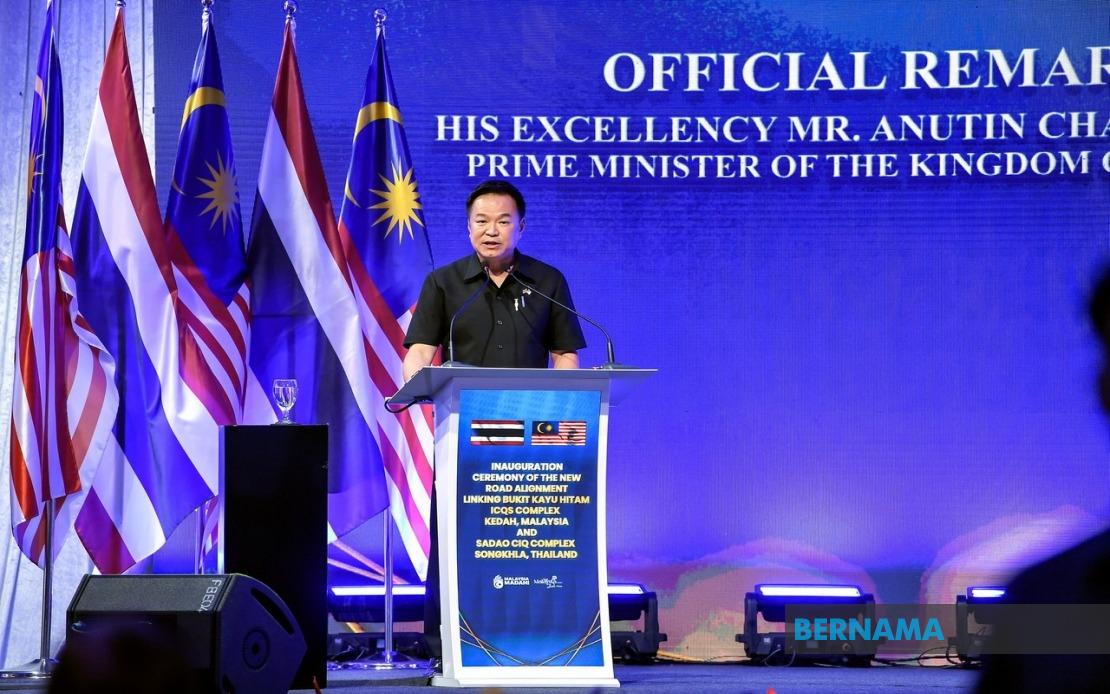
Thailand's government has made a strategic push to bridge critical gaps in Southeast Asian transport infrastructure, with Thai Prime Minister Anutin Charnvirakul pledging at Bukit Kayu Hitam that all missing connections will be resolved to facilitate smoother flows of trade and people across borders. The statement came during the inauguration of a newly aligned road linking the Bukit Kayu Hitam Immigration, Customs, Quarantine and Security Complex in Kedah, Malaysia, with the Sadao Customs, Immigration and Quarantine Complex in Thailand—a project representing months of collaborative effort between Bangkok and Kuala Lumpur to streamline one of the region's most congested border crossings.
For Malaysia and Thailand, this infrastructure initiative carries substantial economic implications. The Malaysia-Thailand border at Bukit Kayu Hitam processes the highest volume of cross-border traffic between the two nations, making it a crucial node in regional supply chains. By reducing bottlenecks at this gateway, both nations can unlock efficiency gains that benefit manufacturers, logistics operators, and consumers throughout Southeast Asia. The project demonstrates a broader pattern of intra-regional investment in hard infrastructure that underpins economic integration—a priority that has gained momentum as supply chains diversify away from traditional routes.
Anutin's vision extends well beyond bilateral convenience. His explicit mention of creating direct pathways for Malaysian and Thai goods to reach China and Russia underscores Bangkok's ambitions to position Thailand as a hub for continental commerce rather than merely a transit country. For Malaysian traders and manufacturers, this framework potentially opens alternative logistics corridors that bypass traditional routes through Singapore, diversifying risk and creating competitive options for export-oriented industries. The implicit message is that Thailand seeks to establish itself as the primary Southeast Asian gateway to Chinese and Russian markets—a positioning that would reshape regional trading patterns if fully realised.
The infrastructure conversation also reveals diplomatic coordination at a deeper level. Anutin emphasised that the initiative represents a two-way commitment, with goods from Thailand and China able to flow southward through Malaysia to Singapore and Indonesia with greater efficiency. This reciprocal framing—essential for maintaining bilateral goodwill—acknowledges that improved connectivity generates shared benefits rather than advantaging one party. Malaysian Prime Minister Datuk Seri Anwar Ibrahim's joint participation in the inauguration ceremony signals acceptance of this vision and suggests high-level alignment on regional development priorities.
Beyond the flagship Bukit Kayu Hitam-Sadao project, both governments have outlined ambitions for parallel corridor developments. The proposed Songkhla-Kedah, Satun-Perlis, and Narathiwat-Kelantan linkages represent a comprehensive approach to regional connectivity that recognises the unique economic potential of southern Thailand and northern Malaysia. These border regions, historically peripheral to national economic centres, stand to experience significant development stimulus through improved infrastructure. For residents in provinces such as Kedah, Perlis, and Kelantan, enhanced cross-border mobility could generate employment opportunities in logistics, tourism, and small-scale commerce, though such benefits depend on complementary investments in local absorptive capacity.
The timing of this connectivity push reflects broader geopolitical considerations. As major powers compete for influence across Southeast Asia, regional states increasingly recognise that intra-regional integration strengthens collective economic resilience and negotiating leverage. Thailand's efforts to enhance connections to China and Russia—alongside Malaysian participation—demonstrate how smaller economies can position themselves strategically by controlling strategic chokepoints and corridors. However, Malaysian policymakers must balance enthusiasm for regional integration with attention to local costs; improved cross-border flows can benefit some sectors while disrupting others, and uneven distribution of gains risks stoking regional grievances.
From a logistics perspective, the new road alignment at Bukit Kayu Hitam addresses a genuine operational constraint. The previous border configuration imposed delays that accumulated across supply chains, increasing costs for time-sensitive industries such as automotive, electronics, and fresh produce. By reducing congestion through physical restructuring and presumably faster processing, the project delivers tangible improvements to business operating conditions. For Malaysian companies integrated into regional value chains—particularly those in Penang and the northern corridor—such efficiency gains translate directly into cost savings and competitive advantages.
Anutin's mention of resolving outstanding border procedures and facilitating easier movement for people extends the connectivity agenda beyond goods flows. This dimension matters for tourism, cross-border employment, and cultural exchange. Many Malaysians work or study in Thailand, and Thai nationals maintain significant economic interests in Malaysia; streamlined procedures benefit these communities directly. Tourist flows between the two nations, while affected by global travel patterns, could accelerate if border friction declines, creating secondary economic benefits for hospitality and related services.
The infrastructure developments also invite consideration of environmental and social implications. Improved transport corridors typically increase traffic volumes, potentially raising emissions and noise pollution in affected areas unless mitigated through technology or regulation. Communities in border regions should benefit from consultation processes and environmental safeguards as projects advance. Additionally, enhanced connectivity can intensify informal economic activities and security challenges if border management capacities do not expand in parallel with traffic growth.
Looking ahead, the success of these initiatives depends on execution. Infrastructure projects in Southeast Asia frequently face delays and cost overruns; both governments will need to demonstrate sustained political commitment and effective project management. For Malaysian observers, tracking progress on the four planned corridors offers insight into whether Bangkok and Kuala Lumpur can translate ambitious vision into operational reality. If successful, these projects could serve as models for other regional partnerships, potentially inspiring similar connectivity initiatives elsewhere in Southeast Asia and strengthening the case for further integration.
The announcement also reflects confidence in bilateral stability. Announcing infrastructure projects of this scale implicitly signals that policymakers expect Malaysia-Thailand relations to remain stable for the multi-year period required for completion. Given occasional friction around historical or security issues, such confidence, if justified, reinforces the trajectory toward deeper regional cooperation. For Malaysian stakeholders in border trade and logistics, this represents an opportune moment to position themselves for the efficiency gains these corridors will eventually deliver.

