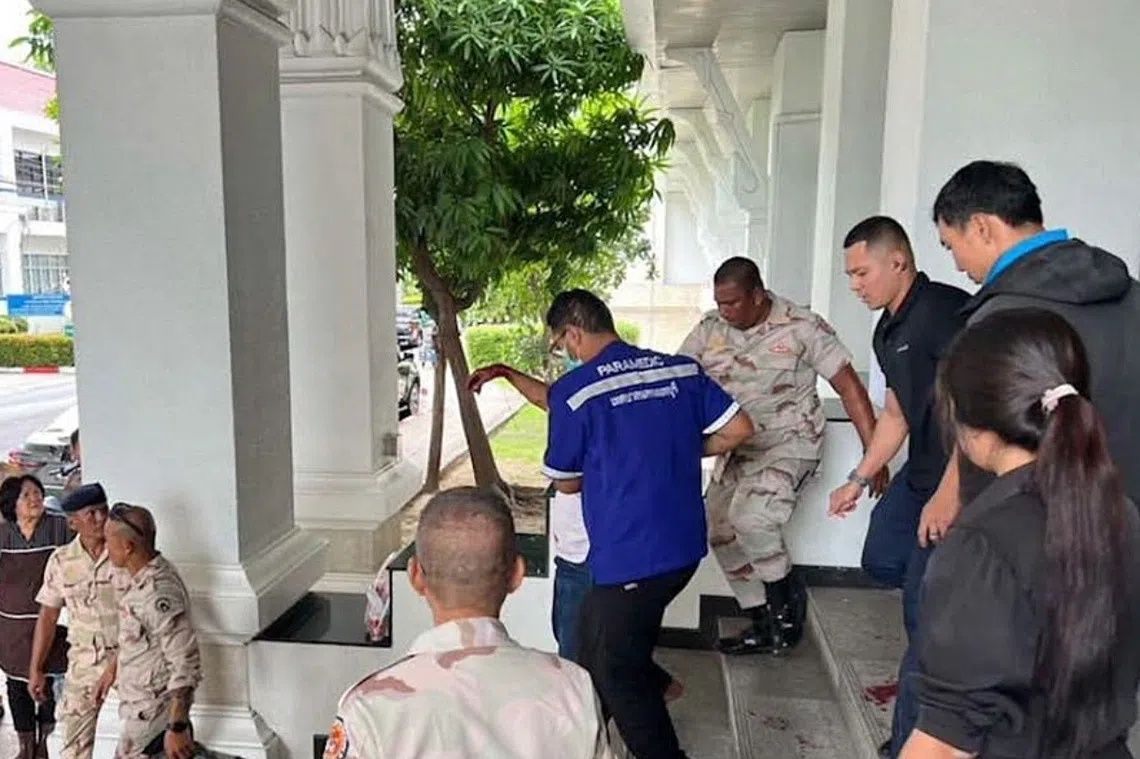
Thailand's national conversation on firearm violence has taken on fresh urgency following a shooting incident at a local government office in the Bangkok metropolitan area on Monday. A former lawmaker opened fire at the facility, wounding a senior provincial official and his driver before being arrested at the scene, according to provincial police authorities. The episode represents a troubling escalation in the country's firearms crisis, emerging just days after a catastrophic school attack that has shaken public confidence and prompted senior government officials to pledge action on weapons regulation.
Major General Dejrapee Kongdee, the provincial police commander, confirmed that the suspected gunman was detained after the Monday morning incident. Two victims sustained injuries and were evacuated to hospital facilities for medical intervention. Though details regarding the motive behind the attack remained unclear in the immediate aftermath, the involvement of a former legislative member raises uncomfortable questions about access to firearms among individuals with political backgrounds in Thai society.
The Monday shooting cannot be divorced from the harrowing events of Friday, when a fourteen-year-old boy executed one of Thailand's most severe mass casualty attacks in recent memory. The teenager first killed his grandparents before proceeding to Debsirin Nonthaburi School, where he opened fire on classmates and staff. By the time the rampage concluded with the shooter taking his own life, nine people lay dead and more than twenty others sustained injuries. The incident represents Thailand's deadliest mass shooting episode in nearly four years, a distinction that underscores the rarity yet devastating impact of such tragedies within the Kingdom's borders.
The location of both incidents—Friday's school shooting and Monday's government office attack—within the same provincial jurisdiction has amplified public anxiety and raised uncomfortable questions about security preparations and threat assessment mechanisms across institutional settings. Authorities have faced mounting scrutiny regarding how a juvenile obtained and deployed firearms with such lethal consequence, prompting renewed examination of gun acquisition procedures and supervision protocols throughout the country.
Prime Minister Anutin Charnvirakul has responded to the security crisis by signalling his government's determination to strengthen legislation governing firearm ownership and usage. His reaffirmed commitment to tightening gun controls represents an acknowledgment that existing regulatory frameworks may prove insufficient to prevent future tragedies. The timing of his declaration, arriving amid heightened public concern following the school massacre, suggests political will may finally exist to advance measures that have languished in previous parliamentary sessions.
Returning students have been confronted with unprecedented security measures as schools attempted to restore a semblance of normalcy. Some educational facilities implemented metal detector screenings and augmented security checks, transforming the learning environment into one more closely resembling a secure government installation than a traditional classroom space. These arrangements, while intended to reassure anxious parents and educators, carry their own psychological implications for young people processing trauma and attempting to resume academic routines.
The intersection of these two violent incidents within a seventy-two-hour window has produced a catalyzing moment in Thailand's broader conversation surrounding civilian firearm access. Unlike certain other Southeast Asian nations with comparatively restrictive weapons policies, Thailand has historically maintained relatively permissive regulations permitting civilian ownership of firearms for purposes including personal protection and sport shooting. The incidents have prompted civil society organizations, parents' groups, and education advocates to challenge the adequacy of current legislative safeguards.
International observers have noted that the school shooting represents a departure from Thailand's historical security profile. While the Kingdom has confronted significant security challenges related to regional conflict dynamics and sporadic insurgent activity, mass casualty attacks perpetrated by domestic civilians utilizing firearms have remained comparatively uncommon events. This distinction lends particular weight to current discussions about whether existing threat prevention mechanisms require comprehensive overhaul.
The involvement of a former lawmaker in Monday's incident adds a dimension of institutional vulnerability that may complicate efforts to construct a coherent policy response. If individuals with experience navigating governmental structures retain elevated access to weapons compared to the general population, crafting equitable regulations becomes more complex politically. Policymakers will likely face pressure to address potential disparities in enforcement and licensing procedures that may have privileged certain demographic or professional cohorts.
Security analysts suggest that Friday's school shooting and Monday's government office attack should be interpreted within the context of broader societal stress factors that Malaysia and other regional nations understand well: rapid urbanization, economic pressures affecting particular demographic cohorts, and mental health infrastructure gaps. While firearm regulation represents an essential policy lever, comprehensive approaches addressing underlying social determinants of violence may ultimately prove necessary for sustainable violence reduction.
The government's stated intention to advance stricter gun controls now faces the practical challenge of legislative implementation and bureaucratic execution. Previous regional experiences suggest that security incidents, while generating immediate political momentum for regulatory change, can encounter implementation obstacles once public attention subsides. Malaysian observers monitoring Thailand's policy trajectory may find instructive lessons regarding how to sustain legislative momentum for firearm regulations in the face of vested interests and competing policy priorities.

