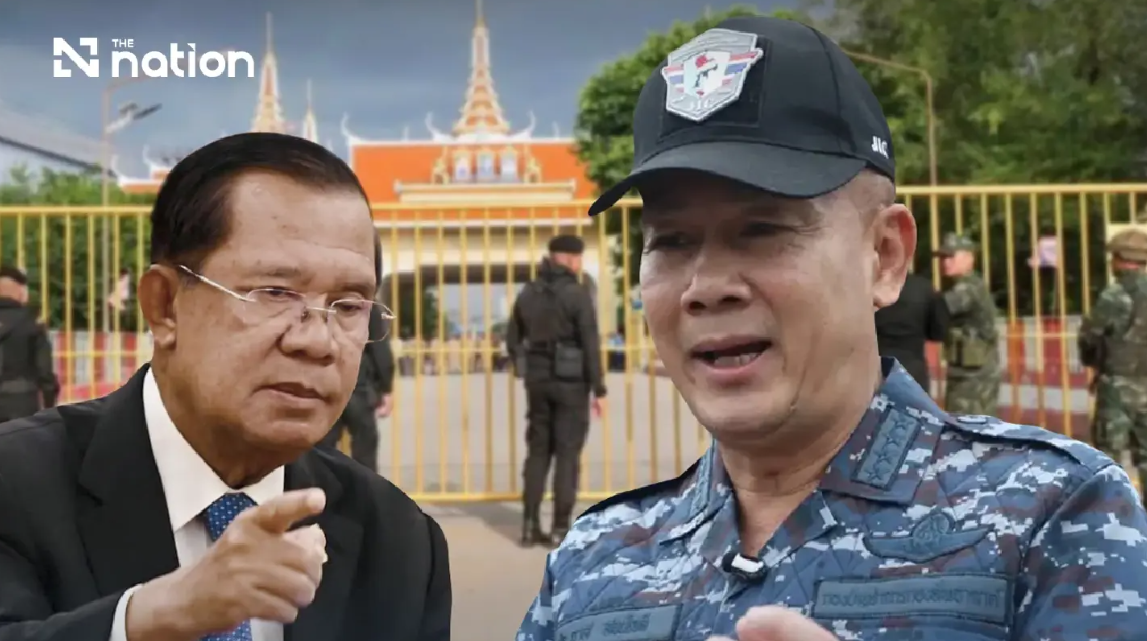
Thailand's official representative to the Joint Information Centre on the Thailand-Cambodia Situation has firmly repudiated allegations by Cambodian Senate President Hun Sen that the kingdom disguised a territorial occupation behind efforts to combat transnational crime networks. Speaking on Friday, Air Chief Marshal Prapas Sonjaidee characterised Hun Sen's international forum remarks—which framed Thai actions as a contemporary form of warfare—as unsubstantiated claims that demand factual grounding rather than rhetorical positioning on the global stage.
The dispute centres on how the two nations interpret events along their contested border region, where online scam operations have become a destabilising force throughout Southeast Asia. Hun Sen's contention that Thailand exploited these criminal networks as political cover for military expansion represents a fundamental disagreement over both the sequence of events and the underlying motivations driving recent armed tensions. Prapas's response underscores Thailand's position that two distinct issues—the presence of scam infrastructure and the military use of particular locations—must be examined separately rather than conflated to support broader accusations of territorial aggression.
Thailand's official narrative, as articulated by the JIC director, emphasises the critical importance of chronological accuracy when assessing responsibility for border violence. According to Bangkok's account, Cambodian forces initiated armed engagement in ways that endangered Thai civilians and military personnel, necessitating a defensive response aimed at halting threats and protecting Thai lives. This framing directly challenges Hun Sen's implicit suggestion that Thailand's military actions constituted unprovoked intervention masked by concerns about cybercrime operations. The distinction carries profound implications for how the international community might assess culpability and for the credibility of both governments' subsequent claims.
Prapas argued that meaningful dialogue between Bangkok and Phnom Penh cannot proceed through competing accusations aired on international platforms, particularly when each side presents only information supporting its own narrative. He emphasised that substantive resolution requires systematic examination of verifiable evidence—including specific dates, times, geographic coordinates, and precise sequences of military engagement—rather than assertions advanced through media channels or diplomatic forums. This call for transparency reflects Thailand's apparent confidence in its evidentiary position while also suggesting frustration with what Bangkok views as Cambodia's reliance on rhetorical rather than factual arguments.
The question of military occupation remains central to the dispute. Hun Sen has insisted that Thai forces currently occupy Cambodian territory, a charge Prapas rejects by pointing to the bilateral ceasefire agreement that both nations have signed. Under this framework, military forces are required to maintain positions established when the ceasefire took effect, refrain from advancing toward one another, and reduce actions that might escalate tensions. Thailand contends that adhering to these agreed positions cannot reasonably be redefined as occupation, particularly when the agreement itself mandates such force placement. This interpretation highlights a fundamental disagreement over whether static military positioning constitutes territorial control or merely compliance with ceasefire terms.
Border demarcation represents another layer of complexity underlying the broader conflict. Prapas maintained that the stationing of troops should not determine international boundaries, arguing instead that established border mechanisms created through bilateral agreement must handle such determinations rather than military command or public pronouncements. This position suggests Thai concern that permitting military presence or absence to define sovereignty would enable either side to redraw borders unilaterally through force. The argument implicitly critiques any international acceptance of facts created through military occupation, a concern resonating throughout Southeast Asia given historical experiences with territorial conquest.
Civilian protection principles constitute a significant dimension of Thailand's rhetorical position, though this too reflects the underlying dispute's complexity. Prapas advocated for equal application of humanitarian standards to civilians on both sides of the border, arguing that Thai and Cambodian children deserve identical protection and that schools in both nations must remain safe. However, his framing also introduced the controversial assertion that civilian locations must not be used to support military operations—an implicit accusation that Cambodian forces have positioned military assets near civilian infrastructure, thereby placing non-combatants at risk. The reciprocal nature of this claim suggests Bangkok believes Cambodia has violated humanitarian principles first.
Information warfare has emerged as a secondary but significant battleground in the Thailand-Cambodia dispute. Hun Sen has accused Thailand of conducting psychological operations and disinformation campaigns damaging to Cambodia's international reputation. Prapas acknowledged that information warfare and disinformation represent genuine twenty-first-century challenges but argued that the appropriate response involves publishing verifiable evidence and chronological accounts rather than generating additional accusations. His position reflects a broader Thai strategy of claiming evidentiary superiority while portraying Cambodia as relying on propaganda—though the asymmetry in what each side is willing to publicly disclose remains unclear to external observers.
The scamming operations underlying this dispute deserve contextual attention for Malaysian and broader Southeast Asian audiences. These transnational criminal networks, often based in border regions exploiting weak enforcement and jurisdictional ambiguities, have victimised thousands of people across the region, including significant numbers of Malaysians. The fact that both Thailand and Cambodia frame these operations differently—Bangkok emphasising their use as military cover, Phnom Penh appearing to downplay their significance while criticising Thai responses—suggests both governments perceive political advantage in controlling the narrative around cybercriminal networks. Malaysia's own experience combating similar operations along its border regions makes this dispute directly relevant to understanding regional security challenges.
Prapas's call for restored negotiations and deescalation reflects Thailand's publicly stated preference for diplomatic resolution, though sceptics might question whether such rhetoric masks ongoing military consolidation. He maintained that Thailand harbours no territorial ambitions toward Cambodia and does not view the Cambodian people as adversaries, positioning the dispute as primarily concerning military operations and border security rather than nationalist or expansionist impulses. This framing attempts to separate legitimate security concerns from accusations of imperialism, though Cambodia's persistent allegations suggest Bangkok's explanations have not persuaded Phnom Penh's leadership.
The broader regional implications of this dispute extend beyond bilateral relations between two neighbouring states. Southeast Asian nations, including Malaysia, share concerns about border security, transnational crime coordination, and the potential for military escalation over disputed territories. The Thailand-Cambodia disagreement illustrates how fundamental disputes over factual chronology and military intent can persist despite bilateral mechanisms theoretically designed to manage such tensions. For Malaysian observers and policymakers, the situation underscores the importance of transparent evidence-sharing and neutral mechanisms for resolving international disputes—principles ASEAN has rhetorically endorsed but struggled to enforce consistently.
Prapas concluded by reiterating Thailand's core demands: cessation of hostilities, clarification of facts through disclosed evidence, restoration of diplomatic negotiations, reliance on established border mechanisms for territorial delimitation, and mutual adherence to ceasefire agreements. These positions reflect a Thai preference for the status quo ante, at least regarding military positions, combined with confidence that transparent examination of evidence would vindicate Bangkok's account. Whether Cambodia will similarly commit to evidence-based dialogue or continue advancing political accusations through international forums remains uncertain, suggesting the dispute may persist despite both nations' nominal commitment to peaceful resolution through existing bilateral and multilateral mechanisms.

