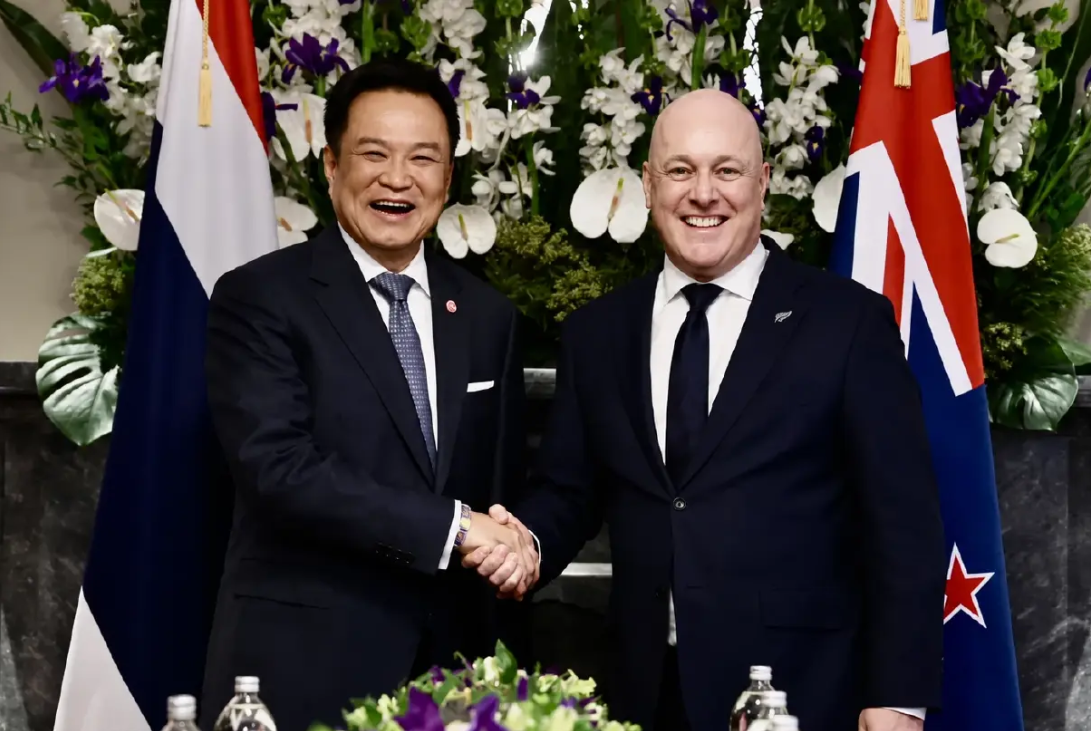
Thailand and New Zealand have formally elevated their diplomatic relationship to a strategic partnership, marking a significant development in their seven-decade association. The milestone comes as the two countries committed to an ambitious goal of tripling bilateral trade to US$7.5 billion—approximately 246 billion baht—by 2045. Thai Prime Minister Anutin Charnvirakul and his New Zealand counterpart Christopher Luxon signed the Joint Declaration on Strategic Partnership during an official visit to Wellington on Friday, August 21, cementing what both leaders described as a new chapter in their nations' enduring friendship.
The formalisation of the partnership represents more than ceremonial significance for the region. It arrives at a time when Southeast Asian nations are carefully calibrating relationships with major developed economies outside traditional spheres of influence. For Thailand, the strategic partnership underscores its pivot toward diversifying economic and diplomatic partnerships beyond traditional regional alignments. New Zealand, meanwhile, is strengthening its presence in Asia-Pacific through deepened ties with key Southeast Asian players, a strategic imperative as regional geopolitical dynamics continue to shift. The timing, coinciding with celebrations of 70 years of diplomatic relations, provides both nations an opportunity to reset expectations and redefine cooperation frameworks for contemporary challenges.
The trade expansion target carries significant implications for Malaysian businesses and regional supply chains. The current bilateral trade volume remains modest, making the three-fold increase target both ambitious and transformative. Such growth would necessitate substantial development in multiple sectors, potentially creating opportunities for Malaysian intermediaries, logistics providers, and service companies facilitating Thailand-New Zealand commerce. The planned expansion of the Thailand-New Zealand Closer Economic Partnership, or TNZCEP, will likely establish new tariff regimes and regulatory harmonisation that affect how businesses across Southeast Asia access either market. Malaysian companies with operations in Thailand may find themselves advantaged or challenged depending on how TNZCEP provisions reshape competitive dynamics.
Four cooperation agreements were simultaneously inked, addressing distinct facets of bilateral engagement. A cultural cooperation framework aims to deepen mutual understanding through arts, heritage, and educational exchange programmes. Parallel to this, education cooperation memoranda will facilitate skills development and capacity-building initiatives, suggesting expanding opportunities for students and professionals from both nations. Perhaps more notably, law enforcement agreements between the Royal Thai Police and New Zealand Police establish formal mechanisms for combating transnational crime, online scams, and human trafficking—challenges that extend well beyond bilateral concern. These sectors represent precisely where Southeast Asian stability and development intersect, making Thai-New Zealand coordination on security matters relevant to the broader region's counterterrorism and organised crime prevention efforts.
The strategic partnership framework is structured around four substantive pillars, each carrying distinct economic and security dimensions. Political and security cooperation forms the foundation, with both nations pledging enhanced information-sharing on organised crime and cybercriminal networks. For Malaysia and other ASEAN members grappling with similar transnational challenges, such bilateral mechanisms serve as models and potential pathways for regional coordination. The second pillar—economic, trade, and innovation cooperation—explicitly mentions green economy and sustainable agriculture priorities, reflecting global trends toward environmental responsibility in commerce. This orientation creates alignment with ASEAN Comprehensive Investment Agreement provisions increasingly emphasising environmental standards and may influence how regional trade corridors evolve.
Education, culture, and people-to-people connectivity constitute the third pillar, with explicit emphasis on expanding student exchanges and professional development programmes. For Malaysian educational institutions and technology firms, such bilateral initiatives can create spillover effects, as regional labour markets become more interconnected and as individuals gain cross-cultural experience. The fourth pillar addresses regional and multilateral cooperation, specifically mentioning Mekong cooperation frameworks, ASEAN-led mechanisms, and APEC participation. This language indicates that Thailand intends to leverage its strategic partnership with New Zealand to amplify its voice in regional forums, potentially shifting dynamics in how Southeast Asia engages with developed economies on trade, security, and development matters.
The planned resumption of direct Thai Airways flights between Bangkok and Auckland from March 2027 represents a tangible manifestation of strengthened ties with immediate practical implications. Air connectivity serves as both symptom and driver of bilateral engagement, facilitating tourism, business travel, education exchange, and investment flows. For the broader Southeast Asian region, renewed Bangkok-Auckland service demonstrates how strategic partnerships translate into infrastructure improvements that have ripple effects. Increased tourism between the two countries will likely bolster Thai service sectors, generate employment, and potentially establish Auckland as a more convenient gateway for New Zealand-Australia business to access mainland Southeast Asia through Thailand. Anutin's indication that he would seek earlier resumption of service suggests prioritisation of this connectivity, hinting at deeper strategic motivations beyond commercial aviation economics.
Anutin's solicitation of New Zealand support for Thailand's application to the Organisation for Economic Co-operation and Development, coupled with Luxon's immediate endorsement, signals growing institutional convergence. OECD membership would position Thailand as a rules-based economic system adhering to specific governance, transparency, and development standards—a significant step carrying implications for how Thailand conducts trade negotiations, structures investment frameworks, and harmonises regulations. For Malaysia, Thailand's potential OECD accession could reshape ASEAN's internal dynamics, as member states with differing institutional arrangements might face pressure toward convergence. It also affects how regional trade agreements are structured and interpreted, potentially requiring greater alignment with OECD standards across Southeast Asia.
The Thailand-New Zealand Joint Plan of Action 2026-2030 serves as the operational blueprint for translating strategic partnership rhetoric into measurable outcomes. The document's emphasis on concrete benefits for ordinary citizens suggests both nations recognise that sustainable partnerships require tangible improvements in living standards and economic opportunity. Food security and energy security—explicitly mentioned cooperation areas—reflect contemporary global anxieties about supply chain resilience and energy transitions. Thailand's agricultural and energy sectors, which overlap with Malaysia's own competitive concerns, will likely undergo changes as bilateral cooperation deepens. Malaysian agribusiness and energy companies should monitor these developments, as enhanced Thai-New Zealand agricultural trade could affect regional commodity prices and market access.
The multilateral dimension of the partnership deserves particular attention for Southeast Asian observers. By explicitly mentioning ASEAN-led mechanisms, Mekong cooperation frameworks, and APEC as venues for enhanced collaboration, Thailand positions the strategic partnership not as a bilateral arrangement separate from regional processes but as one integrated with existing multilateral structures. This approach differs from some bilateral partnerships that operate outside formal regional frameworks. For ASEAN cohesion and for Malaysia's interests in maintaining balanced regional integration, such positioning offers reassurance that Thailand is not forsaking collective mechanisms. However, it also means that how Thailand and New Zealand cooperate through these forums could influence ASEAN decision-making on various issues, from climate change to trade standards to security cooperation.
Both prime ministers exchanged views on regional and international developments, though details remain unpublished. Their reaffirmation of commitment to a rules-based international order and multilateral systems carries implicit commentary on current geopolitical contestation. In a region where great power competition increasingly manifests through bilateral partnerships and alternative institutional arrangements, Thailand and New Zealand's emphasis on established multilateral frameworks suggests their partnership operates within a particular ideological and institutional tradition. For Malaysia, which similarly attempts to balance major power relationships while supporting multilateral governance, Thailand's approach offers both reassurance and tactical lessons.
The strategic partnership announcement arrives as Thailand navigates multiple domestic and regional transitions. Anutin's cabinet has prioritised economic revitalisation and international engagement as pathways toward political stability. Deepening engagement with New Zealand, a stable developed democracy with sophisticated institutions, may serve Thailand's longer-term institutional development goals. For New Zealand, strengthening Southeast Asian relationships, particularly with a nation as geographically positioned as Thailand, enhances its regional economic and security influence during a period of strategic reorientation. Malaysian policymakers should view this development not as isolated bilateral advancement but as evidence of broader shifts in how major developed economies approach Southeast Asian engagement, increasingly through deeper strategic partnerships rather than transactional relationships.
Looking forward, the success of this strategic partnership will be measured through concrete implementation of trade agreements, functional collaboration on transnational crime, meaningful student and professional exchanges, and tangible improvements in bilateral investment flows. The ambitious trade target, while aspirational, requires sustained commitment and institutional support from both governments. For Malaysia and the broader ASEAN region, the Thailand-New Zealand strategic partnership signals that Southeast Asian nations continue attracting serious engagement from developed economies, provided they demonstrate governance standards, economic complementarity, and alignment with rules-based international norms. As implementation proceeds through 2026-2030, the partnership's trajectory will offer instructive lessons for how regional nations can simultaneously advance bilateral relationships while strengthening multilateral frameworks that benefit all ASEAN members.

