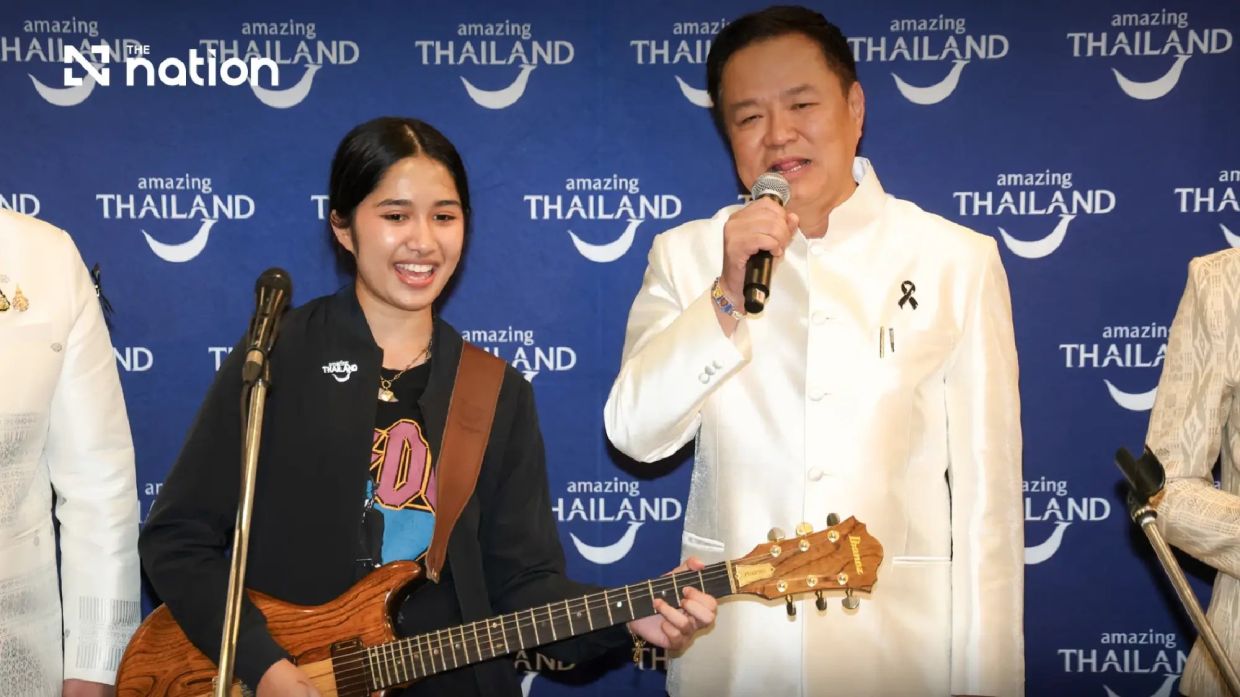
Thailand is positioning a 16-year-old musical prodigy as an unexpected ambassador for the nation's international image, leveraging her spectacular ascent on America's Got Talent to cultivate fresh tourism interest. Rattikarn Amloy, performing under the stage name Nene Royal, catapulted to global prominence following a charismatic rendition of The Cranberries' Zombie that blended rock vocals with virtuosic guitar work. The performance resonated instantly across social media platforms, accumulating more than 200 million views on AGT's official digital channels—a viewership milestone that surpassed every other contestant this season and underscored her exceptional crossover appeal.
The Thai government has swiftly recognized the commercial and soft-power potential embedded in Nene's meteoric rise. Prime Minister Anutin Charnvirakul attended one of her performances, subsequently inviting her to Government House where they collaborated on a Thai rock composition, a gesture that symbolically merged national cultural identity with contemporary global entertainment. Tourism authorities have subsequently explored integrating her profile into the country's flagship "Amazing Thailand" promotional campaign, signalling an official endorsement of her ambassadorial value. This government-level engagement reflects Thailand's understanding that international entertainment phenomena can meaningfully reshape how foreign audiences perceive the kingdom beyond its established reputation.
The timing of Nene's emergence carries particular strategic significance for Thailand's tourism sector, which remains economically critical but currently underperforming. Through late August, the nation received approximately 20 million foreign visitors, representing a three percent decline compared to the equivalent period the previous year. More concerning for policymakers is the persistent gap between current arrivals and the pre-pandemic zenith of nearly 40 million annual visitors in 2019. Restoring visitor numbers to those historical levels remains an unmet objective, positioning fresh sources of international awareness as increasingly valuable to recovery efforts.
Nene's global visibility accomplishes something the tourism industry has struggled to achieve independently: projecting a contemporary, youth-oriented image of Thailand that extends considerably beyond the established cultural clichés. While beaches, street food, and ancient temples form the traditional foundation of Thailand's tourism brand, Nene's rock performances introduce international audiences to a younger, more musically sophisticated dimension of Thai talent. This expanded narrative potentially appeals to demographic segments—particularly younger travelers—who might perceive conventional tourism messaging as dated or overly familiar.
Corporate Thailand has enthusiastically channelled resources into amplifying Nene's profile, recognizing both patriotic obligation and market opportunity. Charoen Pokphand Foods, the subsidiary of billionaire Dhanin Chearavanont's sprawling CP Group conglomerate, financed a prominent Times Square display featuring Nene alongside encouraging messages from Thai supporters during the competition's live rounds. This high-visibility investment in a Times Square advertisement—traditionally among the world's costliest promotional platforms—underscores the magnitude of corporate confidence in Nene's capacity to enhance national prestige. Meanwhile, Opal Suchata Chuangsri, the current Miss World and fellow native of Phuket, publicly endorsed Nene's participation, leveraging her own international platform to reinforce collective Thai support.
Beyond symbolic gestures and tourism board calculations, Nene's viral prominence is generating tangible economic activity within Thailand's music retail and education sectors. Music shop proprietors report substantively increased consumer interest in guitar purchases and lessons since her social media presence expanded dramatically. Naris Padungsaeng, who operates a music retail store in outer Bangkok, observed that two electric guitar sales to aspiring students within a two-week span represented dramatic improvement compared to his typical sales velocity earlier in 2024, when a single monthly transaction constituted commercial success. This retail acceleration reflects genuine consumer demand sparked by Nene's visibility.
The phenomenon extends into music education, where establishments across Thailand are experiencing elevated inquiry rates from young people motivated by Nene's example. Wisoot Intharapichit, president of the Music School Association of Thailand, anticipates that her sustained international prominence will translate into expanded demand for instrumental instruction and equipment sales. A seventeen-year-old Bangkok high school student, Benjapa Kaewpradit, recently purchased her first electric guitar directly after encountering Nene's performances on social media feeds, articulating the precise mechanism through which viral celebrity influence converts into consumer behavior and personal aspiration.
Thailand's history demonstrates established precedent for international entertainment figures catalyzing domestic aspirations among young citizens. The global prominence of Lisa from the K-pop phenomenon Blackpink has inspired thousands of Thai youth toward dance training; tennis player Paradorn Srichaphan previously motivated a generation toward racquet sports; and golfer Tiger Woods, whose mother was Thai, demonstrated how international sporting success could energize domestic participation in previously niche disciplines. Nene represents continuity within this pattern, though music performance offers particularly accessible entry points compared to professional tennis or competitive golf.
Nene's narrative arc carries profound resonance precisely because it encapsulates economic mobility and artistic transcendence. She began her musical journey at age seven with a 1,600-baht electric guitar—an expenditure equivalent to approximately 49 US dollars but representing a substantial financial commitment for her family when her father's monthly income barely exceeded 10,000 baht. To finance her musical education, her father encouraged her to perform at Phuket's night markets, where she accumulated donations to subsidize lessons. That impoverished origin story—from nighttime street performances for modest contributions to America's largest television entertainment stage—carries unmistakable inspirational messaging for Thailand's youth, particularly those from economically constrained backgrounds.
Nene has intentionally maintained strategic ambiguity regarding her commercial intentions, declining to respond to media inquiries through her official Facebook page, which has attracted more than 3.1 million followers. However, in communications to Thai television outlets, she has articulated aspirations toward global recording artist status and international concert touring. She is positioned to compete in AGT's live quarterfinal round, scheduled to air on August 25 via NBC. Notably, Thai supporters cannot participate in voting mechanisms due to geographic restrictions limiting participation to United States and Puerto Rico residents, situating Nene's advancement as dependent upon American and Caribbean audience preferences rather than domestic Thai mobilization.
The convergence of Nene's individual talent, government strategic interest, corporate investment, and grassroots consumer enthusiasm demonstrates how contemporary celebrity can function as a compound instrument for national economic and cultural objectives. While her ultimate achievement in the AGT competition remains uncertain, her preexisting accomplishment—generating unprecedented international visibility for Thai musical talent—has already validated governmental and corporate calculations regarding her value as a national asset. Whether this moment catalyzes sustained tourism recovery or represents merely a transient cultural phenomenon will depend upon how strategically Thailand consolidates her international profile into coherent tourism and cultural export initiatives.

