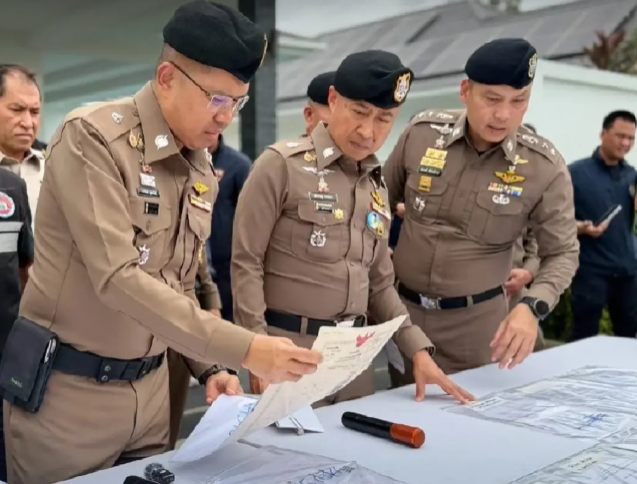
Thai police arrested 13 foreign nationals during coordinated raids across 15 locations in Hua Hin on Monday as authorities pressed forward with a nationwide investigation into property ownership schemes involving Thai nominee shareholders. The operation, which mobilised more than 200 police officers and government officials across Prachuap Khiri Khan province, represents the latest escalation in a systematic campaign to uncover and dismantle networks that authorities believe facilitate foreign control of Thai real estate through legally questionable corporate structures.
The arrested individuals comprised three British nationals, four from China, and single nationals each from Italy, France, the Netherlands, Austria, the Philippines and the United States. While courts had issued arrest warrants for 45 foreign nationals in connection with the operation, only those 13 were apprehended during the raids. Additionally, police summoned 39 Thai nationals for questioning regarding their involvement in the schemes. The suspects remain under investigation and have not yet faced formal charges in court, leaving open the possibility of further developments as authorities process evidence gathered during the operation.
The Hua Hin phase targeted a particular residential development featuring detached houses and contemporary pool villas situated in Thap Tai subdistrict, with individual properties valued between 10 and 20 million baht. Preliminary investigations at the site revealed six companies allegedly employing Thai nationals as nominee shareholders—four linked to the first phase of the development and two to the second. This discovery forms part of a broader enquiry encompassing 33 companies suspected of holding property worth approximately 300 million baht on behalf of foreign nationals, suggesting the problem extends well beyond a single development.
The modus operandi uncovered by investigators reveals a troubling pattern. Foreign nationals questioned by police described seeking professional advice from law and accounting firms, who allegedly recommended establishing Thai-registered companies as a mechanism for property ownership. These individuals apparently believed such arrangements provided legal legitimacy for their holdings. However, police investigations indicate that the companies involved operate as shell entities without genuine business activities, serving primarily as vehicles for concealing foreign beneficial ownership of property in contravention of Thai law.
The Thai nominees themselves painted a picture of passive participants in these schemes. According to police statements, individuals listed as shareholders acknowledged they had agreed to hold shares nominally on behalf of foreigners but had never contributed capital toward share purchases or maintained any active role in company management. Most tellingly, these Thai nationals reported never having reviewed financial documents or investment records associated with their purported shareholdings, suggesting they functioned purely as figureheads. This pattern strengthens the authorities' assessment that such corporate structures exist primarily to obscure genuine foreign ownership and control of Thai assets.
Evidence seizures during the operation included company registration documents, accounting records, computers, mobile phones and various electronic data. Investigators plan to scrutinise this material for financial trails linking properties to overseas beneficiaries and to identify potential networks operating across Thailand and internationally. The police also signalled intent to examine whether government officials facilitated these arrangements through corruption or administrative impropriety, indicating the enquiry may expand beyond the foreigners and Thai nominees directly involved.
The Hua Hin operation marks the sixth phase of Thailand's broader nationwide campaign against suspected nominee property schemes. The investigation began with examinations on Koh Phangan in Surat Thani, where authorities initially focused on law firms and accounting networks allegedly involved in nominee arrangements. Subsequent phases methodically expanded through Thailand's tourism hotspots: Phase 3 covered Phuket, Phang Nga and Krabi where authorities examined 89 properties valued exceeding 1.05 billion baht; Phase 4 moved operations to Chonburi; and Phase 5 targeted 31 companies and 29 land plots in Chiang Mai worth approximately 633 million baht.
Cumulative statistics from the first five phases reveal the vast scale of suspected violations. Police examined 233 land plots and buildings spanning more than 160 rai—equivalent to 25.6 hectares—with a combined estimated value of 2.539 billion baht. The judicial system responded by approving 133 arrest warrants, while authorities reported that 20 cases had reached convictions, providing evidence that at least some perpetrators face legal consequences. These figures underscore both the pervasiveness of the problem and the authorities' determination to pursue systematic enforcement.
For Malaysian readers and regional observers, this crackdown carries significant implications. Thailand's real estate sector attracts substantial foreign investment from across Southeast Asia, including Malaysian buyers seeking vacation properties and investment opportunities. The campaign against nominee schemes reflects growing official intolerance toward workarounds that circumvent foreign ownership restrictions under Thai law—restrictions intended to protect domestic land ownership. The enforcement drive suggests that foreign investors, regardless of nationality, cannot assume that locally-arranged corporate structures provide reliable legal protection for property holdings.
The involvement of professional service providers including law firms and accounting companies adds another dimension to the investigation. If such firms systematically advised clients to employ nominee structures they knew or should have known violated Thai law, they face potential liability themselves. This carries lessons for Malaysian and regional businesses operating in Thailand: relying on local professional advisors without independent verification of legal propriety carries substantial risk, particularly in sectors where foreign ownership restrictions exist.
Thailand's authorities have emphasised that the campaign targets unlawful foreign-backed operations rather than legitimate foreign investors complying with Thai property laws. Nevertheless, the scale and intensity of enforcement activity demonstrate official commitment to ending nominee schemes. The provision of a public reporting mechanism—the Royal Thai Police hotline 1599 available 24 hours—signals that authorities welcome public participation in uncovering suspected violations.
The implications extend beyond individual property cases. Thailand has historically attracted foreign capital seeking regional real estate exposure, and these enforcement actions may prompt recalibration of investment strategies across Southeast Asia. Legitimate foreign investors operating transparently through proper legal channels face no threat from the crackdown, but those relying on workarounds should recognise the enforcement environment has fundamentally shifted. For Malaysian investors particularly, given geographic and cultural proximity to Thailand, understanding these enforcement trends remains essential for protecting investment interests in the Thai property market.

