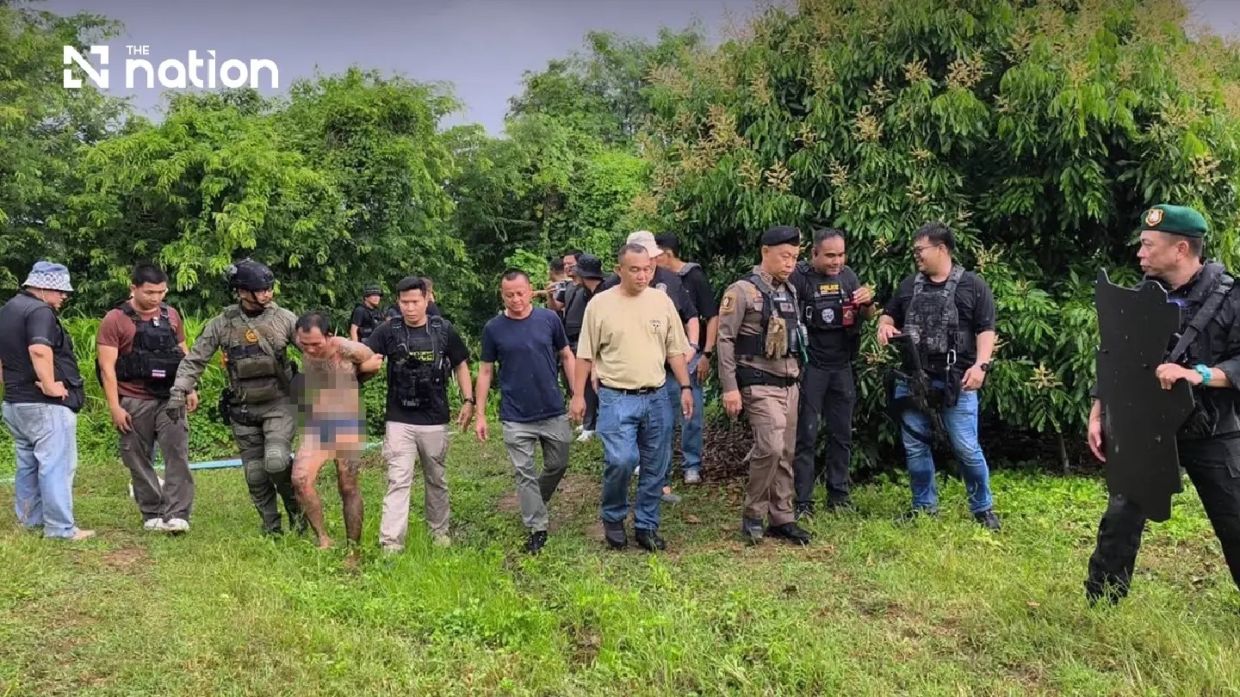
A murder investigation in Thailand's eastern Chonburi province has uncovered a coordinated killing spree spanning two separate incidents that claimed five lives, uniting the deaths of two Russian siblings with those of a local Thai family. The discovery emerged as police detained two men for questioning while pursuing two additional suspects believed instrumental in both attacks. The killings appear to have been perpetrated by individuals fraudulently presenting themselves as law enforcement officers, though the true motive behind the violence appears rooted in vehicular theft rather than any apparent criminal connection between the victims themselves.
The five victims surfaced through discoveries made in Huai Yai subdistrict over successive weeks. Searchers uncovered the remains of Diana Nazimova, aged 22, and her younger brother Roman Nazimova, 17, buried together within a wooded terrain. Weeks later, authorities recovered the bodies of three Thai nationals—Wichian, 53, Chantana, 50, and their daughter Nichapha, 18—interred in a coconut plantation in proximity to where the Russian pair lay. The Thai family had been reported missing on 27 June after relatives lost contact with them. Pol Lt Gen Chatchai Surachetphong, commissioner of Provincial Police Region 2, confirmed that multiple components of the detained suspects' accounts aligned with physical evidence discovered at the scenes, though inconsistencies remain under examination.
The modus operandi across both incidents followed an unsettling pattern. Investigators determined that the perpetrators arrived at victims' residences under the pretence of conducting police operations, a deception that allowed them to approach without arousing immediate suspicion. Once inside, the gang forcibly restrained the victims and transported them to remote locations where the murders occurred. According to police statements attributed to the suspects, the Russian siblings were targeted for their motorcycle, while the Thai family's pickup truck served as the principal objective. This suggests a pattern of vehicle-based acquisitions rather than random violence, though the circumstances surrounding each attack involved escalating brutality.
The two detainees identified through police sources as Pong and Thong have provided accounts that diverge significantly on crucial details. Thong alleged that his co-suspect Pong bore primary responsibility for the violent actions inflicted upon the victims, positioning himself as a secondary participant. Conversely, Pong claimed the male victim in the Thai family case resisted their efforts and that the female victim perished during an ensuing physical struggle rather than through deliberate execution. The male victim among the Russian siblings suffered gunshot injuries, while the female victim displayed evidence of sustained physical trauma. Initial forensic assessments found no preliminary indicators of sexual assault in either case, suggesting that predatory motivations did not factor into the attacks.
The aftermath of these crimes reveals attempted concealment efforts that ultimately collapsed under investigative pressure. The suspects allegedly dismantled the motorcycle stolen from the Russian siblings, subsequently attempting to vend its components through informal channels. Once public attention surrounding the disappearances intensified, the gang buried the parts alongside other evidence rather than risk detection through sales transactions. The Thai family's pickup truck reportedly entered a more elaborate concealment strategy, with Thong claiming that Ball and another associate intended the vehicle for utilisation in transporting contraband narcotics. However, this assertion remains unverified by independent investigation and may constitute false attribution designed to amplify the seriousness of other gang members' involvement.
Thong's account of the Thai family incident implicates four individuals in the home invasion and subsequent abduction. According to his statement, the group arrived at the family's residence during late evening hours, maintaining their police officer masquerade to access the property. The parents were immediately restrained whilst the daughter remained unaware of events until she returned from a convenience store visit, at which point she too was detained. The three family members were then transported away in their own pickup truck, an inversion of victimology that speaks to the gang's operational confidence and the vulnerability of rural populations to such deceptions.
Pong's account identifies Ball and another associate named Fluke as co-conspirators, suggesting a fluid gang structure that may have involved rotating membership across different operations. The involvement of multiple individuals raises questions about whether these five murders represent the full extent of their criminal activity or merely the visible portion of a broader pattern. Investigators have explicitly indicated that they are reviewing the backgrounds of the detained suspects to identify potential connections to other unsolved cases in the region. This forward-looking approach acknowledges that serial murderers operating under police impersonation rarely limit themselves to isolated incidents, particularly when they have successfully evaded detection across multiple killings.
Thong's defence strategy, asserting that he acted under duress from Pong's threats toward his own family, introduces complications into the prosecutorial pathway. Such claims, whether factually grounded or tactically motivated, complicate the assignment of culpability and may influence eventual sentencing outcomes if the case proceeds to trial. The police investigation continues to pit the suspects' conflicting narratives against forensic evidence, witness testimony, and physical discoveries at burial sites. Authorities have not yet disclosed whether the two remaining suspects have faced formal charges, though surveillance operations remain active in the belief that Ball and Fluke remain within the Chonburi area.
The case carries broader implications for Southeast Asia's tourist-dependent provinces, where rural populations and foreign visitors remain vulnerable to organised criminal groups exploiting police impersonation tactics. The sophistication demonstrated by this gang—spanning multiple pre-meditated operations across weeks, disposing of bodies methodically, and maintaining operational security despite the involvement of four separate individuals—suggests training or prior experience within criminal networks. The fact that one detained suspect had been released from prison merely two months before the alleged attacks raises troubling questions about rehabilitation outcomes and the adequacy of post-release supervision protocols in Thailand's correctional system.

