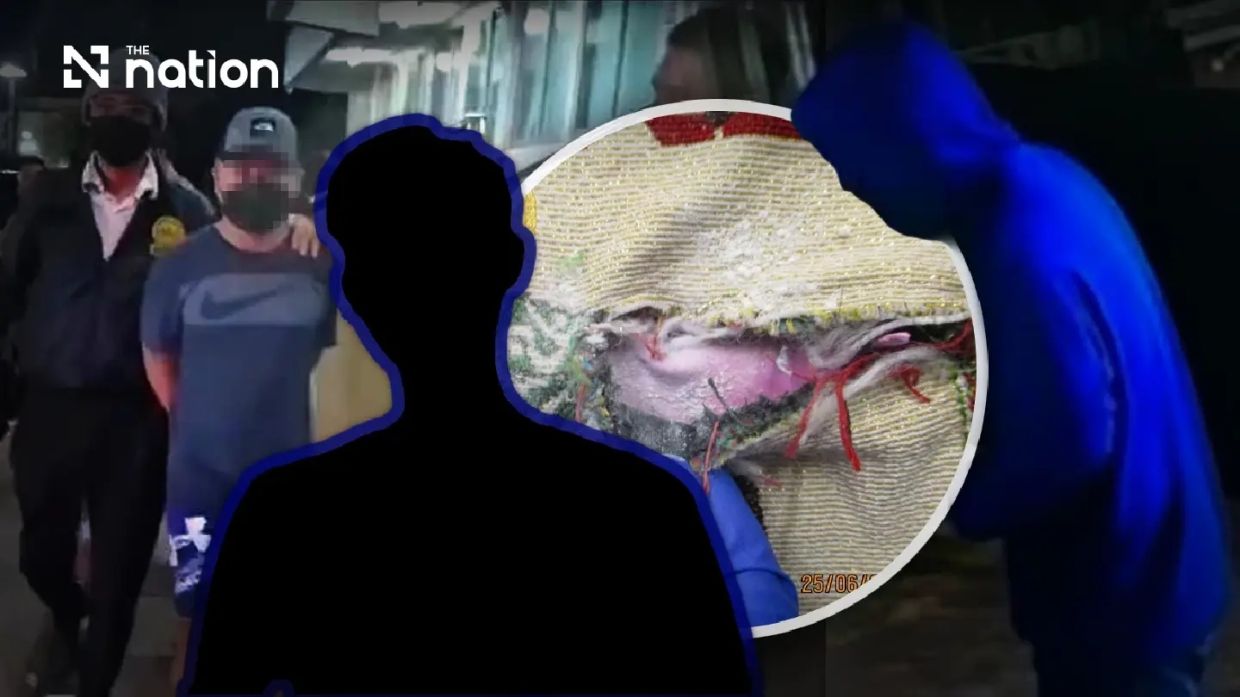
Thai police have widened their crackdown on an international heroin smuggling network after arresting Ekkawit, a suspected intermediary accused of coordinating drug deliveries across Southeast Asia. The overnight apprehension in Phayao marks a significant development in an investigation that has already ensnared multiple operatives in what authorities believe is a sophisticated, multi-layered trafficking organisation with reach extending to Australian shores.
Pol Maj Gen Theeradej Thamsuthee, deputy commissioner of the Metropolitan Police Bureau, confirmed the arrest and outlined the operational structure that investigators have begun to uncover. According to police allegations, Ekkawit served as a crucial link in the supply chain, acting as the physical intermediary who facilitated the movement of concealed narcotics from one handler to the next. The charge sheet suggests he collected heroin-laden packages and ensured their safe passage to subsequent couriers, creating the kind of compartmentalised structure that insulates higher-ranking organisers from direct law enforcement exposure.
The mechanics of this particular shipment reveal a disturbing level of operational sophistication. Ekkawit allegedly used the online alias "Rin Rin" to communicate with Uthai, a man previously arrested while wearing a blue hood, who then transferred the elephant-print fabric bag to Mina, an airline flight attendant. This three-stage handoff process—each participant isolated from full knowledge of the network—represents a deliberate attempt to ensure that the compromise of any single courier cannot unravel the entire operation. Authorities believe this compartmentalisation explains why even cooperative suspects provide only fragmented accounts of their involvement.
Investigators allege that Ekkawit purchased the elephant-print bag in Chiang Mai and coordinated its collection point in Chiang Kham district, Phayao. During initial questioning, he admitted to receiving THB100,000 for his role and claimed to have executed similar tasks two or three times previously, suggesting this was not a one-off arrangement but rather an established component of a recurring operation. His admission indicates that individuals filling this intermediary position may be employed repeatedly, raising concerns about how deeply the network has penetrated Phayao's economy and communities.
The investigation has centred heavily on a figure operating under the chat handle "Rose Rose," whom police identify as someone related to Ekkawit and similarly from Phayao province. This person allegedly coordinated the entire operation by instructing Ekkawit to procure the bag, then orchestrating its concealment, payment, and onward transmission. Rose Rose communicated exclusively through encrypted messaging, maintaining operational security while directing multiple associates. Police have gathered intelligence to identify the real person behind this profile, though the use of anonymous accounts and anonymous payment methods has complicated attribution efforts significantly.
The operational flow that investigators have mapped reveals a well-rehearsed routine. After Ekkawit obtained the bag, Rose Rose arranged for an associate to collect it and have heroin concealed inside—Ekkawit claimed this occurred in Laos, though police remain sceptical of this claim. Following concealment, Rose Rose would instruct Ekkawit to retrieve the package from a kilometre marker where both the bag and THB100,000 cash payment awaited collection. Ekkawit would then coordinate with Uthai, passing payment via cash deposit machine rather than direct transfer, obscuring the financial trail.
The targeting of flight attendants as drug carriers represents a deliberate strategic choice by the network. Mina's occupation provided access to international flights with reduced luggage scrutiny at certain security checkpoints, making her transportation of the concealed narcotics to Australia markedly less risky than conventional smuggling methods. This suggests the network actively recruits airline staff or identifies them opportunistically, potentially creating a vulnerability in aviation security protocols across Southeast Asian airlines. The choice of Australia as a destination indicates the network operates on a truly international scale, with distribution networks capable of absorbing substantial quantities across considerable distances.
Police doubts regarding the suspects' statements underscore the investigative challenges posed by such networks. Uthai initially claimed to have performed courier duties five or six times, yet investigators suspected his account was scripted. Further investigation revealed he had rented accommodation in Phra Nakhon Si Ayutthaya province for at least five or six months, suggesting substantially higher frequency of involvement than his admissions indicated. This pattern—where suspects minimise their participation and coordinators deny supervisory roles—creates prosecutorial obstacles that demand meticulous documentary and digital evidence gathering.
Crucially, police do not regard Rose Rose as the apex of this network despite the person's apparent operational authority. Investigators believe a more senior figure remains above Rose Rose in the hierarchy, orchestrating procurement, distribution network management, and likely controlling the financial flows. This assessment points to a tiered structure where insulation and compartmentalisation extend from street-level couriers through intermediate facilitators to a directing authority. Such architecture is precisely what enabled the network to achieve multiple successful shipments before the current investigation began.
The investigation will proceed to the Narcotics Suppression Bureau (NSB) with Ekkawit's transfer scheduled for Friday evening (July 10, 2026), where Pol Gen Samran Nuanma, deputy national police chief, was to conduct further questioning. This elevation to senior police leadership indicates the gravity with which authorities view the case and the potential for it to illuminate broader trafficking patterns. Investigators are simultaneously expanding their efforts to identify and apprehend remaining network members, particularly Rose Rose and the unidentified senior organiser.
For Malaysia and other Southeast Asian nations, this case exemplifies the regional dimension of drug trafficking challenges. Networks operating across Thailand, Laos, and Australia depend on loose border controls, cryptocurrency and cash payment systems that evade scrutiny, and the deliberate targeting of transport sector employees. The heroin destined for Australia likely transited through multiple countries before concealment, meaning regional cooperation and intelligence sharing remain essential for disrupting such operations. The network's apparent success in executing multiple runs before detection suggests that vigilance at every level—airport security, airline staff vetting, and customs examination—requires continuous enhancement across the region.

