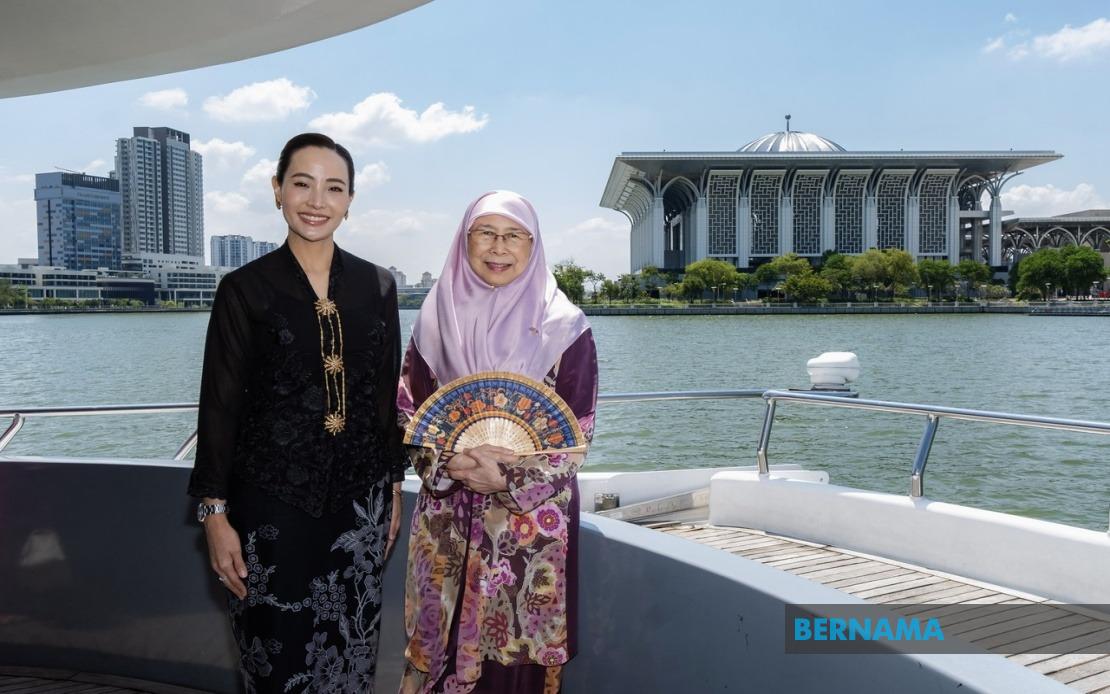
Thailand's First Lady Thananon Charnvirakul experienced Malaysia's administrative capital from the water on Thursday, embarking on a guided cruise across Tasik Putrajaya to appreciate the architectural and natural splendour of the purpose-built city. The leisurely 45-minute voyage offered visiting dignitaries sweeping vistas of the carefully planned township's distinctive skyline and carefully landscaped surroundings, showcasing the design ambitions behind Malaysia's federal administrative headquarters.
Thananon arrived at the lake's departure point shortly after noon, where she was warmly received by Datuk Seri Dr Wan Azizah Wan Ismail, the wife of Prime Minister Datuk Seri Anwar Ibrahim. The greeting set a cordial tone for the cultural and diplomatic engagement that characterised the occasion. Minister Hannah Yeoh, who holds the portfolio for the Prime Minister's Department overseeing Federal Territories, was also present to facilitate the visit and ensure protocol requirements were properly observed.
Throughout the waterborne tour, the Thai First Lady and her Malaysian counterpart engaged in substantive conversation while observing the urban landscape unfold along the water's edge. The informal setting of the lake cruise provided an opportunity for dialogue between the two women, reflecting the personal dimension of diplomatic engagement that often complements formal state functions. Such exchanges frequently serve to build rapport and mutual understanding between nations, transcending the more ceremonial aspects of official visits.
Thananon and Prime Minister Anutin Charnvirakul had arrived in Malaysia earlier that same day, touching down at Kuala Lumpur International Airport where they received a formal state welcome at the Bunga Raya Complex. The official ceremony, complete with traditional protocol, marked the beginning of their two-day visit to the country. The itinerary's deliberate inclusion of Putrajaya—as opposed to confining activities to Kuala Lumpur—demonstrated the significance Malaysia places on showcasing its governmental institutions and national planning achievements to important regional partners.
The visit represents Anutin's inaugural trip abroad in his capacity since his reappointment to the premiership in March 2026, making the Malaysia leg particularly symbolically weighted. The choice of Malaysia as a destination for this initial international engagement underscores Thailand's commitment to prioritising its relationship with its western neighbour. For Kuala Lumpur, hosting the newly reconfirmed Thai leader so promptly signals the importance it attaches to maintaining strong working relationships within Southeast Asia's political upper echelon.
Anwar's personal invitation to Anutin laid the foundation for this bilateral engagement, reflecting the substantive bond that exists between the Malaysian and Thai leadership. At a moment when regional stability and economic cooperation remain paramount concerns for Southeast Asian nations, such high-level visits serve multiple purposes—addressing immediate bilateral matters, signalling regional alignment, and demonstrating to the international community that the two countries remain anchored in their partnership. The two-day schedule allowed for both ceremonial elements and substantive policy discussions.
Malaysia and Thailand share longstanding historical, cultural, and economic linkages that span centuries, though contemporary relations are defined primarily by modern trade dynamics and security considerations. The stated purpose of Anutin's visit—to strengthen bilateral ties and expand cooperation across areas of shared interest—encompasses everything from border management and maritime issues to trade facilitation and people-to-people exchanges. Thailand remains a crucial partner in Malaysia's broader Southeast Asian strategy, and vice versa.
The lake cruise itself, while ostensibly a leisure activity, functioned as a subtle diplomatic statement about Malaysia's development achievements. Putrajaya, with its iconic landmarks and purposefully constructed landscape, represents Malaysia's vision of governance and modernity. Exposing visiting dignitaries to this carefully curated environment inevitably communicates something about Malaysian capabilities and ambitions. The landmarks visible from the lake—government buildings, bridges, mosques, and green spaces—tell a narrative of an aspiring nation state conscious of its global standing.
For Malaysian observers, such visits reinforce the notion that the country occupies a respected position within regional affairs. The protocol afforded to Thailand's leadership, and reciprocally the courtesy extended to Malaysian officials during visits to Bangkok, demonstrates the mutual respect underlying the relationship. Media coverage of such events, while often focusing on surface-level details, serves a domestic function in reinforcing narratives about national importance and diplomatic relevance.
Looking ahead, the substantive outcomes of Anutin's two-day visit would likely encompass agreements or understandings on specific cooperation mechanisms, whether in trade, security, or other domains. Such formalised results, however, often matter less than the opportunity the visit provides for senior officials to maintain the personal relationships that underpin effective bilateral engagement. In Southeast Asian diplomacy, personal connections between leaders frequently prove more durable and productive than institutional frameworks alone.
The timing of this visit, occurring in the middle of the Malaysian year, suggests it was planned well in advance and reflects both governments' commitment to managing their relationship proactively. For Thailand, the choice to move quickly into substantive regional diplomacy following Anutin's reappointment indicates his government's interest in stabilising Thailand's external relationships and reassuring neighbours about Bangkok's continued engagement. For Malaysia, the enthusiastic reception provided clear confirmation that it values its western neighbour and considers the relationship worthy of high-level attention.

