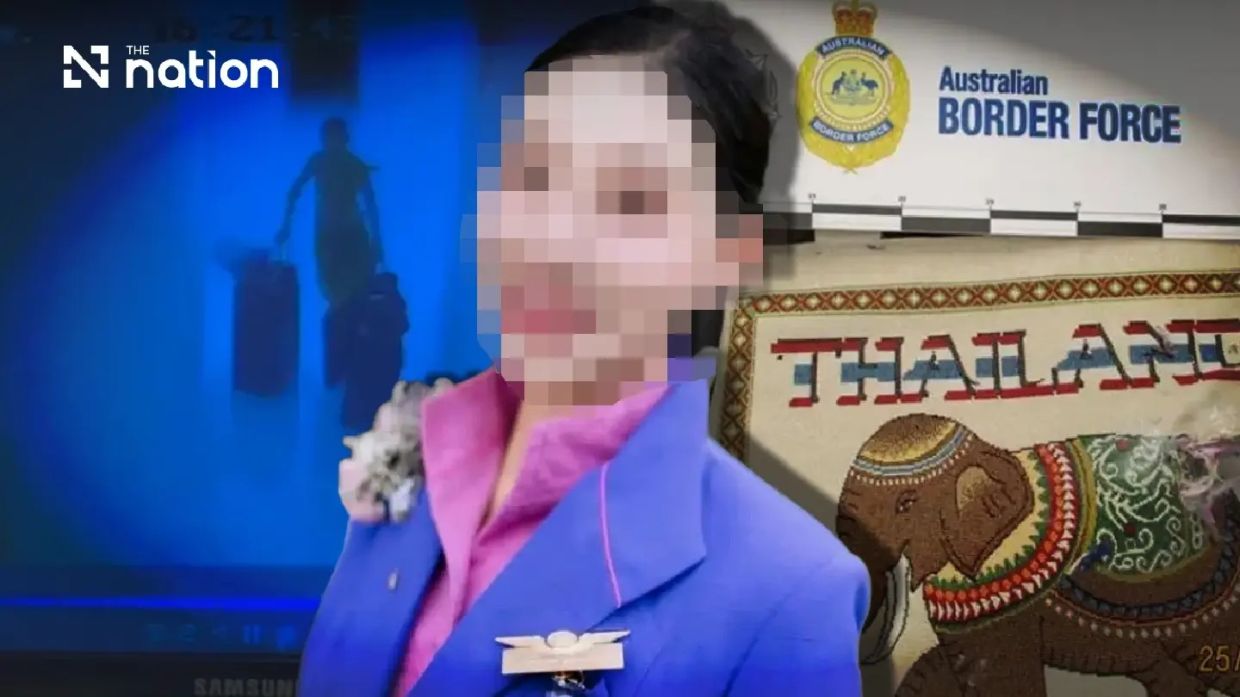
Thai authorities are pursuing a widening investigation into an international drug-smuggling network following the detention of a Thai flight attendant who was discovered carrying 900 grammes of heroin at Melbourne Airport in Australia. The Office of the Narcotics Control Board, collaborating with security agencies across Thailand and Australian law enforcement, is treating the case as evidence of a sprawling transnational operation with roots in the notorious Golden Triangle region. The woman remains in custody pending legal proceedings but has not yet been formally charged, according to Areepak Ngernbamroong, deputy secretary-general of the ONCB, who outlined the investigation's scope and findings during a briefing.
The investigation has uncovered a sophisticated criminal apparatus that appears to deliberately target airline personnel and frequent international travellers. According to Thai police, members of the network created fake social media profiles and sent bulk messages to flight attendants, offering payment in exchange for carrying packages across borders. This deceptive recruitment method represents a deliberate strategy to exploit workers' trust and familiarity with international travel protocols. The operation extends beyond simple courier work, with evidence suggesting coordination across multiple jurisdictions and involvement of individuals from at least three countries, including Thailand, Laos, and Australia.
Three to four related arrests in Bangkok, which yielded more than 26 kilogrammes of heroin, are now being handled by Thailand's Department of Special Investigation because the scope and structure indicate a large-scale organised crime enterprise rather than isolated criminal activity. The DSI's involvement signals official recognition that the network operates systematically across borders and involves multiple layers of participants. These Bangkok-based arrests stemmed from investigative leads that showed a delivery rider receiving heroin from a foreign national, alongside the involvement of a Lao couple. The network employs two distinct distribution methods: posting packages through postal services and conducting direct hand-to-hand transfers, suggesting operational flexibility and awareness of enforcement vulnerabilities.
A figure identified only as "Dear" has emerged as a central character in the Australian end of the operation. This Thai national, who has resided in Australia for approximately ten years under circumstances still being clarified, appears to serve as the primary receiver of shipments sent through the flight attendant scheme. Investigators have established that Dear is not a first-time participant; evidence suggests this person has acted as the recipient in multiple similar incidents previously. Thai authorities have compiled several pieces of evidence linking the detained flight attendant's case directly to Dear and have transmitted this material to the Australian Federal Police for their investigation into the network's larger structure and final recipients.
The payment structure surrounding the alleged arrangement remains inconsistent and unclear, complicating assessments of the flight attendant's culpability. Australian police discovered a reference to 8,800 baht on a mobile phone, yet Thai investigators have separately uncovered reports of two transfers of 1,700 baht each, supposedly made upon receipt of goods and when an airline ticket became available. However, examination of the flight attendant's bank records has not confirmed these transactions, and the account balance suggests limited financial resources. This discrepancy raises questions about whether the flight attendant fully understood the arrangement or whether incomplete information regarding compensation was deliberately withheld from her.
The account provided by the delivery rider who transported the packages adds another dimension to assessments of deliberate conspiracy versus exploitation. The rider reported having conducted similar deliveries three or four times previously but stated this was the first delivery to the flight attendant in question. This testimony potentially supports a narrative of deception rather than premeditation, as the targeted individual may have been selected for a single operation without knowledge of the broader pattern. The boyfriend's statement, indicating that the contents of elephant-patterned bags appeared empty when examined before packing, further suggests the flight attendant may have been manipulated into transporting contraband without full awareness of what was occurring.
Thailand's geographical position as a transit hub for narcotics originating in the Golden Triangle has long posed enforcement challenges, and the flight attendant case illuminates how criminal networks are adapting strategies in response to intensified border security. Historically, major smuggling attempts flowed through Thailand's northern border regions. However, as Thai authorities strengthened interdiction efforts in high-risk northern areas, trafficking organisations shifted their operational geography toward north-eastern routes utilising crossings into Laos. The Mekong River border between Thailand and Laos presents particularly difficult enforcement scenarios in provinces including Nakhon Phanom, Bueng Kan, Loei, and Nong Khai, where the river's narrowness paradoxically creates complications—the lengthy border makes comprehensive surveillance impractical, allowing some narcotics to penetrate Thai territory.
Laotian involvement in the supply chain appears methodical rather than chaotic. Drugs originating from Golden Triangle syndicates are typically packaged before being passed sequentially between criminal groups until reaching storage points within Thailand. This relay structure insulates individual participants from knowledge of the complete operation and complicates prosecutions by fragmenting criminal responsibility. The flight attendant case may represent merely a single operational line within a vastly larger organisation connected to Golden Triangle production and distribution networks. Thai and Laotian authorities maintain ongoing coordination and intelligence-sharing regarding drug trafficking, though the Mekong corridor's geography continues enabling contraband movement.
Thailand has formally transmitted evidence and documentation to the Australian Federal Police, the Thai embassy in Australia, and the Thai consulate to support the flight attendant's legal defence. This diplomatic cooperation reflects recognition that the accused individual may be a victim of a sophisticated scam rather than a willing participant in premeditated smuggling. Authorities acknowledge substantial factual gaps preventing definitive conclusions about her level of awareness or intentional involvement. The DSI and ONCB are continuing to examine connections between the Bangkok arrests and the Melbourne case, recognising that comprehensive mapping of the criminal network requires methodical evidence synthesis across jurisdictions.
The case exposes vulnerabilities specific to globalised labour in aviation and international travel industries, where workers' mobility and frequent border crossing create exploitation opportunities. Criminal networks have evidently recognised that transporting contraband via individuals with legitimate reasons to travel internationally reduces detection risk compared to conventional smuggling methods. For Malaysia and other regional nations with significant aviation sectors, the case underscores the need for enhanced awareness among airline personnel regarding recruitment attempts and the risks of accepting unofficial payment offers. This incident will likely prompt regional aviation authorities to strengthen worker education and reporting mechanisms, as airlines become secondary battlegrounds in the war against transnational drug trafficking.

