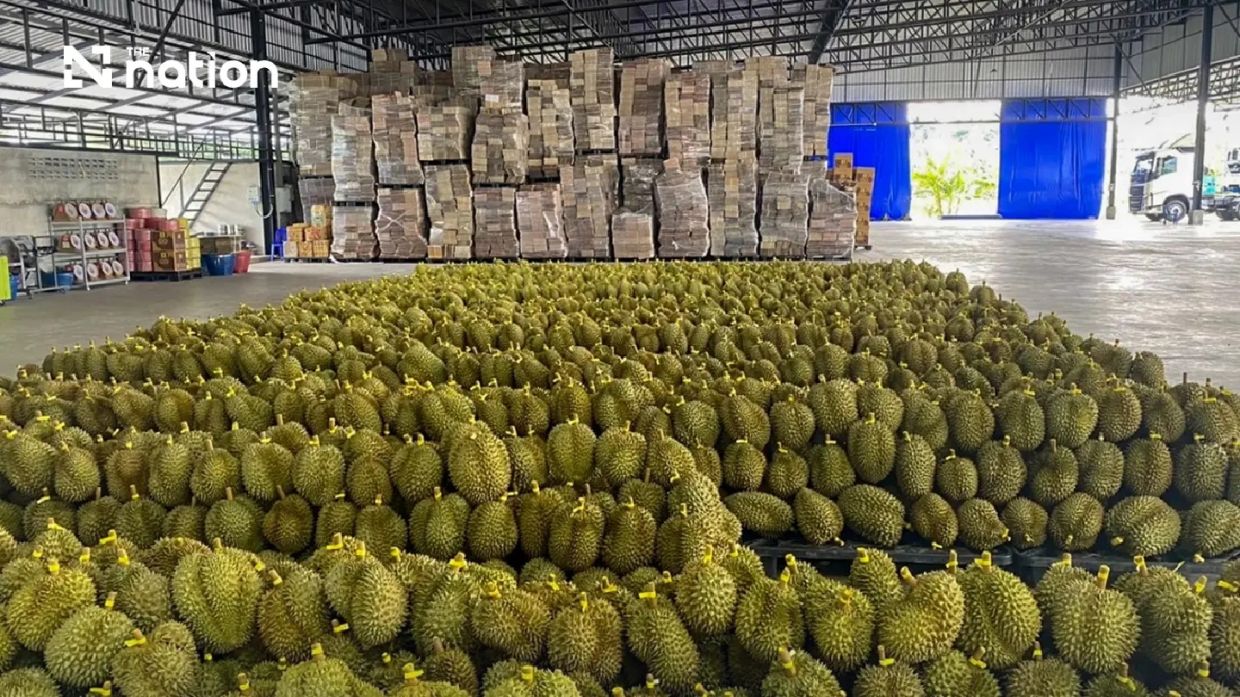
Thailand's fresh durian exports to China have achieved a historic milestone, surpassing THB100 billion in value during the first six months of 2026. The shipments encompassed more than 870,000 tonnes dispatched across 53,665 containers, marking a significant breakthrough for the kingdom's largest tropical fruit export market and setting an optimistic trajectory for the year ahead.
The achievement reflects a fundamental restructuring of how Thailand manages its durian supply chain, moving away from reactive problem-solving towards comprehensive, systematic quality assurance. Rather than addressing issues sporadically as they arise, the Ministry of Agriculture and Cooperatives has embedded oversight mechanisms across every stage of production, processing, and export. This architectural shift has proven instrumental in restoring purchasing confidence among Chinese buyers, whose concerns about contamination, immaturity, and false origin claims had previously constrained trade flows.
Central to this transformation is the enforcement of what officials term the "Four Nos": the prohibition of immature durians, elimination of worm infestation, prevention of false origin claims, and removal of Basic Yellow 2, a synthetic dye that had triggered repeated rejections from Chinese customs authorities. These straightforward yet rigorous standards form the bedrock of quality assurance, but their implementation required coordination across dozens of government agencies, private operators, and farming communities. The complementary four-layer PLUS screening mechanism adds an additional safeguard by identifying plant pests and other hazards before shipment, while science-based risk management protocols enable officials to make inspection decisions grounded in evidence rather than suspicion.
Suriya Jungrungreangkit, the Minister of Agriculture and Cooperatives, has positioned these reforms as foundational to Thailand's agricultural future. During his first 90 days in office, he initiated an overhaul that streamlined inspection procedures, paradoxically reducing bureaucratic burden on exporters whilst strengthening oversight quality. By delegating the Department of Agriculture as the coordinating agency and linking work with the National Bureau of Agricultural Commodity and Food Standards, the Customs Department, and Chinese regulatory bodies, the government created an integrated ecosystem where information flows seamlessly from farm to port to foreign customer.
The traceability dimension proves especially crucial for Malaysian and regional exporters watching Thailand's approach. By linking production records, packing-house data, and laboratory test results directly to electronic phytosanitary certificates, Thailand has eliminated gaps where contamination or fraud could hide. This end-to-end transparency not only satisfies Chinese sanitary requirements but demonstrates to buyers worldwide that each consignment can be verified at every stage. For competing nations in Southeast Asia, the model illustrates how technology and institutional coordination can transform export competitiveness without simply lowering standards.
The underlying tensions driving these changes deserve emphasis. China had previously flagged multiple concerns: cadmium contamination, Basic Yellow 2 residues, immature fruit harvested prematurely to meet quotas, and seed borer damage that weakened consumer trust. Each incident strained the commercial relationship and exposed vulnerabilities in Thailand's reputation as a quality supplier. By systematically addressing these specific grievances rather than issuing generic assurances, Thai officials rebuilt confidence through demonstrated action rather than diplomatic rhetoric. This pragmatic approach has obvious relevance for other agricultural exporters in the region facing similar technical or reputational challenges with major trading partners.
The export figures themselves warrant closer inspection. Over 872,000 tonnes represents not merely a volume milestone but reflects sustained demand from China's growing middle class, whose appetite for premium fruits has expanded dramatically as incomes rise. Thailand's share of this lucrative market directly influences rural incomes across the country, supporting millions of farming families who depend on durian cultivation. The THB100 billion threshold crossed in just six months signals momentum towards the government's full-year target of THB150 billion, a projection that assumes continued Chinese market appetite and the absence of major disruptions.
Rapibhat Chandarasrivongs, the Department of Agriculture's Director-General, characterised the transformation as evidence of the department evolving into a "Smart Regulator": an institution that harnesses science, technology, and sophisticated risk assessment to supervise quality rather than relying on bureaucratic gatekeeping. This conceptual shift carries implications beyond durians. As Thailand repositions itself to address 21st-century trade requirements—traceability, sustainability, food safety, digital documentation—the durian model becomes a template for managing other agricultural exports including mangosteen, mango, and rubber. For Malaysian agricultural authorities observing these developments, the precedent suggests that investing in integrated digital systems and cross-agency coordination yields tangible competitive advantages.
The sustainability dimension of Thailand's strategy also merits recognition. By incentivising quality over sheer volume, the government supports farmer income stability and reduces the pressure to rush unripe fruit to market. Consumers receive better products, operators can compete on reputation rather than price-cutting, and exporters maintain access to premium market segments. This virtuous cycle contrasts with a race-to-the-bottom approach that maximises short-term volumes whilst risking long-term market access through recurring quality failures or contamination scandals.
Looking ahead, Thailand's durian success in 2026 carries significance for regional trade dynamics. As China increasingly emphasises agricultural imports that meet rigorous safety and traceability standards, Southeast Asian exporters face a common imperative to upgrade their institutional capacity. Thailand's willingness to invest in systematic infrastructure rather than pursue short-term export maximisation demonstrates that quality-driven strategies are economically viable. The THB100 billion milestone represents not just a number but validation that strategic governance reform, coordinated across multiple agencies and private partners, can unlock export growth whilst strengthening consumer confidence.
Minister Suriya's framing of the achievement underscores a broader vision: that agricultural competitiveness in the modern global economy hinges on transparency, standards, and traceability rather than scale alone. As Thailand pursues the full-year target of THB150 billion in durian exports, the structural reforms now embedded across the supply chain position the country to weather future challenges—whether regulatory tightening in China, competition from other suppliers, or new food safety concerns. For Malaysia and other regional economies with significant agricultural sectors, Thailand's experience offers both an instructive blueprint and a competitive benchmark.

