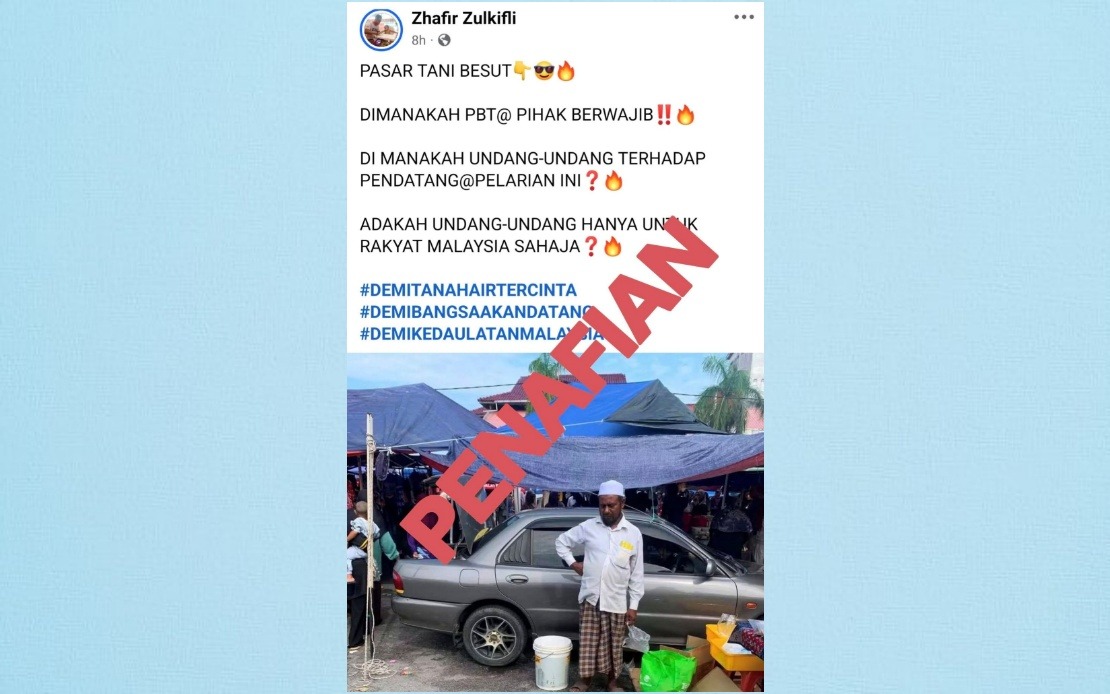
The Terengganu branch of the Federal Agricultural Marketing Authority (FAMA) has moved to dispel spreading rumours on social media that questioned the nationality of traders operating at farmers' markets under its purview. The agency issued a formal statement denying allegations that non-Malaysian citizens were permitted to participate as vendors in its managed market operations, following the emergence of a viral Facebook post that drew public attention to the matter.
According to FAMA's clarification, the incident captured in the widely-shared social media post did not involve any of the farmers' markets directly supervised by the Terengganu office. The post, which surfaced yesterday and garnered significant online engagement, showed what observers believed to be a foreign national selling vegetables at a morning market location in Besut district. However, FAMA explained that this particular market does not fall under the agency's direct management or oversight.
The authority maintained precise operational details regarding its officially-managed facilities within the Besut area. FAMA stated that only two farmers' markets in the district operate under its supervision and adherence to its regulatory standards. These establishments include the Jerteh Farmers' Market, which operates on a weekly schedule every Thursday morning from 7 am until 1 pm, and the Alor Lintang Farmers' Market, which similarly functions on Saturdays during the same morning hours, running from 7 am to 1 pm.
The incident underscores growing scrutiny of market operations in Malaysia, particularly regarding compliance with regulations that typically reserve vendor participation for Malaysian citizens. Such concerns reflect broader anxieties about local trader protection and market access, issues that resonate across multiple states in Malaysia where informal trading remains economically significant for small-scale agricultural producers and vendors.
FAMA's response highlights the importance of distinguishing between regulated and unregulated market spaces. While the agency manages specific farmers' market facilities with defined operating hours and vendor criteria, numerous morning markets and wet markets operate independently across Terengganu without direct FAMA oversight. This distinction carries practical implications for enforcement of trading rules and maintenance of agreed standards within supervised operations.
The clarification comes amid increasing social media activity regarding market trading practices, with residents and observers sharing observations about vendor demographics and compliance with citizenship requirements. The viral nature of such posts demonstrates how quickly concerns can spread online and potentially affect public perception of regulatory agencies' effectiveness, regardless of factual accuracy. FAMA's proactive statement represents an effort to manage this reputational dimension while redirecting attention to its actual operational scope.
For vendors seeking formal market participation in Terengganu, FAMA-managed facilities offer structured environments with established hours and presumably vetted trader rosters. The distinction between these regulated spaces and the informal morning markets where the disputed incident occurred suggests that concerned residents might consider reporting suspected violations to the appropriate municipal or district authorities responsible for those particular venues.
The episode also touches on broader challenges faced by agricultural marketing authorities across Malaysia in maintaining consistent standards across diverse trading landscapes. FAMA's role encompasses supporting local farmers and ensuring orderly markets, objectives that can compete with practical enforcement realities in areas where informal trading networks operate alongside official structures. The agency's intervention demonstrates its commitment to clarifying its specific responsibilities and maintaining credibility with the public and stakeholders.
Local authorities in Besut and district-level administrators would logically bear responsibility for overseeing the morning market where the incident occurred, should they wish to investigate the circumstances and verify compliance with any applicable trading regulations. The administrative separation between FAMA's supervised markets and other trading venues creates corresponding divisions in accountability and enforcement authority, a nuance that becomes significant when concerns emerge about trading conduct.
Moving forward, the incident may prompt discussions about clearer signage or public awareness regarding which markets operate under FAMA supervision versus independent operation. Such transparency could help residents understand which facilities operate under which regulatory frameworks and where to direct inquiries or complaints regarding suspected non-compliance with trading rules. For FAMA's part, the clarification reaffirms its commitment to maintaining standards at the facilities under its direct management while appropriately deferring matters beyond its jurisdictional scope to the responsible authorities.

