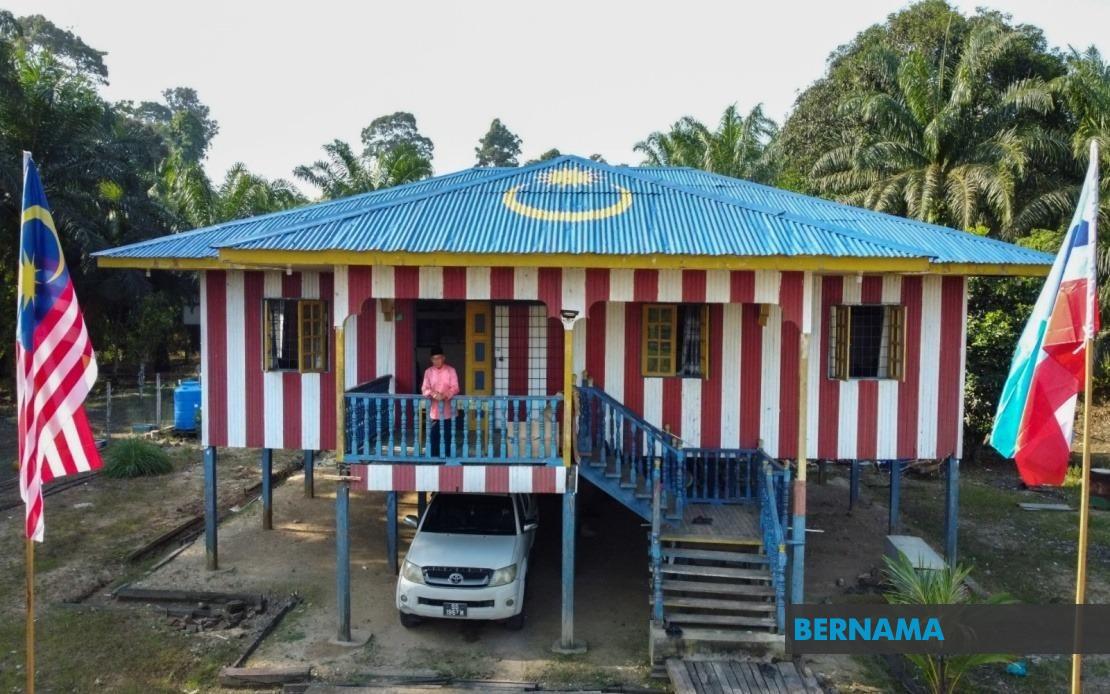
On a quiet street at Batu 15 in Sandakan, Sabah, a wooden house stands apart from its neighbours, its walls blazing in bold red and white stripes while a distinctive deep-blue roof is crowned with a golden-yellow crescent moon and 14-pointed star. This is Teratak Gemilang, the home of 68-year-old entrepreneur Mohd Halikin Angga, which has evolved over more than two decades into a powerful statement of national devotion that stops passersby in their tracks, especially during Malaysia's annual commemoration periods.
Mohd Halikin's journey towards creating this patriotic landmark began in 2004, driven by a personal frustration that many Malaysians might recognise. He observed how national flags, once proudly displayed during National Day festivities, would be hastily removed once the celebrations ended. Worse still, he witnessed flags discarded on roadsides after being blown away by winds or falling from vehicles. These moments stirred something profound within him, prompting him to conceive a permanent manifestation of patriotism that would endure throughout the year. His wooden home became the perfect canvas for this vision.
Beyond its striking exterior, Teratak Gemilang functions as a working tribute to Malaysia's political heritage and constitutional framework. The interior houses a carefully curated mini gallery that welcomes visitors into a space dedicated to the nation's leadership. The living room displays official portraits of the Yang di-Pertuan Agong, the Yang di-Pertua Negeri Sabah, and a complete historical succession of Malaysian Prime Ministers, beginning with Tunku Abdul Rahman Putra Al-Haj and extending to the incumbent office holder. This chronological arrangement serves as an informal educational space, allowing visitors to contemplate the continuity of Malaysia's governance and the diverse individuals who have steered the nation's course.
Among Mohd Halikin's most prized possessions is a historic photograph documenting a pivotal moment in Malaysian history: Tunku Abdul Rahman meeting with 20 North Borneo leaders in 1961 to discuss the proposed formation of Malaysia. The owner encountered this photograph serendipitously during a flight to perform Umrah in 2005, discovering it in a newspaper while airborne. He requested permission from the cabin crew to preserve and frame the image, recognising its historical significance. This photograph now occupies a place of honour within Teratak Gemilang, serving as a tangible connection between Sabah's specific role in Malaysia's formation and the broader national narrative.
Mohd Halikin's patriotism extends remarkably into his personal family sphere, manifesting in his deliberate choices regarding his children's names. Among his seven children, three bear names directly honouring prominent national figures and statesmen. His eldest child was named after Tun Dr Mahathir Mohamad, the fourth prime minister; his second child after Tun Abdullah Ahmad Badawi, the fifth prime minister; and his sixth child, Nur Zahirah, was named after the 13th Raja Permaisuri Agong. For Mohd Halikin, naming represents more than mere identification—it constitutes a conscious investment in ensuring that future generations maintain awareness of the contributions made by Malaysia's past leaders and remain connected to their nation's foundational figures.
The house has become an unexpected tourist destination, particularly during National Month when Malaysian patriotic sentiment peaks. Visitors frequently stop to photograph Teratak Gemilang, drawn by its distinctive appearance and the obvious sincerity of its owner's commitment. For residents and tourists alike, the property has transformed into a physical embodiment of national pride that requires no official designation or government sponsorship—it stands as grassroots patriotism rendered in paint and permanent architectural choices.
What distinguishes Mohd Halikin's project from mere decorative enthusiasm is the deliberate educational and inspirational component woven throughout. The personal sacrifices he has made—investing his own resources and spending considerable time maintaining the property—reflect a belief that patriotism demands more than passive respect for national symbols. His willingness to sustain the appearance and purpose of Teratak Gemilang over two decades suggests a conviction that visible expressions of national love can influence community sentiment and reinforce collective identity.
The significance of Teratak Gemilang becomes particularly pronounced when considered within Sabah's unique position within the Malaysian federation. Sabah, along with Sarawak, joined Malaya and Singapore to form Malaysia in 1963, making Sabah's relationship with the broader nation somewhat distinct from peninsular states. Mohd Halikin's deliberate inclusion of the 1961 photograph documenting North Borneo's participation in Malaysia's formation underscores his awareness of this historical specificity. His project implicitly argues that Sabah's patriotic contribution remains integral to the national story, deserving commemoration and celebration.
Looking forward, Mohd Halikin has expressed his determination to maintain Teratak Gemilang's patriotic appearance indefinitely, ensuring that subsequent generations will encounter a lasting physical reminder of national devotion. He particularly hopes that his home will contribute meaningfully to strengthening unity among Sabah's multiracial community, viewing the house as a unifying symbol rather than an exclusionary statement. This perspective aligns with Malaysia's constitutional commitment to pluralism and interfaith harmony, suggesting that patriotism need not be narrow or divisive but can serve as common ground across ethnic and religious boundaries.
Mohd Halikin's vision extends specifically to the upcoming Malaysia Day 2026 (HKHM) celebrations, when Sabah will commemorate the 63rd anniversary of Malaysian formation. He envisions Teratak Gemilang playing a role in these festivities, providing a focal point for reflection on the state's integration into the federation and the enduring importance of national cohesion. By maintaining his patriotic statement through these milestone years, he contributes to an informal but visible culture of civic remembrance that complements official state ceremonies.
The broader significance of Teratak Gemilang lies in its demonstration that expressions of national identity need not emanate exclusively from government institutions or formal organisations. Individual citizens acting from genuine conviction can shape public consciousness and cultural sentiment. Mohd Halikin's project challenges the notion that patriotism represents an abstract concept confined to official rhetoric or ceremonial occasions. Instead, he has rendered it tangible, accessible, and persistent—a statement that will continue to greet visitors at Batu 15, Jalan Labuk in Sandakan for years to come, embodying one person's profound love for his country through the simple yet powerful act of painting his home in the colours that represent Malaysia to the world.

