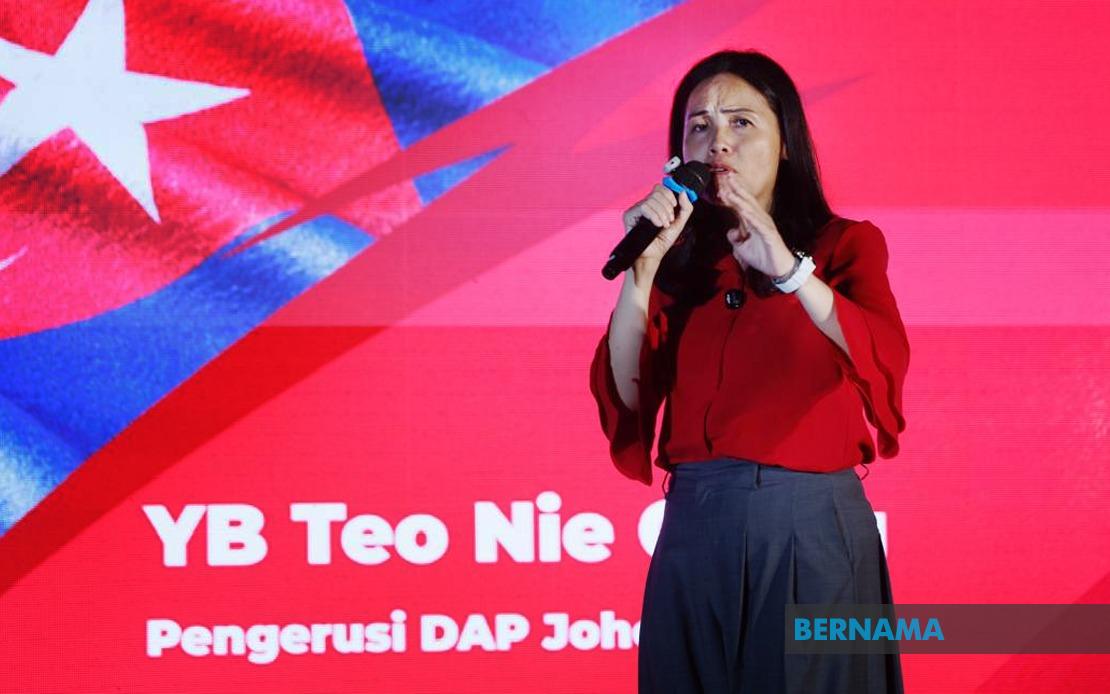
Johor DAP chairman Teo Nie Ching has publicly challenged the rationale behind the Johor state government's plan to establish positions for appointed state assemblymen, raising pointed questions about which candidates would ultimately fill such roles. Speaking at a Pakatan Harapan rally in Paloh on Monday evening, Teo—who also serves as National DAP Wanita chairman and Deputy Communications Minister—expressed deep reservations about how the mechanism might affect public confidence in the state's democratic institutions.
The mechanism in question gained legal standing in May when the Johor State Legislative Assembly passed amendments permitting the appointment of up to five additional assemblymen, a move the government framed as strengthening legislative composition and capacity. Teo's intervention signals growing tension within opposition circles over whether such appointments represent a legitimate governance tool or a potential avenue for political manipulation that bypasses electoral scrutiny.
At the heart of Teo's concern lies a fundamental democratic principle: elected representatives derive legitimacy from voters who judge their credentials, policies, and character through the ballot. Appointed members, by contrast, undergo no such evaluation. She pointedly asked state government officials to clarify their intentions, noting that transparency and public accountability depend on voters understanding who would be selected and why. Without clear justification, she argued, the arrangement risks feeding public scepticism about the administration's true motives.
Teo's timing and framing proved deliberately provocative. She questioned whether appointed positions might go to defeated election candidates, implying that unsuccessful politicians could circumvent electoral rejection by winning appointment instead. More broadly, she hinted at coalition dynamics within the Johor government, obliquely referencing PAS's electoral support in the state and suggesting that appointment decisions might reward particular political allies rather than serving broader public interest. Such inference, though unspoken directly, reflected underlying tensions within Malaysia's Unity Government coalition.
Despite her criticism of the appointment plan, Teo pivoted to defending the broader performance of the Unity Government, which formed nationally following the 2022 general election. She acknowledged imperfection while emphasizing incremental but meaningful policy achievements across education and social welfare portfolios. Her message attempted to position DAP and its coalition partners as agents of systemic improvement, attempting to offset concerns that ruling coalitions had become entrenched or complacent.
Among specific accomplishments Teo highlighted were guarantees ensuring all SPM students achieving ten A grades gain matriculation placement regardless of socioeconomic background, a reform addressing long-standing equity concerns within Malaysia's tertiary education pipeline. She also pointed to expanded access to public universities for holders of the Unified Examination Certificate, a development meaningful for students from vernacular Chinese schools who previously faced constrained pathways into premier institutions. These measures reflect attempts to broaden educational opportunity across Malaysia's diverse demographic landscape.
Funding increases for Chinese independent schools further illustrated Teo's argument. Allocations rose to RM20.16 million in the current budget cycle compared with RM12 million in 2019, representing substantial real growth that directly affects school operations and student facilities. For Chinese-educated communities in Johor and elsewhere, such budgetary commitments carry symbolic and practical significance, signalling government willingness to invest in educational sectors historically viewed with indifference or subtle discrimination.
Teo positioned these reforms within a longer-term strategic narrative, describing democratic progress as a marathon rather than a sprint. Her framing suggested that Malaysia's governance improvements unfold gradually through institutional channels rather than dramatic shifts, requiring sustained public engagement and electoral support across multiple election cycles. This messaging targeted voters potentially discouraged by the pace of change or frustrated by governance challenges persisting despite coalition transitions.
The Johor state election scheduled for Saturday represents the first substantial electoral test for the state government's tenure and provides voters opportunity to evaluate the administration's performance across its policy portfolio. Some 2.7 million registered voters are expected to participate in balloting to elect 56 state representatives, with results carrying implications beyond Johor for Malaysia's overall political balance and the viability of the Unity Government framework.
Teo's intervention also reflected broader DAP strategy within the Johor campaign, emphasizing the party's role as constructive critic within the ruling coalition rather than adversary. By acknowledging achievements while questioning specific decisions like the appointed assemblyman mechanism, DAP positioned itself as stakeholder committed to democratic integrity and accountable governance rather than purely partisan interest.
The appointed assemblymen issue, though potentially affecting only five of fifty-six seats, touches on fundamental questions about representation and legitimacy that resonate across Malaysia's political landscape. International observers and democratic advocates frequently scrutinize mechanisms permitting unelected participation in legislatures, viewing them as potential vectors for democratic backsliding. Teo's public challenge, therefore, resonated beyond Johor's immediate context, engaging with evolving standards around democratic accountability in Southeast Asian governance.
As Johor voters prepare to cast ballots, Teo's remarks underscored persistent tensions between the ruling coalition's operational continuity and opposition concerns about institutional integrity. Whether the appointed assemblymen mechanism becomes a model for other states or remains confined to Johor may partly depend on how voters respond Saturday and whether the arrangement's implementation generates public controversy or proceeds uneventfully.

