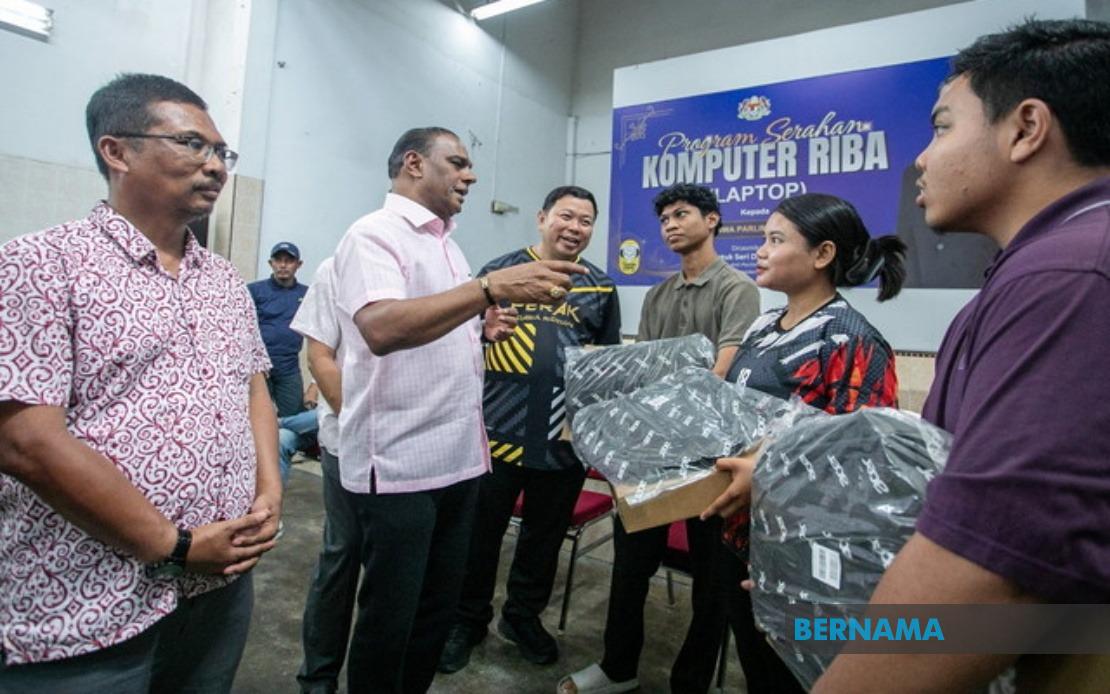
Datuk Seri M. Saravanan, the Member of Parliament for Tapah, presided over the distribution of laptops to 45 university students from B40 households on Friday, marking another milestone in a constituency-wide initiative that has supported more than 1,000 students since launching in 2008. The programme reflects growing recognition among Malaysian policymakers that digital access has shifted from luxury to necessity, particularly for learners navigating increasingly technology-dependent education systems across peninsular Malaysia's Perak region.
The cohort of recipients this year encompassed students across multiple qualification levels, demonstrating the breadth of the scheme's reach. Thirty students pursuing diplomas formed the largest group, followed by five certificate-level enrollees, four matriculation candidates, and three degree-track learners. The remaining three recipients came from the SPM, STPM, and foundation programme pathways respectively, illustrating the programme's commitment to supporting learners across the entire spectrum of post-secondary education.
Saravanan emphasised during the handover ceremony at Mahatma Gandhi Hall that laptop provision has evolved beyond peripheral enhancement into fundamental educational infrastructure. As universities and colleges increasingly integrate online learning modules, digital submission systems, and cloud-based collaboration tools into curricula, students without personal computing devices face compounding disadvantage. For B40 families—those earning below RM4,360 monthly according to government classifications—laptop purchases represent a substantial financial obligation that can deter educational aspiration or force impossible household budget trade-offs.
The selection mechanism underpinning the distribution reflects institutional care in ensuring resources reach genuinely disadvantaged households. A dedicated assessment committee reviews applications whilst consulting both the District Education Office and community leaders within Tapah, cross-referencing claims against local knowledge to identify households facing genuine financial constraints. This layered verification approach protects programme integrity whilst building community ownership of distributional fairness—a critical consideration in rural parliamentary constituencies where personalised networks influence political perception.
Beyond immediate laptop provision, Saravanan highlighted the broader educational transformation occurring within Tapah's Orang Asli communities. Over two decades, indigenous youth from the constituency have increasingly pursued tertiary education and entered professional careers including medicine and law. This generational shift carries profound significance for Malaysia's indigenous communities historically marginalised from formal educational pathways. When young Orang Asli professionals establish themselves in urban professional environments, they generate demonstration effects that inspire subsequent cohorts from their own communities to pursue tertiary qualification, thereby disrupting intergenerational cycles of educational undersupply.
Aidil Iskandar Ramlan, an 18-year-old recipient preparing to commence Diploma in Public Administration studies at UiTM Raub, embodied the programme's intended beneficiary profile. His father works as a secondary school security guard whilst his mother manages household duties—occupations generating insufficient income to accommodate non-essential technology expenditure. The laptop alleviates his family's financial burden substantially, permitting him to access assignment submission systems, participate in online forums, and utilise educational software that UiTM increasingly mandates. Without the device, Aidil would either depend on institutional computer labs with limited availability or burden his family with significant debt.
Similarly, 19-year-old Ea Endry Iana Aslan anticipated deploying her allocated device for Early Childhood Education studies at FELCRA College. She characterised the laptop as transformative for household finances, removing pressure from parents already managing limited resources. Her gratitude toward Saravanan reflected a common sentiment among programme recipients—recognition that political actors at parliamentary level can meaningfully intervene in educational access through constituency-based redistribution initiatives.
The sixteen-year continuity of Tapah's laptop programme distinguishes it within Malaysian parliamentary constituency service. Most MP-initiated welfare schemes lack such longevity, either terminating through successor MP disinterest or budget reallocation. Saravanan's sustained commitment suggests institutional embedding within constituency administration, possibly involving dedicated annual budget allocations or partnerships with educational institutions and corporate sponsors. Such durability enables cumulative impact; 1,000-plus beneficiaries over sixteen years represents meaningful educational infrastructure investment at the constituency level.
However, the initiative simultaneously illustrates structural limitations within Malaysia's approach to digital educational equity. Whilst constituency-level laptop distribution addresses immediate access barriers, it cannot substitute for systemic reform ensuring all B40 households receive comparable support irrespective of parliamentary representation. A comprehensive national digital education policy would establish standardised, means-tested laptop provision across all constituencies, ensuring equitable access regardless of MP political initiative or personal capacity for fundraising.
The programme's persistence also reflects underlying economic realities constraining B40 household purchasing power in modern Malaysia. Despite economic development over the past two decades, income distribution has widened, and tertiary education costs have escalated faster than wage growth for lower-income households. Students from affluent backgrounds access technology through parental provision; students from B40 families depend on institutional or philanthropic support. This structural inequality shapes educational outcomes measurably, as research consistently demonstrates that device access correlates with academic performance, online engagement, and employment readiness among tertiary learners.
Looking forward, the Tapah initiative suggests emerging political recognition that educational equity cannot rest solely upon institutional provision within campuses. As universities consolidate online delivery mechanisms, students require personal computing capacity. By extending laptop provision to pre-university selection phase, Saravanan's programme acknowledges that digital preparation begins before formal enrolment. Students already possessing devices can explore online learning platforms, develop digital literacy, and familiarise themselves with educational software prior to commencing formal study—advantages that compound throughout tertiary education.
The distribution ceremony ultimately reflected convergence between immediate need satisfaction and longer-term development investment. Forty-five students received practical tools enabling educational participation; their families experienced direct financial relief; their communities witnessed indigenous youth educational advancement. Simultaneously, the initiative demonstrated parliamentary service beyond abstract representation, manifesting in tangible resource transfers that shape educational trajectories. Within Malaysia's federalised education system, such constituency-level initiatives increasingly represent the frontline of digital equity intervention, filling spaces where centralised policy has proven insufficient.

