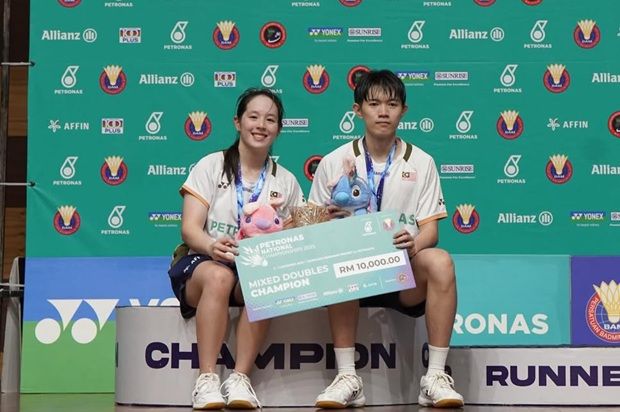
Malaysian mixed doubles shuttler Clarissa San is poised to take on one of badminton's most demanding stages when she competes at the Japan Open next week, paired with Chen Tang Jie in what represents the biggest tournament opportunity of her career. The 20-year-old's entry into the prestigious BWF World Tour event comes as a direct result of an injury to her original partner Toh Ee Wei, who is currently recovering from anterior cruciate ligament damage at a rehabilitation facility in Melbourne. Rather than viewing this as a setback, Clarissa is embracing the unexpected chance to compete alongside Tang Jie at an elite international platform.
The pairing between Clarissa and Tang Jie emerged from necessity but has already developed into a meaningful professional relationship that extends beyond their Japan Open appearance. The two players have committed to competing together in multiple tournaments beyond Japan, with Clarissa acknowledging plans to participate in three or four additional events as a team. This extended partnership gives both players a genuine opportunity to build chemistry and develop tactical understanding rather than approaching the tournament as a one-off experiment. For Clarissa in particular, the extended timeframe offers crucial space to adapt to the demands of competing at Tang Jie's level without the pressure of immediate success being paramount.
Tang Jie has adopted a distinctly supportive role in preparing Clarissa for the psychological and technical challenges ahead. The experienced campaigner functions simultaneously as a mentor and an older brother figure, a dynamic that speaks to the considerable age gap between the players and the specific guidance Clarissa requires at this stage of her career. Tang Jie's approach emphasizes emotional composure and technical focus, constantly reminding Clarissa to manage her nerves and concentrate on executing the gameplan rather than becoming overwhelmed by the occasion. This mentorship extends to in-match situations, where Tang Jie provides immediate guidance whenever Clarissa makes errors, transforming mistakes into teaching moments rather than sources of frustration.
Head coach Nova Widianto has aligned with Tang Jie's supportive messaging, reinforcing daily reminders that fear and anxiety are counterproductive emotions in high-pressure competition. The coaching staff recognizes that Clarissa's primary vulnerability entering the tournament is mental rather than technical, as her preparation has been thorough and her training form adequate. The consistent reinforcement of calm execution and match enjoyment reflects a deliberate strategy to insulate the debutant from the overwhelming atmosphere that often affects young players at their first major tournament appearance. This psychological foundation proves especially valuable given the caliber of opposition at the Japan Open.
Clarissa herself has approached her tournament debut with admirable realism and humility regarding her current level. She has explicitly rejected setting high performance targets, instead framing her primary objective as faithfully reproducing the technical and tactical work she has completed during training sessions. This mindset shift—from outcome-focused goals to process-focused execution—demonstrates maturity and suggests she has internalized the coaching philosophy advocated by both Widianto and Tang Jie. The Selangor-born player acknowledges substantial room for improvement across multiple dimensions of her game, a self-awareness that will likely accelerate her development by focusing her attention on specific weaknesses rather than celebrating small victories.
The opening-round draw has positioned Tang Jie-Clarissa against Taiwan's Yang Po-hsuan-Hu Ling-fang, a matchup that presents both manageable difficulty and genuine competitive substance. This pairing neither appears designed to gift an easy passage nor to overwhelm the Malaysian debutants with an impossible challenge, creating an appropriate testing ground for Clarissa's tournament debut. Victory in the opening round would significantly enhance Clarissa's confidence and validate her preparations, while a competitive loss would still provide valuable experience against international opposition without the crushing disappointment of a heavily favored matchup.
Clarissa's debut occurs within a broader Malaysian contingent making various statements at the Japan Open. Jimmy Wong and Cheng Su Yin enter as a pairing facing Japan's Yuichi Shimogami-Sayaka Hobara, while the independent mixed doubles pair of Goh Soon Huat and Shevon Lai Jemie confront Americans Chen Zhi Yi and Francesca Corbett. Wong Tien Ci and Lim Chiew Sien have drawn the considerably more daunting assignment of facing China's fifth-seeded Guo Xinwa-Chen Fanghui in their opening encounter. This diverse representation underscores Malaysian badminton's competitive depth across multiple partnership combinations.
The Japan Open represents an inflection point in Clarissa's career trajectory, offering her tangible evidence of whether she possesses the technical foundation and mental resilience to compete sustainably at the sport's highest echelon. For many promising young players, early major tournament appearances serve either as confidence-building stepping stones or as humbling experiences that clarify the work required to reach genuine elite status. Regardless of the specific results achieved, the Japan Open will furnish Clarissa with competitive data about her current standing and precise indicators of areas requiring development. The presence of Tang Jie as both partner and mentor ensures she will not face this baptism by fire in isolation.
The broader context of Malaysian badminton's mixed doubles program adds significance to Clarissa's emergence as a viable international competitor. As the sport continues to emphasize depth and successive cohorts of talent, players like Clarissa represent the pipeline ensuring Malaysia maintains competitive relevance across multiple partnership combinations and age groups. Her successful navigation of this debut tournament, whether defined narrowly by match victories or broadly by demonstrating professional standards, contributes to the wider ecosystem of Malaysian badminton excellence. Tang Jie's investment in mentoring rather than treating her as merely a temporary replacement for Ee Wei signals organizational commitment to developing emerging talent rather than prioritizing immediate tournament success.
For Malaysian badminton followers, Clarissa's Japan Open participation warrants close attention not because immediate greatness is anticipated but precisely because her development path will likely reflect broader trends in Malaysian mixed doubles over the coming years. The mentorship model demonstrated by Tang Jie and Widianto—emphasizing process over outcome, emotional regulation over tactical sophistication, and incremental learning over peak performance—offers a blueprint for sustainable talent development. As Clarissa takes the court against Yang Po-hsuan-Hu Ling-fang, she carries with her the accumulated institutional knowledge and personal support systems that serious national badminton programs invest in their emerging stars.

