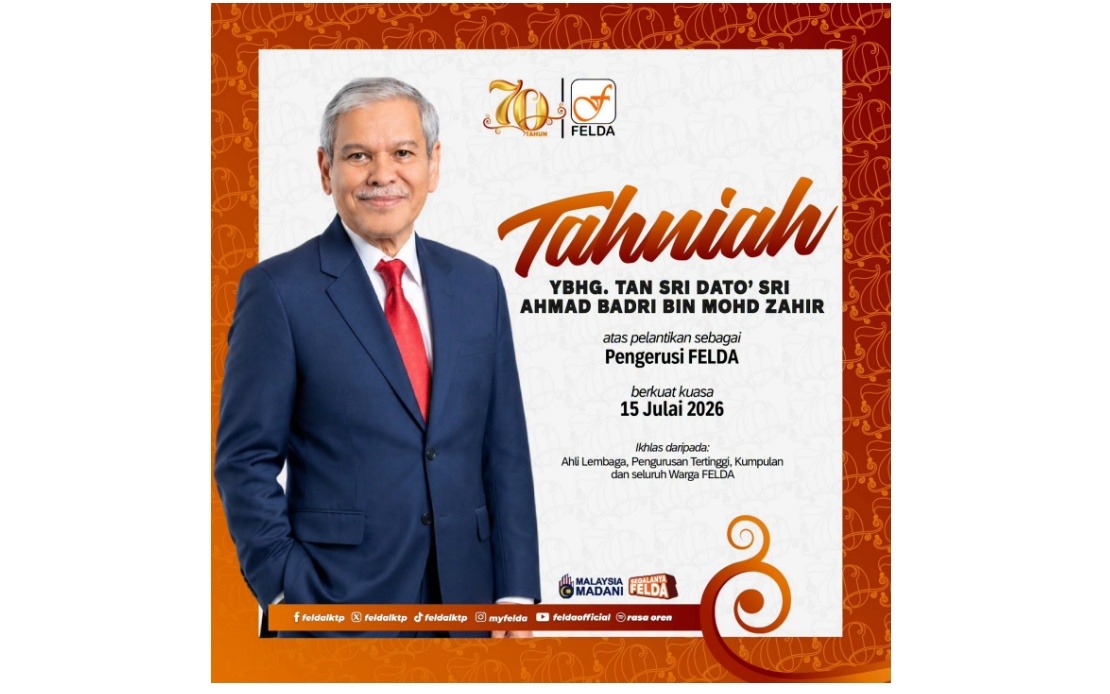
Tan Sri Ahmad Badri Mohd Zahir has been appointed chairman of the Federal Land Development Authority (FELDA), marking a significant leadership transition at one of Malaysia's largest rural development agencies. The announcement, made in Kuala Lumpur, reflects governmental confidence in his ability to navigate the organisation through its ongoing transformation and modernisation efforts. FELDA, which oversees welfare and economic activities for more than three million settlers and their descendants, represents a critical pillar of Malaysia's rural economy and social fabric.
The appointment underscores the importance the government places on FELDA's role in achieving inclusive and sustainable development objectives. According to the official statement, Ahmad Badri's credentials in governance and organisational management position him to strengthen institutional frameworks while advancing the agency's strategic agenda. His track record suggests an emphasis on balancing commercial efficiency with the social responsibilities inherent to FELDA's settler-focused mandate, a tension that has long defined the organisation's operational philosophy.
Ahmad Badri brings more than three decades of experience spanning both public administration and private enterprise. His career began in 1989 at the Ministry of Finance, where he established foundational expertise in government financial management and policy implementation. This early grounding in fiscal affairs proved formative, equipping him with understanding of how development agencies interface with the broader economic system and national budget priorities.
Perhaps his most prominent public sector role came as Treasury Secretary-General from 2018 to 2020, a position of considerable influence over Malaysia's fiscal strategy and resource allocation. During this period, he would have engaged directly with challenges facing government-linked entities, rural development frameworks, and macroeconomic planning during a complex political transition. This experience at the apex of Malaysia's financial hierarchy provides relevant perspective for addressing FELDA's operational and strategic challenges.
Beyond Treasury work, Ahmad Badri has held high-profile positions in Malaysia's institutional ecosystem. He previously chaired the Employees Provident Fund, the mandatory pension scheme serving millions of Malaysian workers, a role requiring sophisticated understanding of long-term financial stewardship and fiduciary responsibility. He has also served on boards of Bank Negara Malaysia, the central banking institution; Permodalan Nasional Berhad, the state investment vehicle; and Tenaga Nasional Berhad, the national energy utility. These directorships across diverse sectors indicate comfort navigating complex organisational landscapes and stakeholder management.
Currently, Ahmad Badri chairs RHB Bank Bhd and the Malaysian Rubber Board while holding board membership at Sime Darby Bhd, a diversified conglomerate with extensive agricultural operations. His simultaneous involvement with rubber and agricultural institutions proves particularly relevant given FELDA's historical roots in plantation development and its ongoing reliance on commodity-based revenue streams. Understanding the dynamics of rubber, palm oil, and agricultural markets remains essential for FELDA's financial sustainability and settler prosperity.
His educational background reflects professional development oriented toward real estate and business management. Ahmad Badri holds a Master of Business Administration from the University of Hull in the United Kingdom, supplemented by a bachelor's degree in Estate Management from Universiti Teknologi MARA. The estate management qualification proves especially pertinent, given FELDA's core business of managing land allocations and agricultural holdings across peninsular Malaysia.
The timing of this appointment arrives as FELDA confronts pressures common to many development-era statutory bodies in Malaysia. These pressures include the need to modernise operational practices, improve financial sustainability, enhance settler services, and adapt to evolving commodity markets and climate challenges. Ahmad Badri's experience implementing governance reforms and managing stakeholder expectations across multiple institutions suggests familiarity with navigating these institutional complexities. His appointment signals intention to pursue professional management standards while maintaining the social and economic welfare responsibilities central to FELDA's founding mission.
FELDA's settler population, exceeding three million individuals when including dependants, represents a substantial constituency with direct interest in the organisation's trajectory. Settlers depend on FELDA for land management, agricultural support services, social programmes, and income distribution from commodity operations. Ahmad Badri's public statements emphasise commitment to maintaining settler welfare whilst driving economic transformation, a balancing act requiring political sensitivity and operational acumen.
The appointment also reflects broader governmental interest in strengthening governance across major statutory bodies and government-linked companies. Malaysia has prioritised institutional reform and transparency in recent years, with leadership changes often signalling renewed focus on performance standards and accountability. Ahmad Badri's background in fiscal management and institutional stewardship aligns with these reform priorities.
FELDA's transformation agenda encompasses digital adoption, operational efficiency improvements, and diversification beyond traditional plantation-based revenue models. These initiatives require leadership comfortable with organisational change and capable of building consensus among diverse stakeholder groups, from settler communities to corporate management to government agencies. Ahmad Badri's experience across multiple institutions suggests exposure to such transformation challenges.
Regionally, FELDA's evolution carries implications for Southeast Asian agricultural development models and rural economic policy. As a substantial land management entity with long historical roots, FELDA's approaches to sustainability, worker welfare, and commodity production influence broader development thinking. Ahmad Badri's appointment may signal strategic direction concerning these questions, particularly regarding environmental stewardship and inclusive growth within agricultural sectors increasingly scrutinised for sustainability practices.
The transition represents continuity in institutional leadership while positioning FELDA for the next phase of its development journey. Ahmad Badri's appointment recognises that effective transformation of large, complex organisations serving vulnerable populations requires leaders combining financial acumen, political understanding, and demonstrated commitment to sustainable institutional development. His track record across Malaysia's financial and corporate institutions positions him to advance these objectives while safeguarding the interests of the settler communities upon whom FELDA's legitimacy ultimately depends.

