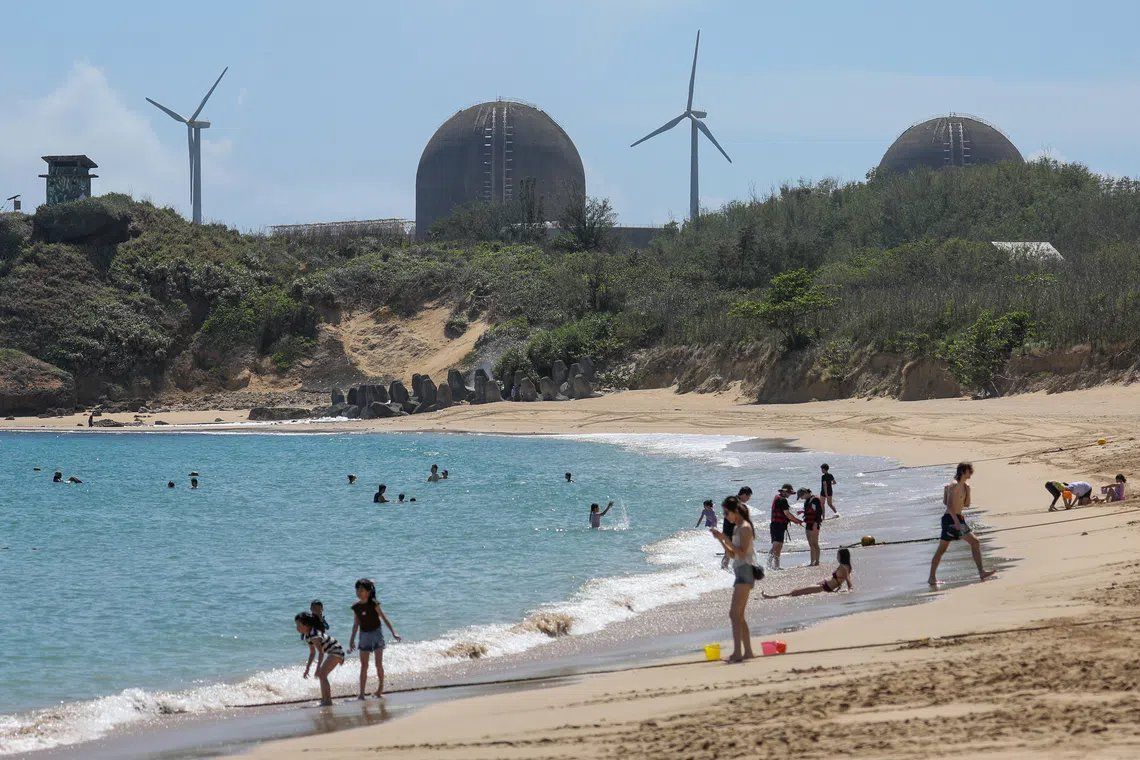
Taiwan's voters will decide the fate of the nation's nuclear energy policy once again this November, participating in their fourth major referendum on atomic power within just eight years. The ballot measure arrives alongside comprehensive local elections spanning nine categories of officials, including county magistrates and city mayors, creating a complex electoral landscape that experts argue extends far beyond technocratic energy policy into the realm of partisan political strategy. The convergence of these contests has sparked serious academic and public debate about whether Taiwan's direct democracy mechanisms have transformed into tools for partisan advantage rather than genuine instruments of popular will.
The nuclear referendum poses a straightforward but consequential question: whether the government should abandon its "Nuclear-Free Homeland" policy in favour of maintaining atomic energy capacity to support public health, ensure reliable and affordable electricity, strengthen national defence resilience, and facilitate artificial intelligence industry development. This framing reveals how thoroughly energy policy has become intertwined with broader national security and economic competitiveness concerns, particularly given accelerating demand from Taiwan's growing technology sector. The measure represents a notable shift in how nuclear issues are positioned within public discourse, moving beyond simple safety debates to encompass geopolitical strategy and technological advancement.
What distinguishes this referendum cycle from previous ones is the remarkably compressed timeframe between announcement and voting. The 2026 referendum was announced on August 28 and will be decided on November 28—a mere three-month window that Taiwan's legal scholars argue provides insufficient opportunity for genuine public deliberation. Associate Professor Lin Jia-he from the College of Law at National Chengchi University drew pointed contrasts with Switzerland's referendum process, which typically spans three to five years from initial proposal to final vote. This extended period permits government agencies, civil society organisations, and ordinary citizens to thoroughly examine complex policy questions from multiple angles before casting ballots. Taiwan's compressed timeline, by comparison, forces voters to make consequential decisions about intricate energy combinations and long-term infrastructure strategy without adequate time for substantive public discussion.
The political machinery driving this referendum, however, appears far more transparent to academic observers than to most ordinary voters. The opposition coalition of the Kuomintang (KMT) and Taiwan People's Party perceives these referendums as mobilisation tools capable of energising conservative-leaning supporters who prioritise law-and-order issues and energy security. Historical precedent reinforces this calculation: during the 2018 local elections, when ten national referendums appeared alongside electoral contests, the KMT achieved remarkably strong results. Senior research fellow Qi Dongtao from the East Asian Institute at the National University of Singapore suggests that this electoral consideration carries weight comparable to, or potentially exceeding, the substantive policy merits of the measures themselves. Higher turnout among ideologically conservative voters could decisively influence close races for local office, making referendum scheduling a calculated electoral tactic.
Beyond simple turnout mechanics, the opposition appears to be constructing a political narrative around Taiwan's perceived failure to maintain law and order and energy stability. Political scientist Chong Ja Ian from NUS identifies another dimension: opposition parties seek to position themselves as strong advocates for tough governance who are supposedly restrained by the ruling Democratic Progressive Party (DPP) and existing legal constraints. Within Taiwan's political culture, Singapore frequently serves as a cultural reference point embodying both rigorous law enforcement and economic prosperity. By invoking nuclear energy security alongside crime prevention, the KMT attempts to communicate that alternative governance approaches could deliver superior outcomes across multiple policy domains simultaneously.
This referendum represents only one dimension of a broader pattern of escalating direct democracy activity since 2017. That year witnessed decisive changes to Taiwan's referendum framework, fundamentally altering the political incentive structure. Previously, referendums required fifty percent voter turnout to achieve validity—a threshold that proved insurmountably high, causing former President Chen Shui-bian's 2004 cross-strait relations referendums to fail despite commanding overwhelming support from those who actually participated. The revised framework dramatically lowered these barriers, requiring only that affirmative votes exceed negative votes and that valid "yes" ballots represent at least twenty-five percent of the total electorate. This structural change transformed referendums from tools requiring sustained, broad consensus into mechanisms that smaller, more motivated constituencies could deploy effectively.
The consequences of this liberalisation have proven substantial. Three proposed referendums were submitted to the Central Election Commission this year, though only the nuclear measure secured approval. The commission rejected a proposal to legalise caning for serious crimes, emphasising that such a measure would violate human rights protections. Another rejected proposal concerned allocating all traffic fine revenue to road safety improvements and public transport subsidies. These rejections suggest that institutional guardians retain capacity to filter proposals, yet the sheer volume of submissions reveals how thoroughly the referendum mechanism has been absorbed into standard party political practice.
Qi's analysis identifies a troubling transformation of democratic institutions. When political parties routinely propose highly contentious issues specifically designed to generate public attention and mobilise their particular supporters, referendums can devolve from instruments of direct democracy into mere extensions of partisan electoral competition. This dynamic inverts the traditional understanding of when referendums should be deployed: they should theoretically address major constitutional questions or significant policy shifts where demonstrable cause exists to seek explicit popular authorisation beyond normal legislative processes. Instead, Taiwan's system has increasingly featured referendums on matters that political parties calculate will generate advantageous electoral turnout patterns or media attention.
The accumulated effect of this pattern has bred voter cynicism and engagement fatigue. Sean Chang, a 39-year-old public relations professional from Taipei, articulated widespread disenchantment: while referendums initially seemed to embody genuine democratic intention, the accumulating experience has convinced him that they function primarily as vehicles for partisan manipulation of public opinion. He recalled participating in the 2018 referendum cycle but subsequently found himself psychologically exhausted by the constant pressure to evaluate complex policy questions from multiple perspectives. Eventually, he abandoned the effort to engage seriously, retreating from the referendums entirely. His trajectory likely reflects broader patterns among Taiwan's electorate, where cumulative exposure to frequent direct democracy measures has produced scepticism rather than heightened civic engagement.
This November's "nine-in-one" elections will determine 11,051 local positions across Taiwan, with campaigning traditionally emphasising parochial and domestic concerns rather than national strategic issues. Yet political scientists stress that these local contests function simultaneously as bellwethers for Taiwan's broader political direction, with implications extending toward the national presidential elections scheduled by 2028. The nuclear referendum will intersect with this local electoral moment, potentially influencing voter turnout patterns and party performance across multiple races. Whether voters perceive the referendum as a genuine opportunity to shape energy policy or merely as another partisan ploy may substantially affect their enthusiasm for participation and their receptiveness to opposition messaging across the full electoral slate.
The convergence of institutional reform, partisan strategy, and voter fatigue creates a complex environment for Taiwan's democratic processes. Observers from across the political spectrum acknowledge that referendums serve legitimate functions when deployed judiciously, yet the current trajectory suggests increasingly utilitarian application by competing political parties. The structural incentives embedded in Taiwan's 2017 reforms ensure that this pattern will likely persist unless the threshold requirements are adjusted again or political norms against excessive referendum deployment strengthen. Meanwhile, ordinary voters face the challenge of distinguishing between referendums representing genuine policy deliberation and those designed primarily to optimise electoral outcomes for partisan advantage.

