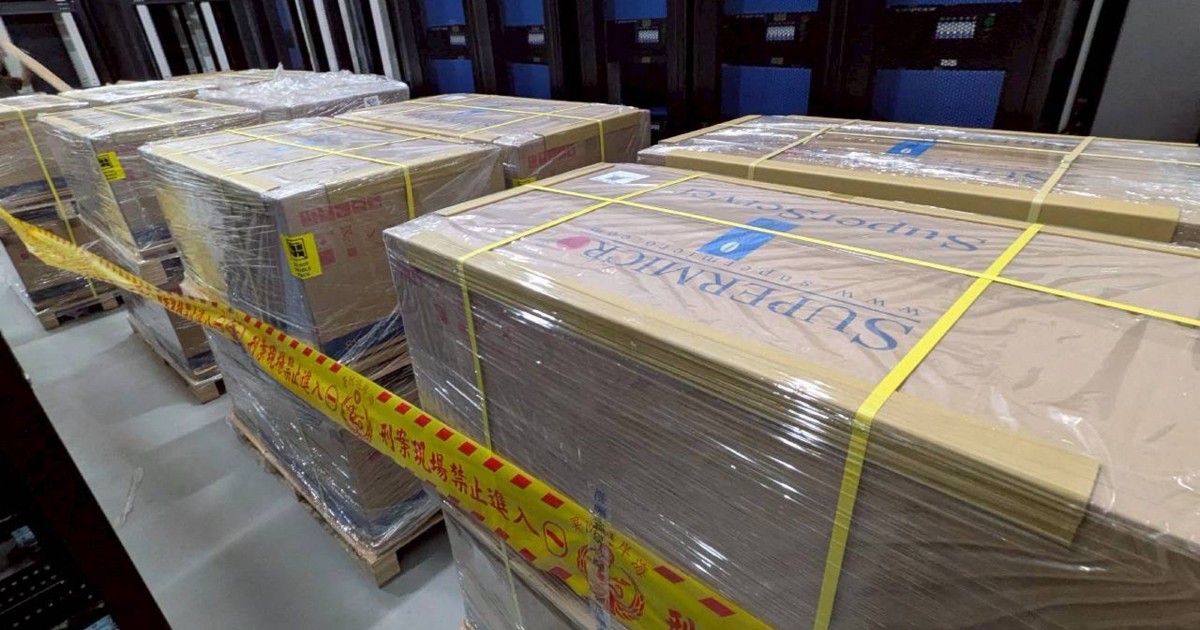
Taiwan's authorities have launched a series of coordinated investigations targeting technology firms operating within its jurisdiction, signalling a significant escalation in enforcement efforts against the illicit export of advanced semiconductor equipment to mainland China. The action, confirmed by prosecutors on Tuesday, focused on the island's offices of Super Micro Computer, an American corporation, alongside two additional technology enterprises whose identities remain under investigation protocols. This expanded operation represents a critical moment in Taiwan's commitment to monitoring and preventing the diversion of cutting-edge artificial intelligence chips, particularly those manufactured by industry leader Nvidia, away from authorised international markets and towards restricted destinations.
The investigation reflects mounting pressure from multiple quarters to tighten control over semiconductor supply chains in the Asia-Pacific region. Taiwan, as the world's preeminent manufacturer of advanced microchips through companies like Taiwan Semiconductor Manufacturing Company (TSMC), occupies a pivotal position in global technology commerce. The nation's role as both a major exporter and transit point for high-value electronics makes it particularly vulnerable to smuggling operations that exploit gaps in enforcement or exploit the complexity of international logistics networks. Authorities in Taipei have recognised that allowing such flows to continue unchecked could jeopardise Taiwan's international standing and its relationship with allied nations, particularly the United States, which has invested considerable diplomatic capital in securing semiconductor supply chains against Chinese acquisition.
The focus on Nvidia's AI processors underscores the strategic importance these components hold in contemporary technological competition. Artificial intelligence capabilities have become central to military applications, economic productivity, and digital infrastructure development. Advanced processing units manufactured by Nvidia are subject to stringent export controls implemented by the United States, designed to prevent their concentration in the hands of state actors or corporations working under state direction in China. When such components move through unauthorised channels, they circumvent these carefully constructed export restrictions and potentially accelerate China's advancement in critical technology domains. For Taiwan, being implicated as a conduit for such transfers creates international complications and raises questions about the effectiveness of its regulatory framework.
The raids themselves represent a shift towards more aggressive investigative postures among Taiwanese law enforcement. Rather than relying solely on customs inspections or passive monitoring of shipping documentation, the authorities have now undertaken direct examination of corporate premises and business records. This operational shift suggests that investigators believe smuggling networks have become increasingly sophisticated, potentially involving internal collusion within legitimate technology companies or elaborate schemes designed to obscure the ultimate destination of shipments. The involvement of Super Micro Computer, a publicly traded enterprise with legitimate business operations across Asia, indicates that smuggling operations may be embedded within otherwise lawful commercial activities, making detection significantly more challenging.
For Malaysian and broader Southeast Asian technology sectors, these developments carry important implications. The region has emerged as an increasingly significant hub for electronics manufacturing, assembly, and distribution. Malaysian companies operating in semiconductor-related fields, as well as those involved in technology logistics and distribution networks, should anticipate heightened scrutiny from regional authorities acting in coordination with Taiwan and other jurisdictions. The enforcement action serves as a reminder that governments throughout Asia are tightening standards around sensitive technology exports and are prepared to pursue investigations crossing national boundaries when smuggling networks span multiple countries.
The investigation also reflects the geopolitical dimensions of semiconductor competition between the United States and China. American restrictions on AI chip exports to China have become increasingly stringent, with successive administrations implementing new limitations to prevent technological transfer to potential adversaries. Taiwan, as a close ally of the United States and dependent on American security guarantees, faces pressure to demonstrate compliance with these broader strategic objectives. Conversely, Chinese entities have strong economic incentives to acquire advanced chips through alternative channels when official purchase routes are closed. This fundamental tension creates conditions where smuggling networks inevitably emerge, placing jurisdictions like Taiwan in the middle of great power competition.
The expansion of the smuggling probe suggests that authorities have identified multiple distribution pathways and possibly larger networks than initially suspected. What may have begun as investigations into isolated incidents has apparently developed into uncovering systematic operations involving coordination across several firms. The involvement of multiple companies in a single investigative action indicates that prosecutors believe the smuggling infrastructure may be more extensive than single-firm operations, potentially involving networks of intermediaries, logistics providers, and front companies designed to obfuscate transaction trails.
For legitimate technology companies operating in Taiwan and the region, these enforcement actions create both compliance burdens and competitive pressures. Companies must now implement more rigorous internal controls, customer verification procedures, and export documentation protocols to ensure they do not inadvertently become channels for smuggling operations. Failure to maintain robust compliance frameworks could result in legal liability, regulatory sanctions, and reputational damage. The regulatory landscape around technology exports has become substantially more complex, requiring companies to invest in specialised compliance expertise and systems.
The timing and scale of these raids also suggest coordination with international partners, particularly American authorities and intelligence agencies concerned with Chinese technology acquisition. Such investigations rarely proceed without information-sharing and support from allied governments. Taiwan's willingness to conduct high-profile enforcement actions demonstrates its strategic alignment with Western objectives in restricting Chinese access to advanced technology, even when such actions carry diplomatic or economic costs within the region.
Looking forward, the investigation may reveal details about smuggling methodology, the extent of Chinese demand for restricted chips, and the sophistication of networks involved in circumventing export controls. These findings will likely inform future policy decisions regarding technology exports, corporate accountability, and international cooperation mechanisms designed to prevent sensitive technology transfer. For Malaysia and other Southeast Asian nations, the case serves as a cautionary example of how smuggling networks can emerge even within legitimate business environments and the necessity of developing robust regulatory capabilities to detect and prevent such activities.

