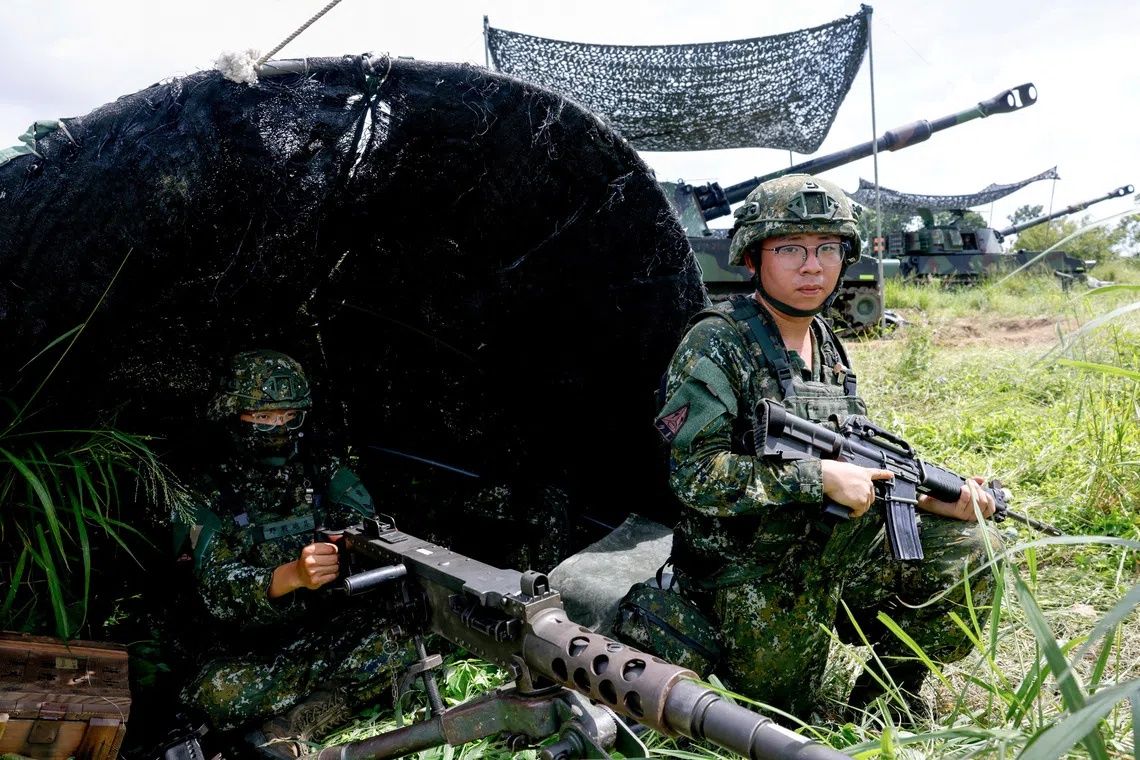
Taiwan has commenced its most comprehensive military exercise in decades, introducing novel testing mechanisms designed to evaluate how commanders maintain operational effectiveness when confronted with unpredictable enemy actions. The Han Kuang drills, which began on August 5 and are scheduled to conclude on August 14, mark a significant departure from previous years by incorporating measures that simulate real wartime conditions rather than relying on scripted scenarios. This shift reflects growing recognition within Taiwan's defence establishment that previous exercises have been insufficiently rigorous and have failed to prepare military personnel for the complexities of actual combat operations.
The 10-day exercise, initiated by orders from an underground command centre in Taipei, will mobilise more than 20,000 troops, including approximately 5,000 reservists, across multiple operational theatres. The drills encompass combat-readiness protocols including the dispersal of fighter jets from their home bases to secondary locations, emergency naval deployments off Taiwan's Pacific coast, and the simulated relocation of major military arsenals. These activities reflect Taiwan's strategic concern that in any conflict scenario, Chinese forces would prioritise the destruction of command centres, ports, logistics facilities, and defence industry installations during the initial phases of an attack.
Among the most significant innovations introduced during this iteration of Han Kuang is the implementation of a "backbrief" system derived from United States military doctrine. Under this approach, junior officers receiving operational orders are required to restate the mission objectives and procedural details back to their commanding officers before deployment. Defence officials characterise this mechanism as essential for ensuring that commanders and subordinates maintain alignment regarding the operational intent underlying specific orders, thereby reducing the risk of miscommunication during high-stress combat situations where rapid decision-making is essential.
For the first time in the exercise's history, which extends back to 1984, Taiwan will deliberately throttle mobile internet speeds across the island to assess how civilians and emergency services would maintain communication networks in scenarios where bandwidth becomes severely constrained. This measure represents a realistic assessment of wartime conditions, as military planners recognise that Chinese operations would likely target communications infrastructure. By simulating degraded internet conditions, Taiwan's authorities aim to identify vulnerabilities in civilian crisis management systems and determine how the public might adapt to operating under severely restricted connectivity.
The exercise will also introduce an "embedded reporter" mechanism that evaluates how the military would manage wartime news releases and counter disinformation campaigns emanating from hostile sources. This represents an acknowledgment that modern military conflicts involve a significant informational and propaganda component, and that Taiwan's defence strategy must account for efforts to undermine public morale through false or misleading narratives. By testing these mechanisms during peacetime exercises, the military seeks to develop institutional capacity to combat enemy disinformation while maintaining public confidence during actual conflict.
Defence officials have explicitly framed Han Kuang as a departure from "laboratory-like exercises in a vacuum" and characterised the new approach as placing commanders in "real field environments, facing real bottom-line conditions." This conceptual reframing suggests that previous exercises, despite their scale, have been perceived as artificial and insufficiently representative of actual operational challenges. The emphasis on introducing unexpected scenarios that deviate from pre-planned enemy behaviours is intended to test commanders' capacity for improvisation, reassessment, and rapid reorientation when circumstances diverge from intelligence assessments and operational assumptions.
Central to the exercise's design is an effort to determine how field commanders would respond to situations where the actual enemy behaviour diverges significantly from anticipated scenarios. As defence officials have explained, the objective is to assess how commanders would "reassess, readjust, and quickly issue orders" when confronted with circumstances that do not conform to the original enemy scenario. This focus on adaptive command reflects recognition that in real military operations, rigidity and overreliance on pre-planned responses can prove catastrophic, whereas flexibility and situation-specific decision-making often prove decisive.
The drills will also include tests of Taiwan's civilian government's capacity to maintain continuity of operations during cascading crises ranging from natural disasters to military invasion. These resilience drills represent an integration of civilian and military planning that acknowledges the totality of a wartime emergency. By incorporating exercises that test how local officials would preserve governmental functions during multiple simultaneous challenges, Taiwan's authorities are attempting to ensure that preparedness extends beyond the military domain into the broader governmental and civil defence apparatus.
Another component involves the mobilisation of civilian factories and coordination with the private industrial sector to support military logistics and repair operations during wartime. This measure reflects Taiwan's understanding that modern warfare depends not only on military personnel and equipment but also on the capacity of the civilian economy to sustain military operations through sustained production and logistical support. By integrating civilian industrial mobilisation into the exercise, Taiwan seeks to ensure that this critical dimension of wartime readiness receives adequate attention and preparation.
Escort drills conducted off Taiwan's Pacific coast address a strategic concern that has grown increasingly prominent as Chinese military capabilities have expanded. Taiwan's defence planners recognise that in any conflict scenario, Chinese military forces would attempt to sever the island's maritime supply lines, particularly the logistical pathways connecting Taiwan to allied nations in the Pacific region. By conducting escort operations during peacetime exercises, the military seeks to develop operational familiarity with the tactics and procedures necessary to maintain open sea lanes in the face of enemy interdiction efforts.
The broader strategic context for these enhanced exercises reflects Taiwan's assessment that China's military pressure has intensified and that the risk of conflict has increased. While China's defence ministry declined to comment on the exercises, it continues to refuse to renounce the use of military force to bring Taiwan under its control, a position that underscores Beijing's unresolved stance regarding the island's political status. For Taiwan, this persistent ambiguity regarding Chinese intentions necessitates continuous enhancement of military readiness and the development of increasingly sophisticated and realistic training mechanisms.
Taiwan's emphasis on making exercises more realistic responds to past criticism that some drills had been excessively staged or scripted, with outcomes predetermined and military personnel following choreographed routines rather than engaging in genuine problem-solving under uncertainty. By introducing mechanisms that force commanders to respond to unexpected developments and by incorporating civilian participation and internet throttling, Taiwan has moved significantly toward exercises that replicate the fundamental unpredictability and chaos characteristic of actual military operations. This evolution reflects a maturing understanding of how to translate peacetime training into genuine operational readiness.

