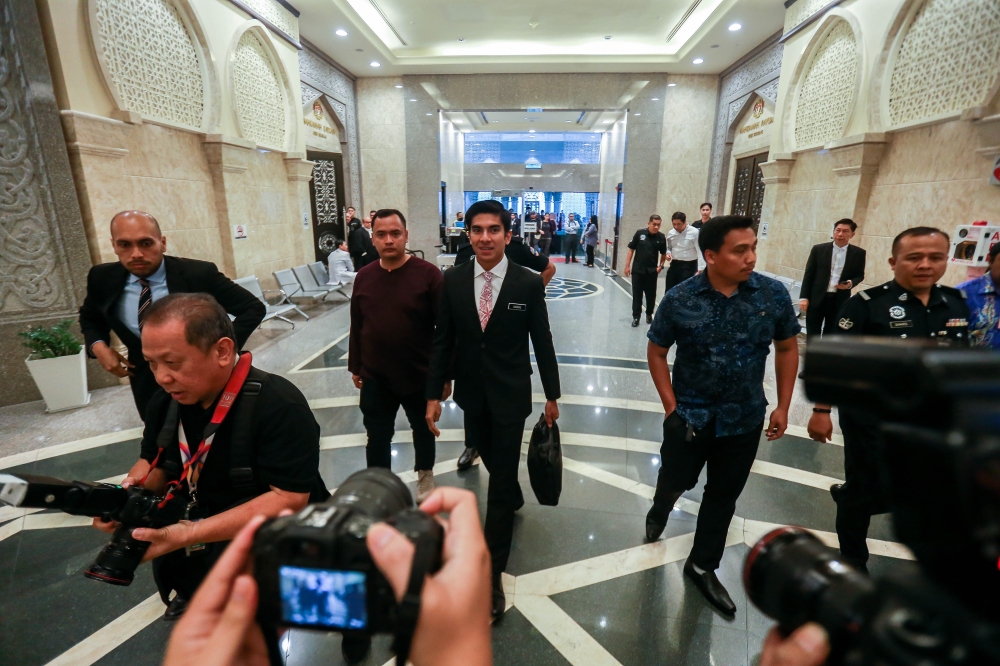
Muar Member of Parliament Syed Siddiq Syed Abdul Rahman made his way to the Palace of Justice in Putrajaya early on Saturday morning, accompanied by close family members and his fiancée, as crowds of supporters began gathering outside the courthouse. The atmosphere reflected the magnitude of what was at stake—a Federal Court judgment that could fundamentally reshape the trajectory of one of Malaysia's more prominent younger politicians. The convergence of personal and political significance drew substantial public attention, with supporters camping out from dawn to witness the proceedings firsthand, underscoring the broader interest in how the court's decision might reverberate across Malaysia's political landscape.
The case before Malaysia's highest court represented a pivotal moment for Syed Saddiq, who has maintained a considerable public profile as the Muar constituency representative and a figure associated with reform-minded politics. The Federal Court's decision carried weight far beyond individual circumstances, as it touched upon critical questions regarding the application of electoral and political law in Malaysia. For supporters who gathered at the courthouse, the ruling symbolised more than a personal verdict—it represented a test of judicial independence and how Malaysia's courts handle high-profile political cases. The presence of family members signalled the intensely personal nature of the proceedings, whilst the broader crowd underscored the public dimension of the matter.
Putrajaya, as the seat of Malaysia's federal government and judicial authority, provided the appropriate venue for such a consequential ruling. The Palace of Justice itself has witnessed numerous landmark decisions that have shaped Malaysia's legal and political development. Syed Saddiq's arrival with his fiancée present reflected the emotional weight of the moment, suggesting that the judgment would have immediate and lasting consequences for his personal life and professional standing. The early arrival of supporters demonstrated the significant following that Syed Saddiq has cultivated, particularly among younger voters and those interested in progressive political reform.
Within Malaysia's contemporary political context, the ruling held implications that extended beyond Syed Saddiq himself. As a relatively young political figure with visibility in parliamentary proceedings, his position carries weight in discussions about generational change within Malaysia's political establishment. The Federal Court's determination would consequently influence perceptions of how Malaysian law addresses political figures and whether the judicial system applies consistent standards across cases of political significance. This broader scrutiny meant that the judgment would likely generate substantial commentary from legal experts, political analysts, and civil society organisations.
The composition and conduct of the Federal Court in reaching its decision would itself merit close examination by observers of Malaysia's judiciary. The court's reasoning and conclusions would set precedents potentially affecting how future cases involving political figures and electoral matters are adjudicated. For Malaysian legal professionals and constitutional scholars, the detailed judgment—once delivered—would provide important guidance on judicial interpretation of relevant legislation. The case therefore represented not merely a singular event but a moment that would contribute to the evolving body of Malaysian jurisprudence on political law.
The situation also reflected the increasingly intense scrutiny that accompanies high-profile political cases in Malaysia's media environment. News coverage, social media discussion, and public commentary had built considerable anticipation around the Federal Court's announcement. Syed Saddiq's base of supporters, concentrated in certain demographic segments, had maintained active interest in the case's progression through lower courts and appellate review. The Saturday gathering demonstrated how judicial proceedings involving prominent political figures attract public engagement that extends well beyond courtroom observers and legal professionals.
For the Muar constituency specifically, the outcome would potentially have local implications. As the Member of Parliament representing the area, Syed Saddiq's political status and capacity to continue his parliamentary duties could be affected by an adverse judgment. Constituents who had elected him to represent their interests had therefore invested in the outcome of the Federal Court proceedings. The presence of supporters at the Palace of Justice reflected this constituency-level engagement alongside the national political significance of the case.
The involvement of Syed Saddiq's family and fiancée in attending the court proceedings carried symbolic weight within Malaysian cultural and social contexts. The decision to bring close relatives and his intended spouse signalled transparency and a personal confrontation with whatever judgment was forthcoming. It suggested that Syed Saddiq was prepared to face the court's determination with his immediate circle present, rather than treating the proceedings as an isolated legal matter divorced from personal relationships and family considerations.
The Federal Court ruling, once announced, would establish clarity regarding Syed Saddiq's legal standing and political prospects going forward. The judgment would either substantiate concerns that had prompted legal action or validate his position and permit continuation of his parliamentary career without impediment. Either outcome would carry consequences for Malaysia's political configuration, particularly regarding how younger, reform-oriented figures are received and supported within the electoral and legislative spheres. The decision would also potentially influence similar cases and how prosecutors and courts approach comparable matters involving political actors.

