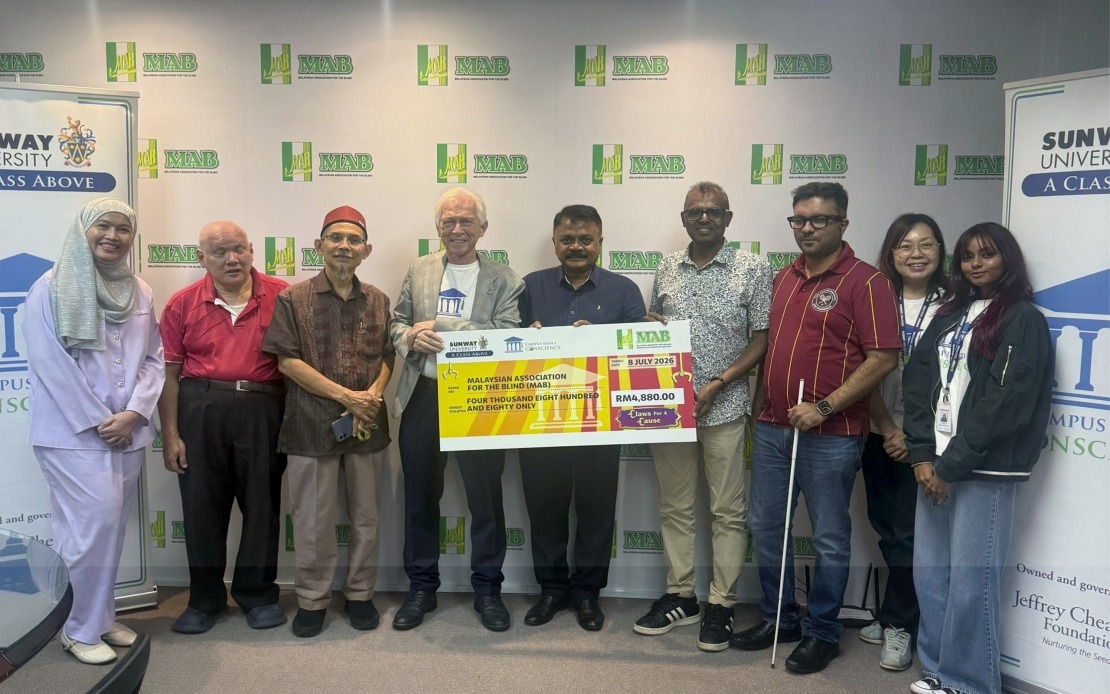
Sunway University has generated RM4,880 in donations for the Malaysian Association for the Blind (MAB) by converting a recreational claw machine game into a fundraising mechanism. The "Claws For A Cause" initiative, conducted over a week-long period and organised in partnership with Space Panda, demonstrates how tertiary institutions are increasingly leveraging campus activities to drive charitable outcomes. The university mobilised its student body and staff members to participate in the game, with proceeds channelled directly to support the organisation's work assisting people with visual impairments.
The fundraising effort operated under Sunway University's established "Campus With A Conscience" programme, which serves as an umbrella framework for coordinating community-focused projects across the institution. By integrating the claw machine activity into this broader social responsibility initiative, the university transformed what might ordinarily be dismissed as mere entertainment into a vehicle for meaningful charitable contribution. This approach reflects a growing trend among Malaysian higher education institutions to embed social consciousness into everyday campus experiences, making charitable giving accessible and engaging rather than transactional.
Professor Sibrandes Poppema, the university's President and Vice-Chancellor, positioned the initiative within the institution's wider mission statement during formal remarks about the campaign. He emphasised that Sunway University's organisational identity extends considerably beyond the conventional boundaries of classroom instruction and research output. According to his statement, the university aspires to function as a "mission-driven, fifth-generation university" that operates across multiple dimensions including education delivery, research advancement, technological innovation, and active community participation. This framing suggests that institutional leadership views social engagement as integral to institutional purpose rather than peripheral corporate social responsibility.
The partnership structure between Sunway University and Space Panda illustrates a practical model for university-industry collaboration in the social impact space. Rather than operating as isolated actors, the two entities pooled resources and legitimacy to amplify the fundraising campaign's reach and effectiveness. Space Panda's provision of the claw machine technology and entertainment infrastructure, combined with Sunway University's access to a substantial campus population, created synergies that neither party could have generated independently. This collaborative approach offers lessons for other Malaysian universities seeking to expand their community engagement capacity without proportionate increases in dedicated budgetary allocations.
Marcus, identified as the Director of Space Panda, framed the company's participation within a broader corporate philosophy emphasising incremental charitable action. His statement acknowledged that organisations often overlook the cumulative impact of smaller contributions, instead fixating on the necessity of large-scale donations. By endorsing a philosophy that "even small acts of kindness could make a meaningful difference," Space Panda positioned itself as embracing grassroots philanthropy. The company further noted that its decision to support MAB specifically resonated with its own values, given the organisation's focus on empowering individuals experiencing visual impairments—a constituency frequently marginalised in mainstream discourse about disability inclusion.
The Malaysian Association for the Blind, as the beneficiary organisation, operates within a healthcare and social welfare landscape where private donations and corporate partnerships have become increasingly essential. Government funding streams for disability-focused NGOs in Malaysia frequently prove inadequate for comprehensive service provision, particularly given Malaysia's ageing population and rising prevalence of age-related vision loss. Organisations such as MAB therefore depend substantially on fundraising initiatives to sustain programmes including rehabilitation services, vocational training, and advocacy work aimed at improving accessibility standards across physical and digital environments. The RM4,880 contribution, while modest in absolute terms, contributes to this vital funding ecosystem.
For Sunway University specifically, the initiative demonstrates institutional commitment to translating stated values into concrete action. Malaysian universities frequently articulate social responsibility objectives in strategic plans and mission statements, yet translating these aspirations into visible, measurable outcomes remains challenging. By generating a tangible fundraising result tied to a specific beneficiary organisation, Sunway University provides stakeholders—including prospective students, alumni, and community members—with evidence that social consciousness extends beyond rhetorical positioning into practical implementation. This transparency around social impact metrics increasingly influences how universities are perceived within competitive higher education markets.
The broader context of campus fundraising in Malaysia reflects evolving expectations regarding institutional citizenship. As Malaysian society grapples with widening wealth inequality and persistent challenges around disability inclusion, universities face mounting pressure to demonstrate that their considerable institutional resources and intellectual capital contribute positively to social welfare outcomes. Fundraising initiatives such as "Claws For A Cause" serve dual functions: they generate material resources for vulnerable populations whilst simultaneously signalling to the university community that contributing to social causes constitutes a legitimate and valued component of campus life.
The decision to partner with an entertainment company rather than approaching fundraising through conventional academic channels—lectures, seminars, or skills-based volunteering—represents a strategic choice to maximise participation breadth. By lowering barriers to engagement through a playful, accessible activity rather than demanding specialised knowledge or significant time commitments, Sunway University and Space Panda likely attracted participants who might not otherwise contribute to charitable causes. This inclusive approach to fundraising design carries implications for how Malaysian universities conceptualise community engagement more broadly, suggesting that traditional academic frameworks may alienate segments of campus populations from social impact opportunities.
Looking forward, the success of this particular initiative may incentivise replication across other Malaysian universities and corporate partners. The relatively simple mechanics of converting a recreational activity into a fundraising mechanism, combined with the positive publicity such campaigns generate, create compelling incentives for broader institutional adoption. Should this model proliferate, Malaysian's disability-focused charitable organisations could potentially benefit from substantially expanded funding pipelines rooted in campus communities. Simultaneously, universities would strengthen their positioning as socially conscious institutions actively contributing to national development objectives beyond tertiary education provision itself.

