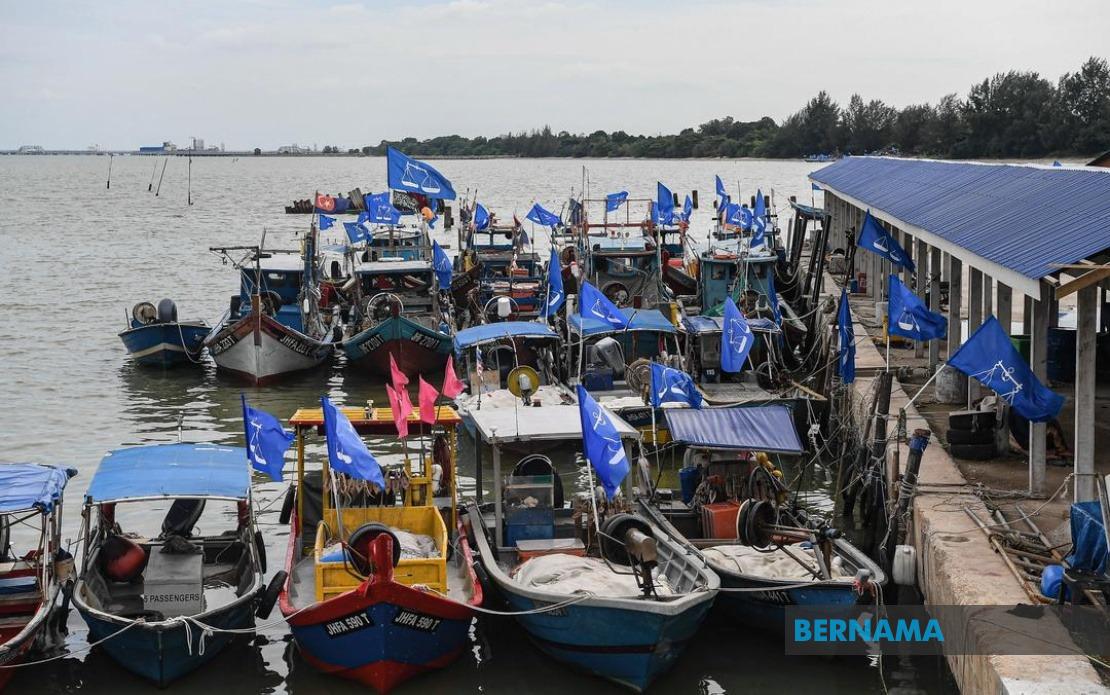
The waterfront settlement of Sungai Rengit in Kota Tinggi has become a focal point of electoral hope ahead of Johor's 16th state election, as traders and fishing communities voice their frustrations about unresolved infrastructure challenges and seek concrete commitments from the incoming Tanjung Surat assemblyman. Located strategically near the Pengerang Integrated Petroleum Complex (PIPC), this coastal area serves both residential populations and industrial workers, yet the communities operating here contend with deteriorating facilities and mounting security concerns that threaten their livelihoods.
The food court traders at Medan Selera Sungai Rengit represent the most visible manifestation of this longer-term crisis. For nearly a decade, these small businesses have occupied temporary structures that were never intended to be permanent, their operators displaced from an original location to accommodate a development project that fundamentally altered their working conditions. What began as a brief relocation has stretched indefinitely, leaving traders managing stalls with basic canopy roofs and plywood walls, structures that offer minimal protection and no security against the elements or criminal activity. The fundamental failure to provide appropriate permanent facilities has cascaded into secondary problems that now constrain economic productivity and personal safety.
Beverage trader Lai Swee Hong, who has invested three decades into her business, articulates the core tension facing the community. While authorities designated an alternative site, its location on a one-way road with severely limited parking creates practical barriers that make it commercially unviable for vendors accustomed to serving a regular customer base. The proposed replacement site represents not a genuine solution but an acknowledgment of displacement that fails to account for the operational realities of street-level food commerce. Lai and her peers were initially assured the temporary arrangement would last approximately eighteen months, a timeline that has proven wildly inaccurate, leaving traders without clear information about their long-term prospects and unable to make meaningful business investments.
The security dimension compounds these infrastructure deficiencies and reveals a pattern of inadequate official response. Stalls lacking doors or proper locking mechanisms create obvious vulnerabilities, and reported thefts throughout the past year have eroded income and morale among vendors. Food trader Wini Fasiha Zawawi notes that despite formal police reports and notifications to local authorities, substantive security interventions have not materialized. The fact that police patrols occur without corresponding reductions in theft suggests either insufficient coordination or under-resourcing of enforcement. For small traders operating on tight margins, even losses not reaching thousands of ringgit constitute meaningful damage to household finances and business viability.
The fishing community in the surrounding kampung faces a distinctly different but equally pressing set of concerns centered on operational sustainability rather than physical infrastructure. Senior fisherman Sin Hock Hwee, who has pursued this livelihood for half a century, identifies fuel subsidies as a critical lifeline against escalating maritime operating costs. The government's existing fuel support programme meaningfully reduces the capital requirements for daily fishing operations, and the community regards its continuation and enhancement as foundational to the sector's viability. For aging fishermen facing accumulated physical wear and limited alternative employment prospects, these targeted subsidies represent essential social insurance against destitution.
Younger members of the fishing community articulate expectations for more ambitious developmental investments. Hidayat Isa, a registered voter in his mid-thirties, calls for upgrades to jetty facilities and heightened sensitivity to the voices of emerging fishermen who may be experimenting with new techniques or market approaches. His framing reveals a generation gap within the sector, where older fishermen prioritize immediate cost relief while younger participants seek structural improvements that would enhance the sector's long-term attractiveness and competitiveness. The tension between these priorities suggests that any incoming representative must balance emergency assistance with strategic development vision.
The political context for these community demands involves a direct contest between two distinct camps. Pakatan Harapan (PH) candidate Faizul Abdul Ghani stands against incumbent Aznan Tamin from Barisan Nasional (BN) in the Tanjung Surat state constituency race. Both candidates must now contend with a community that has demonstrated patience for nearly ten years without receiving satisfactory resolution, suggesting that electoral rhetoric will require substantive commitments rather than vague promises. The Johor state election as a whole involves 172 candidates competing for 56 seats, with voting scheduled for July 11 and early voting on July 7, creating a compressed timeline in which candidates must demonstrate responsiveness to local grievances.
The Sungai Rengit situation exemplifies broader patterns within Malaysian local governance where temporary accommodations calcify into permanent arrangements without triggering sustained political attention. The displacement of traders ostensibly served a development agenda, yet the absence of coordinated relocation planning and timeline management suggests that development projects frequently prioritize site acquisition over community transition. This dynamic repeats across multiple constituencies and sectors, indicating a systemic weakness in local authority planning capacity and political accountability mechanisms. Traders in other areas facing similar circumstances likely observe Sungai Rengit closely to assess whether electoral cycles translate into tangible service improvements.
The fishing community's emphasis on subsidy continuation reflects Malaysia's broader approach to managing cost-of-living pressures through targeted price support rather than income enhancement or sectoral restructuring. While fuel subsidies do provide measurable relief, the reliance upon ongoing government transfer mechanisms creates institutional fragility, as subsidy policies remain subject to fiscal pressures and political shifts. A more sustainable approach might emphasize productivity improvements, market access enhancements, and skills development that would increase fishermen's earning potential beyond simple cost reduction. The incoming Tanjung Surat representative faces a choice between managing these immediate expectations or leveraging electoral credibility to pursue longer-term sectoral transformation.
Hidayat Isa's proposal that Kampung Sungai Rengit be designated an adopted village for the incoming representative represents a strategic framing that attempts to secure political attention through ceremonial designation. The adopted village concept, while largely symbolic, can create institutional mechanisms through which the elected representative maintains consistent engagement with community concerns. This mechanism proves particularly valuable in constituencies where diverse economic sectors—fishing, trading, industrial work—require distinct policy approaches. By formalizing the relationship through adopted village status, the community creates touchpoints through which to access the representative and monitor whether campaign commitments translate into administrative action.
For Malaysian observers across the peninsula, Sungai Rengit encapsulates the tensions between rapid development imperatives and community service delivery continuity. The coastal location near a major petroleum complex places the area within strategic economic corridors, yet this positioning has not translated into proportionate service investment or coordinated relocation planning. The compressed electoral timeline means that candidates must now mobilize resources to address a decade of neglect, setting precedents for how quickly newly elected representatives can transition from campaigning to problem-solving. The community's willingness to articulate specific, costed demands—parking facilities, jetty upgrades, subsidies, security measures—provides incoming representatives with clear benchmarks against which their performance can be measured.
The July 11 polling day thus carries particular weight for Sungai Rengit residents who have articulated a clear mandate for change while remaining characteristically measured in their demands. The trading community seeks not transformation but basic functionality: adequate parking, secure facilities, reliable security presence. The fishing community seeks not sectoral overhaul but modest enhancements: sustained subsidies, jetty improvements, consultative governance. These constitute eminently achievable commitments that test whether the incoming Tanjung Surat representative possesses the administrative competence, political will, and resource access to translate electoral victory into community benefit. The resolution of Sungai Rengit's decade-old infrastructure crisis will likely shape perceptions of state government effectiveness throughout Johor's coastal constituencies.

