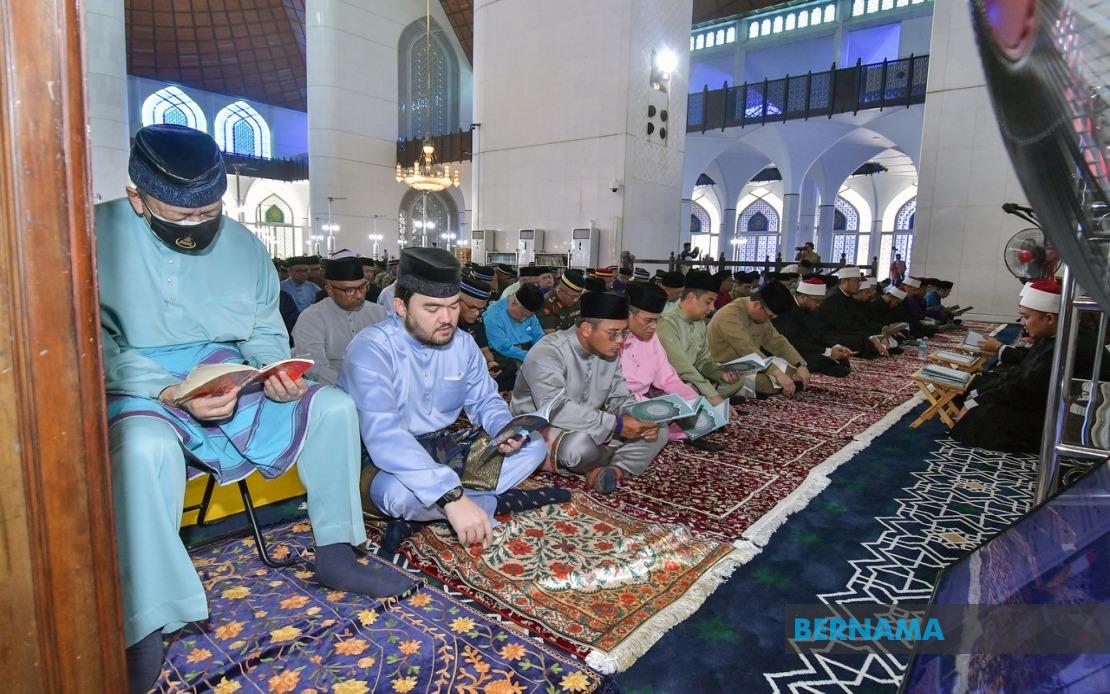
Sultan Sharafuddin Idris Shah, the reigning Sultan of Selangor, participated in a Surah Yassin recitation ceremony held at Masjid Sultan Salahuddin Abdul Aziz Shah in Shah Alam on Wednesday, 28 August. The spiritual gathering formed part of pre-Merdeka observances across the nation as Malaysia gears up to commemorate its independence. Accompanying the Sultan was Tengku Amir Shah Sultan Sharafuddin Idris Shah, the Raja Muda of Selangor, underscoring the significance of the religious occasion within the state's leadership hierarchy.
The event drew considerable participation from the local community, with approximately 1,000 worshippers assembling to recite Surah Yassin collectively. The congregation notably included members of the security forces stationed throughout Selangor, reflecting a broader cross-section of society coming together for the spiritual commemoration. This inclusive participation demonstrates how religious observances during the Merdeka season serve to unite diverse segments of the population in shared reverence and national sentiment.
Upon his arrival at the mosque, Sultan Sharafuddin was warmly received by Selangor Menteri Besar Datuk Seri Amirudin Shari and Dr Mohammad Fahmi Ngah, who chairs the State Islamic Affairs and Innovation Culture Committee. The presence of these senior state officials, alongside Datuk Mohd Shahzihan Ahmad, director of the Selangor Islamic Religious Department (JAIS), and Datuk Salehuddin Saidin, chairman of the Selangor Islamic Religious Council (MAIS), underscored the ceremonial importance attached to the gathering and the coordinated involvement of key religious and administrative bodies.
Following the collective recitation, Sultan Sharafuddin proceeded to perform the Friday prayers alongside the assembled worshippers. The Imam of the mosque, Muhammad Farhan Wijaya, delivered a sermon centred on the theme "Merdeka Daripada Belenggu Kerakusan," which translates to "Freedom from the Shackles of Greed." This thematic choice carries particular resonance during the National Day period, linking Malaysia's political independence with the spiritual principle of liberation from materialistic excess. The sermon thus intertwined religious instruction with broader messages about national values and ethical conduct.
The timing of this religious observance carries significance within Malaysia's cultural calendar. The pre-Merdeka period traditionally sees intensified public engagement with national themes, and the participation of high-ranking state officials in religious ceremonies amplifies these observances. In Selangor, a state with substantial Muslim population and strong Islamic institutional infrastructure, such gatherings gain particular prominence as expressions of both religious devotion and patriotic sentiment.
Selangor's approach to celebrating Malaysia's independence is notably structured around the theme "Malaysia MADANI: Kesejahteraan Dinikmati," which translates to "Malaysia MADANI: Prosperity Enjoyed." This aligns with the national framework adopted for the 2024 Merdeka celebrations. The state-level festivities will culminate in a major celebration scheduled for Sunday, 30 August at Kajang Stadium, commencing at 8 pm. This comprehensive state-wide commemoration demonstrates how religious observances precede and complement the larger public celebrations of national independence.
The inclusion of security force personnel in the Surah Yassin recitation reflects Malaysia's tradition of involving uniformed services in National Day commemorations. This participation carries symbolic weight, acknowledging the role of defence and security institutions in safeguarding the nation's independence and territorial integrity. The presence of these personnel within a religious setting also underscores the harmonious integration of religious practice with national institutions in Malaysia's constitutional framework.
Masjid Sultan Salahuddin Abdul Aziz Shah, the venue for this gathering, holds considerable significance within Selangor's Islamic landscape. As one of the state's principal mosques, its selection for this pre-Merdeka observance reinforces its role as a centre for important religious and civic occasions. The mosque's capacity to accommodate approximately 1,000 worshippers for this ceremony reflects its substantial infrastructure and established position within the state's religious institutions.
The choice of sermon content linking independence with freedom from greed suggests an interpretive approach that views Malaysia's Merdeka achievement not merely in political or economic terms, but as encompassing broader moral and spiritual dimensions. This perspective aligns with Malaysia's constitutional position of Islam and its emphasis on values-based governance, particularly prominent within state-level religious administration in Selangor. The sermon thus positions National Day observance within a framework of ethical reflection rather than purely celebratory spectacle.
For Malaysian observers and the broader Southeast Asian context, this event illustrates how Malaysian states integrate religious observance with national commemoration during key calendar moments. The participation of the Sultan—a figurehead holding simultaneous constitutional and religious significance—demonstrates the intertwined nature of governance and faith within Malaysia's institutional structure. This model differs from secular approaches to national celebrations and reflects Malaysia's distinctive constitutional arrangement regarding Islam's position within the state.
As Selangor and other Malaysian states progress toward the full National Day celebrations on 30 August and beyond, these pre-Merdeka religious observances establish a contemplative and spiritual foundation for the ensuing festivities. They serve to remind citizens that independence carries not only political and economic implications but also spiritual and moral dimensions warranting collective reflection. The attendance of senior officials alongside ordinary citizens reinforces the inclusive and unifying nature of these occasions across Malaysia's diverse society.

