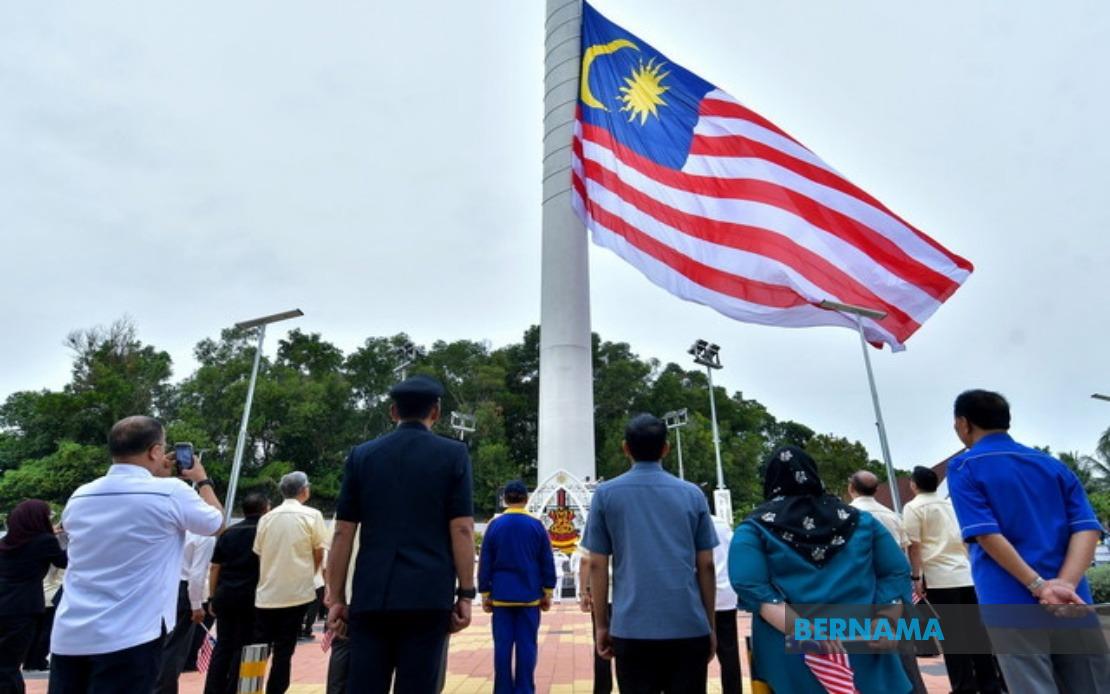
Sultan Sharafuddin Idris Shah, the Sultan of Selangor, has delivered a pointed message to the nation as August's Independence Month celebrations unfold: the Jalur Gemilang transcends its ceremonial purpose to represent something far more profound—a shared commitment to national cohesion that cuts across the demographic lines dividing Malaysian society. Speaking from Shah Alam on August 26, the Ruler stressed that while Malaysians embrace vastly different cultural traditions, religious convictions, political philosophies and historical narratives, the red-and-white banner flying overhead serves as a tangible reminder that all remain bound together as citizens of a single nation.
The Selangor Flagpole at Dataran Selangor hoisted the Jalur Gemilang at dawn this morning, marking the beginning of an extended display that will remain in place through Malaysia Day on September 17. Yet the Ruler's accompanying statement went beyond ceremonial acknowledgment, suggesting that the symbolic weight of Independence Month celebrations often fails to penetrate deeply enough into national consciousness. His Royal Highness articulated a distinction that many political and civic leaders have struggled to communicate: displaying thousands of flags across the country represents the easy portion of patriotic expression, whereas the genuinely challenging undertaking involves constructing a functional multi-ethnic, multi-religious society where diverse populations genuinely experience mutual respect and belonging.
In remarks that appear calibrated to address contemporary polarization within Malaysian politics and society, Sultan Sharafuddin explicitly cautioned against weaponizing identity categories as tools of division. He called on political figures and institutional leaders to model restraint, setting examples through their demonstrated commitment to moderation, tolerance and compassion rather than exploiting religious, racial or ideological fractures for electoral or factional advantage. The implicit critique here addresses a persistent pattern whereby politicians opportunistically mobilize communal anxieties to consolidate support, undermining the very unity that Independence Day ostensibly celebrates.
The Ruler's intervention carries particular weight given Selangor's demographic composition and political significance. As Malaysia's most populous state and economic engine, Selangor embodies the nation's ethnic and religious diversity in microcosm. The Sultan's emphasis on teaching younger generations to respect those of different faiths, cultures and ethnic origins reflects concerns about the transmission of inclusive values across generational cohorts. Educational institutions and families serve as the frontline venues for cultivating cosmopolitan attitudes, yet these spaces increasingly face competing narratives emphasizing communal boundaries rather than shared Malaysian identity.
Central to Sultan Sharafuddin's argument is the proposition that the Jalur Gemilang itself operates as an essentially neutral vessel, refusing to discriminate between Malays, Chinese, Indians, Kadazan-Dusuns, Ibans or any other indigenous or immigrant-descended community. Similarly, the flag acknowledges no hierarchy among Malaysians professing Islam, Buddhism, Christianity, Hinduism or any alternative spiritual tradition. This framing inverts common political rhetoric that often treats certain ethnic or religious groups as primary stakeholders in the Malaysian project while positioning others as secondary beneficiaries. By insisting the flag belongs equally to all without exception, the Ruler reasserts a foundational principle increasingly contested in contemporary Malaysian discourse.
The broader context for these remarks involves a decade of intensifying identity-based contestation within Malaysian politics. Episodes of communal tension, disputes over religious authority and jurisdiction, and periodic campaigns highlighting perceived threats to specific communities have created a climate where many Malaysians experience their national identity as fragile or contested rather than solidly anchored. The framing of Independence Day celebrations becomes a critical opportunity either to reinforce fractures or to rebuild bridges, and Sultan Sharafuddin's intervention clearly advocates for the latter approach.
His Royal Highness articulated an important distinction between the performative aspects of national celebration and their deeper substantive meaning. Ceremonies, flag hoisting and patriotic gatherings represent necessary but insufficient expressions of national commitment. The authentic measure of a functioning nation-state rests instead on whether ordinary citizens from diverse backgrounds can navigate daily life with confidence that they possess equal rights, that their distinctive identities receive recognition and respect, and that peaceful coexistence represents not an aspirational ideal but an attainable reality. This standard positions national unity not as something achieved through symbolic gestures alone, but as the outcome of deliberate institutional choices and individual behavioral commitments.
The Ruler's emphasis on leaders setting examples warrants particular attention given the Malaysian political environment's current fractious state. Public disputes between religious authorities, competitive claims over constitutional interpretation, and recurring episodes of inflammatory rhetoric from political figures have created a climate where citizens receive mixed signals about national values. When institutional leaders model the very behaviors—sectarian positioning, intolerance, divisive rhetoric—that undermine unity, formal independence celebrations ring hollow to many observers. Sultan Sharafuddin's call for exemplary leadership from politicians and administrators therefore addresses this credibility gap directly.
The timing of these remarks carries significance as well. August and September represent the culmination of Malaysia's Independence Month observances, a period when media attention focuses on national identity questions and when many Malaysians are more receptive to messages about shared citizenship. By positioning the Ruler's statement within this calendar window, the message reaches audiences when they are already engaged with Independence themes, potentially amplifying its resonance. The accompanying flag ceremony at Dataran Selangor created a visual and ceremonial anchor for the message, transforming abstract principles into concrete public ritual.
For Southeast Asian observers, Sultan Sharafuddin's intervention demonstrates how monarchical institutions in constitutional monarchies can articulate unifying messages that transcend partisan political divides. Unlike elected officials whose statements inevitably invite partisan interpretation, royal figures speaking in their institutional capacity can sometimes access rhetorical space that politicians cannot occupy. This dynamic has particular relevance for regional democracies grappling with polarization and seeking voices capable of speaking to national unity without appearing to advance narrow factional interests.
The implicit challenge posed by the Ruler's remarks extends beyond politicians and leaders to the broader Malaysian citizenry. By suggesting that true national independence involves maintaining social cohesion and mutual respect, Sultan Sharafuddin invites individual Malaysians to examine their own contributions to either strengthening or weakening national unity. This rhetorical move positions patriotism not as passive acceptance of state authority, but as active participation in the continuous work of building and maintaining a functional multi-ethnic, multi-religious polity. Whether this intervention catalyzes meaningful behavioral change or remains confined to ceremonial rhetoric will become apparent in subsequent weeks and months as Malaysians navigate political and social interactions informed by these principles.

