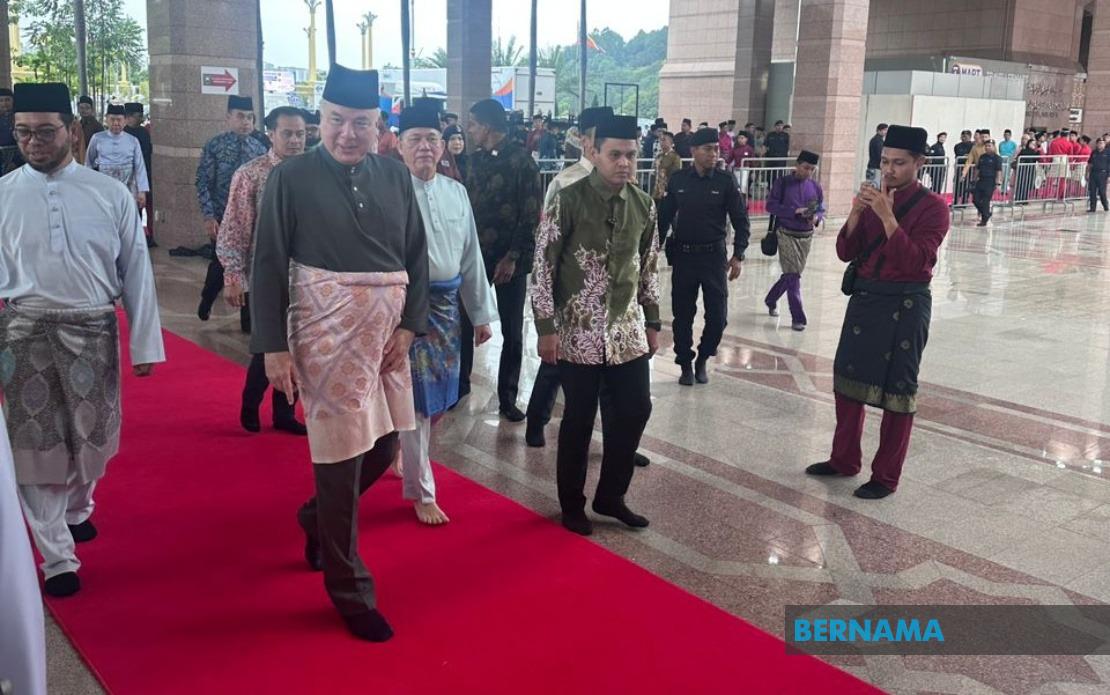
At the National Level Maal Hijrah 1448 Celebration held in Putrajaya on June 17, Deputy Yang di-Pertuan Agong Sultan Nazrin Shah delivered a pointed message to Malaysia's leadership establishment: emotional impulses and reckless actions in governance produce outcomes that ordinary citizens ultimately pay for with hardship. Speaking before approximately 5,000 attendees at the Putra Mosque, the Sultan of Perak articulated a vision of decision-making grounded in measured judgment rather than personal sentiment, a theme likely resonating with Malaysians navigating a period of political volatility and competing policy directions.
The Sultan's remarks zeroed in on a particular vulnerability in modern governance—the temptation toward short-term thinking and reactive leadership. When officials prioritise immediate political advantage over long-term consequences, he cautioned, the burden falls not on decision-makers but on citizens who endure the fallout. This observation carries particular weight in the Malaysian context, where policy reversals, hastily announced initiatives, and competing visions between federal and state governments have sometimes created confusion and economic uncertainty for businesses and families alike.
Central to the Sultan's vision is the notion that prudent leadership demands composure, receptiveness to diverse viewpoints, and careful analysis before action. He stressed that this quality—calmness combined with thoroughness—represents not weakness but the hallmark of effective governance. The emphasis on "well-informed judgments" speaks to a leadership philosophy that values expertise, data, and consultation over ideological reflexes or political convenience, a principle with obvious relevance to Malaysia's ongoing efforts to strengthen institutional quality and restore public confidence in government decision-making.
The Sultan grounded his argument in Islamic history, drawing from the example of Prophet Muhammad's Hijrah migration to Medina. He noted that the Prophet's selection of Abdullah bin Uraiqit as a guide—a non-Muslim—demonstrates Islam's historical recognition of competence and integrity regardless of religious identity. This invocation carries contemporary significance for Malaysia, a multi-ethnic, multi-religious democracy where meritocratic recruitment and the valuing of expertise across communal lines remain contested ideals. The Sultan's framing suggests that national leadership should prioritise capability and trustworthiness over narrow sectarian considerations.
Beyond decision-making processes, Sultan Nazrin shifted focus to the concept of sacrifice as foundational to national progress. He articulated sacrifice not as mere acceptance of loss but as a deliberate subordination of personal interest to collective welfare—a quality he suggested has become increasingly rare in contemporary Malaysia. This concern about the erosion of civic commitment speaks to broader anxieties about social cohesion and the willingness of different constituencies to accept short-term costs for long-term national benefit, a tension evident in debates over subsidy rationalisation, education policy, and economic restructuring.
The Sultan emphasised that sacrifice, properly understood, demands courage, perseverance, and genuine conviction. He expressed concern that within Muslim communities and Malaysian society more broadly, the language of sacrifice sometimes rings hollow—invoked in speeches but rarely translated into lived commitment. This observation suggests scepticism toward rhetorical nationalism divorced from substantive action, a critique with obvious relevance to Malaysian politics, where symbolic gestures sometimes substitute for coherent policy or institutional reform.
Unity constituted the third major theme of Sultan Nazrin's address. Drawing inspiration from the Medina Charter, which successfully bound together disparate groups through tolerance and equitable governance, the Sultan presented unity not as an outcome of uniformity but as a product of just leadership, mutual respect, and institutional fairness. This framing addresses a persistent challenge in Malaysian society: forging common purpose across lines of ethnicity, religion, and regional interest. The Sultan's invocation of the Medina Charter—a document that established protections for minority communities and mechanisms for dispute resolution—suggests that Malaysian unity requires more than exhortation; it demands institutions and practices that protect minority interests while enabling collective decision-making.
The Sultan further argued that national greatness inheres not in nostalgia for past achievements but in the capacity to learn from history and apply those lessons to contemporary challenges. This forward-looking orientation contrasts with leadership narratives that emphasise recurring grievances or golden ages, suggesting instead that Malaysian identity should be defined by continuous adaptation and self-improvement. For policymakers and political leaders, this argument implies that invoking history productively means extracting actionable principles rather than relitigating past disputes.
Maal Hijrah, in Sultan Nazrin's interpretation, transcends a mere calendar observance or historical commemoration. Instead, he positioned it as an opportunity for collective self-reflection, examination of past failures, and recommitment to core principles. This reframing gives religious observance contemporary political significance: the celebration becomes a moment for citizens and leaders alike to assess whether national institutions, policies, and conduct align with foundational values of justice, integrity, and collective welfare. In this sense, the Sultan's remarks connect spiritual renewal to institutional accountability.
The Sultan's emphasis on addressing societal forgetfulness—the tendency for people to become "overwhelmed by the tides of worldly life" and lose sight of core principles—reflects concerns about the pace of contemporary change and its effects on collective memory and shared values. As Malaysia undergoes rapid economic transformation, urbanisation, and social change, the risk exists that traditional anchors and ethical frameworks become attenuated. The Sultan's call for conscious recommitment to sacrifice, unity, and wisdom-based leadership represents an attempt to strengthen these anchors.
The event's attendance by Deputy Prime Minister Datuk Seri Fadillah Yusof and Minister in the Prime Minister's Department (Religious Affairs) Dr Zulkifli Hasan signals that the themes Sultan Nazrin articulated carry policy resonance within government. The gathering of 5,000 people under the theme "MADANI Dihayati, Ummah Diberkati"—translating roughly as "MADANI Embodied, Community Blessed"—connects the Sultan's message to the government's broader MADANI (Madness Averted, Development Advancing, Nation Integrated) framework, suggesting that ethical governance and social cohesion remain central to Malaysia's stated development vision.
Ultimately, Sultan Nazrin's address functions as a call to institutional and personal discipline. In a political context sometimes marked by competing factions, divergent policy agendas, and public scepticism about leadership motives, the Sultan's emphasis on prudent, sacrifice-oriented, unity-conscious leadership represents an appeal to a higher standard. Whether Malaysian political leaders and citizens will heed this call—subordinating impulse to strategy, personal interest to collective welfare, and short-term advantage to long-term nation-building—remains an open question that will substantially shape Malaysia's trajectory in coming years.