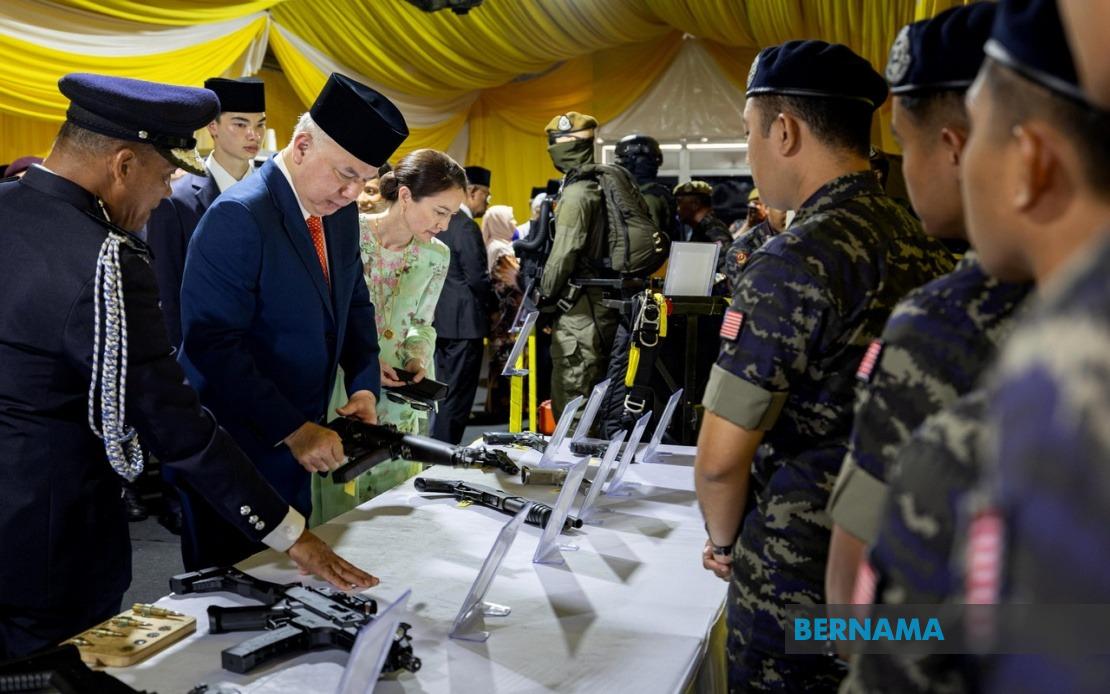
In a ceremony held in Ipoh on July 7, Sultan Nazrin Shah inaugurated the newly constructed Sultan Nazrin Shah 69 Commando Camp in Ulu Kinta, marking a significant milestone for Malaysia's elite paramilitary police unit. The occasion brought together the Perak royal household, senior government officials, and law enforcement leadership to commemorate what authorities describe as a strategic enhancement of the nation's security infrastructure. The gathering underscored the symbolic importance placed on the facility by political and security establishments across multiple levels of government.
Among those attending were members of the Perak royal family, including the Raja Permaisuri, Raja Muda, and Raja DiHilir, alongside Perak's Menteri Besar and federal security officials. The presence of Home Minister Datuk Seri Saifuddin Nasution Ismail and Inspector-General of Police Tan Sri Mohd Khalid Ismail highlighted the federal government's direct engagement with the project, signalling its prioritization within the nation's security architecture and budgetary planning.
The facility represents an investment exceeding RM206 million, constructed across a sprawling 338-hectare site. This substantial expenditure reflects a deliberate policy choice to consolidate and modernize the operational base of the 69 Commando, a unit established in 1969 that has evolved into one of Malaysia's most specialized paramilitary forces. The scale of the development suggests long-term strategic planning aimed at positioning the unit to address emerging security threats over subsequent decades, rather than serving merely as an incremental facility upgrade.
During his address, Saifuddin Nasution contextualised the opening within broader national security achievements, noting Malaysia's ranking of 12th among 163 countries in the Global Peace Index. This metric serves as a benchmark for the government's security policy outcomes, positioning the new camp as a contributing factor to maintaining this standing. The ranking itself carries political weight, offering tangible evidence of effective governance in security matters—a critical domain for public confidence in any administration.
The 69 Commando's operational history provides considerable justification for the investment. The unit has been instrumental in addressing major security episodes spanning decades, from counter-insurgency operations during the communist era to interventions in contemporary crises. Its involvement in Ops Daulat in Lahad Datu, Sabah, in 2013—a significant armed incursion that tested Malaysia's border security—and participation in the international response following the MH17 tragedy in 2014 demonstrate the unit's evolution from primarily domestic operations to engagement with complex, transnational security challenges.
Beyond headline operations, the unit has maintained consistent involvement in counter-terrorism efforts and hostage rescue missions, operational categories that have grown in frequency and sophistication across the region. These capabilities position Malaysia as a credible partner for regional security cooperation, particularly as Southeast Asian nations grapple with evolving terror tactics and transnational criminal networks. The camp's modern training infrastructure is intended to sustain and enhance these specialist capabilities.
The government's framing of the facility emphasizes its role as more than infrastructure. Officials have presented the camp as a symbolic acknowledgment of the 69 Commando's institutional sacrifices and contributions, an approach that speaks to personnel morale and unit identity. For an organization requiring high levels of operational readiness and personal commitment, such recognition carries institutional value alongside practical benefits of improved facilities. The naming of the camp after the Sultan of Perak further elevates its symbolic status within the state and national consciousness.
From a regional perspective, Malaysia's investment in specialized paramilitary capacity reflects broader Southeast Asian concerns about security threats ranging from terrorism to transnational criminal operations. The new facility positions Malaysia within the context of comparable regional military and paramilitary modernization efforts undertaken by Singapore, Thailand, and Indonesia. This alignment suggests shared threat assessments across the region and coordinated approaches to building specialized response capabilities.
The facility's design explicitly incorporates modern operational, training, and administrative functions within a single complex. This consolidation approach differs from distributed facility models, reflecting contemporary doctrine emphasizing integrated command structures and coordinated deployment capabilities. The comprehensive nature of the facility—combining training grounds, accommodation, command centers, and administrative infrastructure—suggests a twenty-first-century understanding of modern police paramilitarism requiring diverse capability bases under unified operational control.
Handover to the Royal Malaysia Police in 2024 marks formal integration into the national police structure, though the 69 Commando has historically maintained distinct operational protocols reflecting its specialized role. The completion of this facility during the current administration positions the investment as a MADANI Government achievement, linking security capability enhancement to the ruling coalition's governance narrative. For policymakers, the camp represents a tangible demonstration of commitment to security sector modernization, an area where public perception directly influences confidence in governmental competence.
Looking forward, the facility is positioned as an institutional anchor enabling generational continuity within the 69 Commando. Training capacity expansion will reportedly allow the unit to develop personnel numbers and operational sophistication required for evolving security scenarios. The emphasis on nurturing new officer cohorts suggests institutional planning extending well beyond immediate operational needs, reflecting confidence in the unit's enduring relevance within Malaysia's security framework.
For Malaysian audiences observing security policy development, the camp opening represents a specific government investment priority amid broader fiscal constraints. The RM206 million expenditure must be understood within ongoing debates about defense and security spending allocation, particularly as Malaysia balances maritime security concerns, domestic terrorism prevention, and regional stability contributions. The facility's completion and ceremonial opening provide opportunities for officials to justify such expenditures through demonstrated operational benefits and institutional recognition of security forces' contributions.

