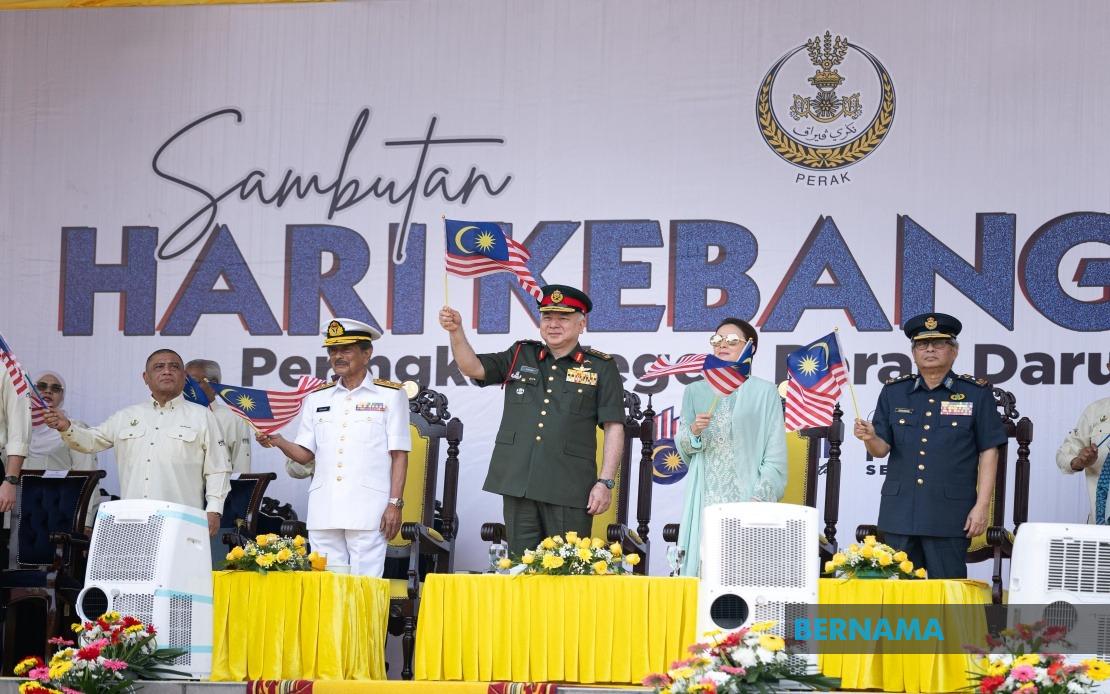
Sultan Nazrin Shah, the Sultan of Perak, presided over a solemn ceremony in Ipoh on August 31st to recognise the extraordinary contributions made by 11 military and police personnel who have dedicated their lives to safeguarding Malaysia's security and territorial integrity. Held at Dewan Bandaran Ipoh, the Perak-level National Day 2026 Awards Presentation Ceremony brought together senior state officials, members of the royal household, and the Menteri Besar to celebrate these individuals whose service often comes at profound personal cost.
Each honouree received RM1,000 in recognition of their commitment to the nation, accompanied by a formal certificate of appreciation presented by Sultan Nazrin himself. This financial acknowledgement, while symbolic, represents the state's commitment to honouring those who have sacrificed in ways that civilians often struggle to comprehend. The composition of recipients underscores the multi-faceted nature of Malaysia's security apparatus, with six drawn from the Malaysian Armed Forces, two from the Royal Malaysia Police, and three from the Royal Malaysian Navy.
Among the most poignant cases was Warrant Officer 2 Mohamad Razali Din, whose service during Operation Naga in Banding left him with a permanent disability. When he stepped on a landmine, Mohamad Razali lost his left leg below the knee—a sacrifice that encapsulates the hidden costs of Malaysia's ongoing counter-insurgency and security operations. His recognition at this ceremony reflects not merely what he lost, but the deliberate choice he made to serve despite the dangers inherent in his duties.
Warrant Officer 2 Megat Abdullah Megat Othman's citation provides a contrasting but equally significant narrative of active heroism. During Operation Batu Kawah in Sri Aman, Megat Abdullah successfully eliminated three communist terrorists, demonstrating the tactical competence and bravery demanded of those engaged in direct operational duties. His commendation with a commando knife symbolises both the respect of his peers and the institution's acknowledgement of decisive action in defence of national security.
The broader cross-section of recipients—Staff Sergeant Idris Ismail, Corporal Mokhtar Sulaiman, Lance Corporal Khairul Anuar Abdul Hamid, and Lance Corporal Alias Abd Wahab from the Army; retired Sub-Inspector Omar Jayus and retired Sergeant Major Abdul Malek Nordin from the Police; and retired First Admiral Mohamad Imran Abd Hamid, retired Commander Mohd Akhbar Mohd Yusof, and retired Warrant Officer 2 Ahmad Safwi Shaari from the Navy—demonstrates that bravery and sacrifice are distributed across the ranks and across all branches of Malaysia's security forces. The inclusion of several retirees also signals that recognition extends beyond active service, acknowledging contributions made over entire careers.
Peering beyond the ceremony itself, Menteri Besar Datuk Seri Saarani Mohamad used the occasion to articulate a vision of national cohesion that extends well beyond military honour. He stressed that Malaysia's foundational strength has never rested on homogeneity but rather on the deliberate choice of a diverse population to coexist within a single nation-state. This framing is particularly relevant given contemporary tensions within Malaysian society around identity, representation, and belonging.
Saarani's address cautioned against the erosion of this carefully maintained equilibrium, arguing that national unity begins to fragment when citizens prioritise categorical identities—race, religion, or ethnic group—above individual humanity and shared civic bonds. He invoked powerful symbols of collective identity: the Jalur Gemilang, the Federal Constitution, the Malay language as a unifying medium, and the institution of the Malay Rulers as custodians of this multiethnic arrangement. These are not merely symbolic flourishes but the actual constitutional and institutional scaffolding upon which Malaysia's plural democracy depends.
The Menteri Besar's warning that neighbour-to-neighbour and friend-to-friend relationships deteriorate when difference supersedes personhood carries acute urgency in Malaysia's contemporary landscape. Social media amplification of communal identities, periodic political mobilisation along ethnic and religious lines, and the proliferation of competing narratives about national identity have collectively strained the bonds Saarani described. His observation that distance widens when these unifying symbols become blurred reflects a sophisticated understanding of how social fracture typically progresses—not through dramatic rupture but through the gradual erosion of everyday trust and intercommunal connection.
The timing of this address during a national day celebration dedicated to military heroes is deliberately symbolic. By honouring those who have literally bled for the nation alongside articulating a vision of inclusive nationalism, state leadership communicates that Malaysia's security challenges and its social cohesion challenges are fundamentally intertwined. A nation divided against itself cannot effectively defend itself, and conversely, those who defend the nation do so in service of its entire multiethnic population, not merely their own community.
For Malaysian observers and particularly those in Perak, this ceremony encapsulates a broader question about how the nation manages the tension between celebrating particular acts of service and sacrifice whilst maintaining the civic space necessary for a diverse society to function. The recognition of individual heroism, whether through battlefield prowess or endurance in the face of permanent disability, must coexist with the institutional commitment to treating all citizens as equally valuable members of a shared political community.
The presence of Raja Muda of Perak Raja Jaafar Raja Muda Musa and Raja DiHilir of Perak Raja Iskandar Dzurkarnain Sultan Idris Shah, alongside Menteri Besar Saarani Mohamad and the state bureaucratic apparatus, underscores the multi-institutional nature of Malaysian governance and the symbolic importance of having both traditional and elected leadership endorse this vision of inclusive national pride. When constitutional monarchs and elected officials jointly preside over honouring military service whilst articulating commitments to plural democracy, they send a powerful signal about the alignment of these principles at the highest levels of governance.
As Malaysia continues navigating complex security challenges in an increasingly multipolar region—from maritime concerns in Southeast Asia to transnational extremism to state-level geopolitical competition—the cultivation and public honouring of military and police personnel remains strategically important. Yet equally important is Saarani's insistence that these security challenges cannot be solved through security measures alone. The social cohesion he described, and the warning against its erosion through communal prioritisation, addresses a vulnerability that no military capability can remedy. Thus the 11 heroes recognised in Ipoh serve not only as individuals honoured for specific acts, but as emblems of a larger national project that requires both institutional strength and social solidarity to succeed.

